
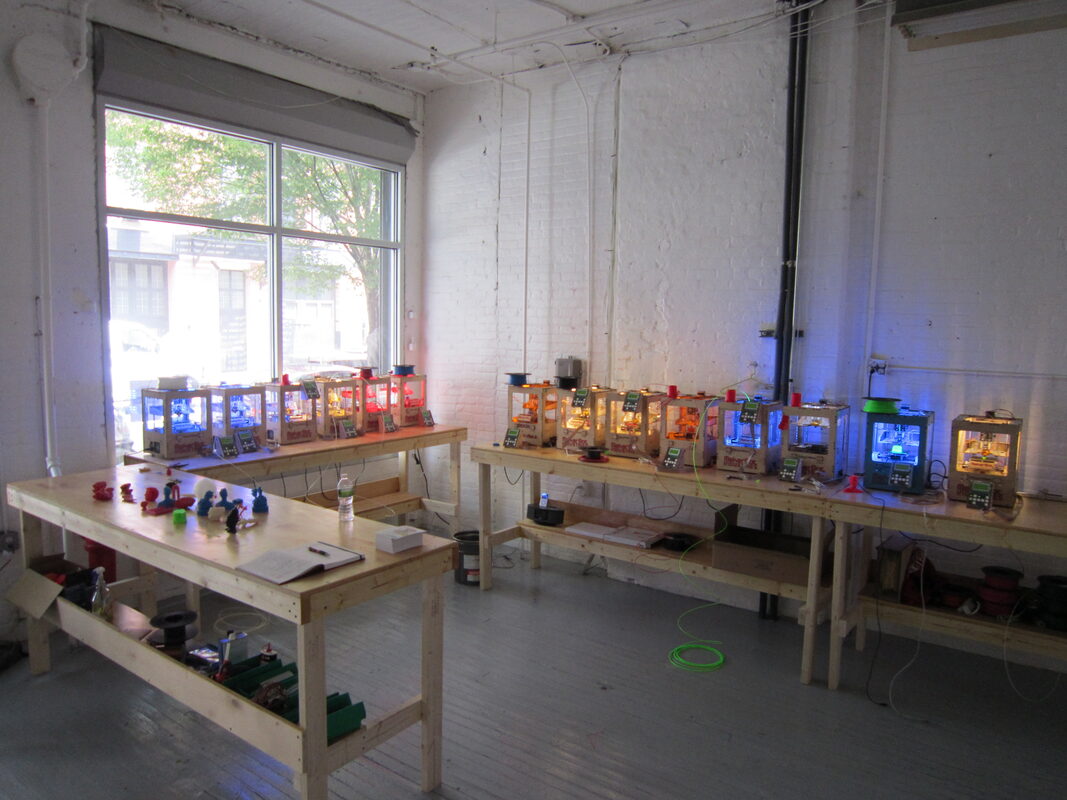
Any maker who has run a print farm knows the dirty secret of "identical" machines: they aren't. Two printers off the same production line, loaded with the same filament and fed the same G-code, will still hand you subtly different parts. Now researchers at the IMDEA Materials Institute in Madrid and Lawrence Berkeley National Laboratory have put a number on that intuition — and built an algorithm to exploit it. In work published July 21, 2026 in the journal Advanced Engineering Informatics, the team describes an AI system that learns the operational "personality" of each machine in a fleet, then decides on its own whether to tune those machines as a group or one at a time.
The premise is deceptively simple. When you automate a manufacturing process, you typically treat a batch of nominally identical machines as interchangeable — optimize once, deploy everywhere. The IMDEA and Berkeley approach rejects that assumption. Instead, it builds a unique performance profile for every machine using statistical analysis of how each one actually behaves, and only then chooses a strategy: joint optimization when the machines are genuinely similar, individual optimization when they diverge enough to warrant it.
What "Personality" Actually Means Here
It is worth being precise, because the anthropomorphic framing does a lot of marketing work. The "personality" the system detects is not temperament in any romantic sense — it is the accumulated, measurable signature of manufacturing tolerances, wear, calibration drift, and the thousand small physical realities that separate one real printer from its spec sheet. A slightly loose belt, a marginally hotter thermistor reading, a hair of extra backlash: individually trivial, collectively enough to shift a printed part's dimensions or weight.
"Even mass-produced machines may have their own operational 'personality,'" the researchers note. "Our system learns these differences and uses them to our advantage, determining whether it is more efficient to treat them as a team or as individuals." That last clause is the interesting part. Machine-to-machine variation is usually framed as noise to be suppressed. Here it becomes signal — information the optimizer can use to converge faster on good settings rather than averaging it away.
How the Algorithm Decides
The core mechanism is a branching decision. The system first characterizes each machine statistically, producing a profile that captures how that unit responds across the parameter space. It then compares those profiles. If the machines look alike, the algorithm pools their data and optimizes jointly — a sensible move, because more data per model generally means faster, more reliable convergence. If the profiles diverge, it splits them out and optimizes each machine on its own terms, so a well-behaved unit isn't dragged toward compromise settings by an outlier, and vice versa.
That adaptive choice is the whole trick. Joint optimization is efficient but assumes homogeneity; individual optimization is precise but data-hungry. By measuring similarity first and committing to a strategy second, the algorithm tries to get the efficiency of the former without paying the accuracy cost when it's unwarranted.
The Validation: Three "Identical" Printers
To test the idea, the team turned to a small fleet of three theoretically identical 3D printers. The algorithm detected measurable differences between them — confirmation, if any were needed, that "identical" is a spec-sheet fiction. More importantly, accounting for those differences paid off. Compared with treating all the machines equally, the approach delivered significantly faster convergence and, in the researchers' words, a "substantial reduction in errors in the weight of printed parts."
Weight is a useful proxy here. Part mass is a downstream consequence of extrusion behavior, dimensional accuracy, and infill consistency all at once, so a systematic reduction in weight error implies the optimizer is genuinely dialing in each machine's true behavior rather than chasing one metric. For a full accounting of the methodology, the paper is indexed under DOI 10.1016/j.aei.2026.104960.
Beyond Printers
Although 3D printing is the proving ground, the researchers are explicit that the method is not printer-specific. The same profile-then-decide logic extends to any domain running parallel experiments on nominally identical apparatus — they name materials discovery, chemical synthesis, and sensor calibration as candidates. In high-throughput autonomous labs, where robots run hundreds of experiments across banks of equipment, the payoff is fewer failed experiments and less wasted material and time. Variability, the team argues, is especially damaging in precision-driven sectors like aerospace and additive manufacturing, where an out-of-spec part isn't a cosmetic annoyance but a scrap-and-restart event.
The project is a collaboration between IMDEA Materials — represented by Dr. Christina Schenk, Miguel Hernandez del Valle, Luis Calero, and Dr. Maciej Haranczyk — and Dr. Marcus Noack of Lawrence Berkeley National Laboratory, a collaborator on the study.
What It Means for Makers
If you run a single printer, this is interesting context rather than an immediate tool: it validates, with data, the frustration of watching a "known-good" profile behave differently after you swap in a second machine. The practical lesson is that a calibration dialed in on one unit is not automatically transferable, and the errors that difference introduces are measurable, not imagined.
For anyone running a farm or an automated production cell, the implications are sharper. The dominant workflow — calibrate once, clone the profile across every machine — leaves accuracy on the table whenever your units have drifted apart, which the research suggests is essentially always. An optimizer that decides per-machine whether shared or bespoke tuning is warranted is a direct fit for print-farm quality control, particularly where part weight or dimensional tolerance actually matters to the customer.
The caveat is that this is published research, not a plugin you can drop into your slicer this weekend. There's no released software, no OctoPrint integration, no consumer front end. What the paper offers is a validated approach and a clear result on real hardware. Whether it reaches makers as a usable tool depends on someone — the authors, a vendor, or the open-source community — turning the algorithm into something that talks to a printer's firmware and a farm's job queue.
Still, the underlying message is worth internalizing regardless of tooling: your machines have personalities whether or not you choose to see them. The research just makes the case that seeing them — and optimizing accordingly — is measurably better than pretending they're all the same.
