
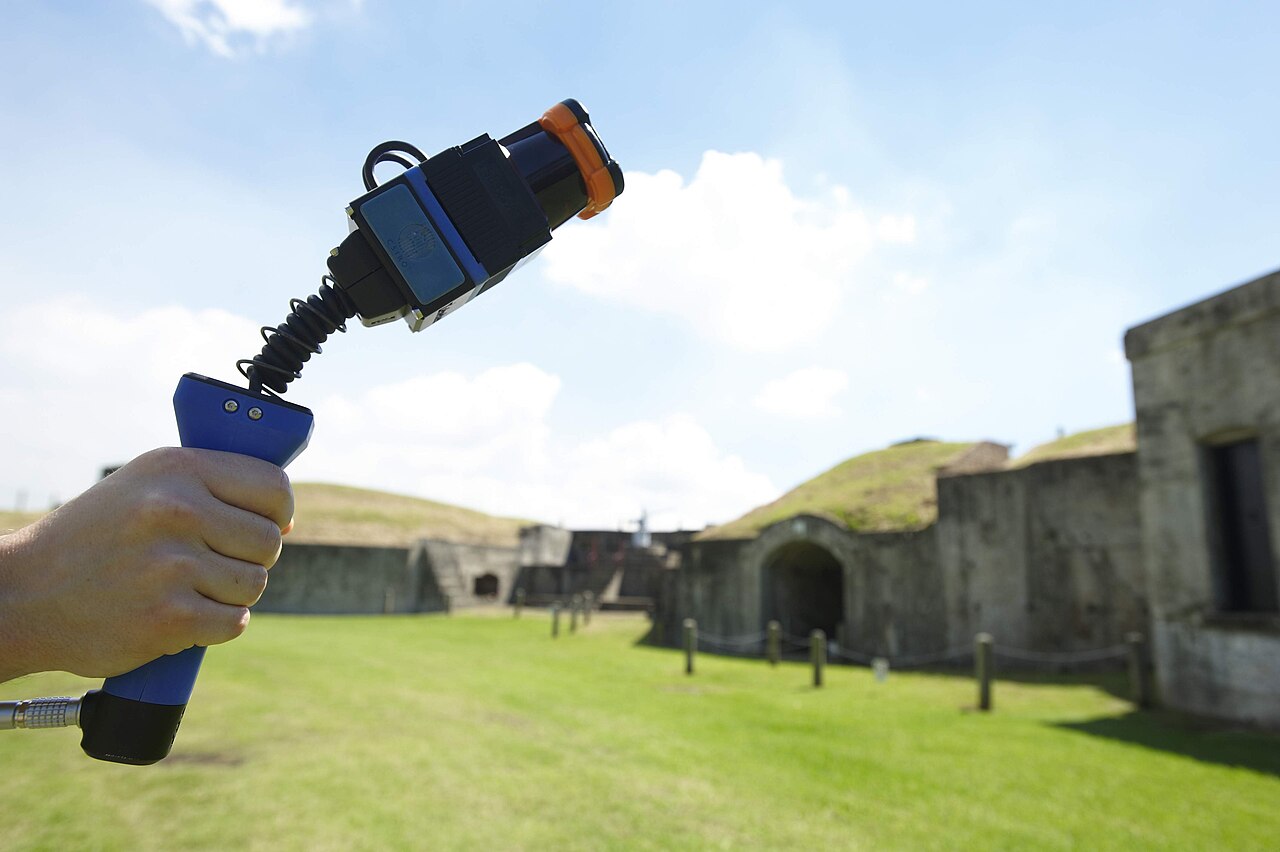
Artec 3D, the Luxembourg-based scanner maker best known for its handheld 3D scanners, has moved into the large-scale end of reality capture. Its new Artec Twins software is built for digital twins of whole sites. It takes point clouds, meshes and Gaussian splats from several kinds of capture hardware and keeps them in one project. Artec says it can render billions of points in real time at up to 200 frames per second "without decimation or latency." The product page was archived on October 9, Radiance Fields reported the release on October 10, and 3D Printing Industry covered it on October 23. It is also the first Artec product that generates Gaussian splats inside the application.
Most makers won't need a site-scale digital-twin platform. Still, the release says a lot about where scanning software is going. It also shows that Gaussian splatting has moved from a research curiosity to a feature that commercial metrology vendors now build into their products.
From one scanner's companion to a fusion platform
According to 3D Printing Industry, Artec Twins started as software for the Artec Jet, the mobile SLAM LiDAR scanner Artec launched in April. A walk-through LiDAR device produces far more data than a desktop scanner. The point clouds from a building or an industrial plant quickly outgrow software tuned for scanning a cylinder head or a figurine. Twins builds on Artec Studio, the company's established processing suite. On top of that it adds Gaussian splatting, analysis tools and algorithms meant for very large datasets.
The bigger change is multi-source fusion. Twins can combine data from Artec's own scanners, including the Jet, the Ray II and the sub-millimeter Leo, with captures from smartphones, drones and satellites. Artec's product page calls this multi-scale fusion "from satellite down to component." In practice, a satellite or drone survey can supply the context of a site, terrestrial LiDAR can capture the structure, and a handheld scanner can capture one part at high resolution, all in the same coordinate space. According to 3D Printing Industry, areas of more than 100 square kilometers stay navigable.
Splats, points and meshes in one project
The headline feature is how Twins handles representations. Artec's page says point clouds, meshes and Gaussian splats can sit in the same project, and users can switch between them on demand. That matters because each one is good at a different job. Point clouds are the raw measured data. Meshes are what you need for CAD, simulation or printing. Gaussian splats give photorealistic views of scenes with reflective and translucent surfaces that traditional reconstruction methods struggle with.
Splats are generated inside the platform rather than in a separate tool. Radiance Fields reports that all processing runs locally, with no cloud step. Note one limit on the speed claims. The 200 fps figure refers to point-cloud rendering, and Radiance Fields notes that Artec publishes no frame-rate figure for splats.
Navigation options include a first-person mode and an outdoor skybox. Both are aimed at walk-throughs rather than inspection from a fixed orbit.
Geometry first
Artec is careful to present Twins as a measurement tool, not only a visualization tool. 3D Printing Industry quotes CEO Art Yukhin describing the approach as "geometry first." That fits the company's metrology background, and it separates Twins from splat viewers whose main job is to look convincing.
The analysis tools support that framing. According to Artec's page and 3D Printing Industry's report, Twins can:
- generate distance maps that compare scans against CAD models
- cut cross-sections and compute volumes
- fit geometric primitives to scanned data
- georeference datasets using ground control points (GCPs)
- compare as-built conditions with the design and report deviations
Those are the core tasks of construction verification, plant retrofits and heritage documentation. Having these tools in the same project as the splat views is what makes the product more than a viewer. Artec frames it as measurement and presentation drawn from the same data.
Formats, hardware and price
Interoperability gets serious attention, which matters for anyone who wants to move data from Twins into the tools they already use. Radiance Fields lists the supported formats:
- Gaussian splats: PLY import and export
- Point clouds: E57, LAS, LAZ, PTX, BTX, XYZ and RCP
- Meshes: OBJ, PLY, STL, USD and USDZ
STL and OBJ export means the path into a slicer exists. USD and USDZ support points toward real-time engines and AR viewers.
The hardware requirements are real but not exotic. Radiance Fields reports a minimum of an Intel Core i7-class CPU with an NVIDIA RTX 4060 8 GB. Artec lists an RTX 4090 24 GB as recommended and notes that splat generation can be more demanding. Because processing is local, the GPU sets the practical ceiling, especially for splat generation.
Pricing is clearly professional. Radiance Fields gives it as US $6,840 per year on subscription, or $17,100 for a lifetime license.
What It Means for Makers
At these prices, Artec Twins is for survey firms, AEC contractors, plant engineers and heritage organizations. It is not for the hobbyist with a turntable scanner. Even so, three parts of the release are relevant to the maker world.
First, Gaussian splatting is becoming a standard capture format. When a metrology-focused vendor builds splat generation into its main software and adds measurement tools around it, splats are no longer just a novelty for pretty fly-throughs. Expect cheaper scanning tools to follow, and expect more requests to turn splat captures into printable geometry.
Second, a splat is not a mesh, and Artec's design admits as much. Twins keeps points, meshes and splats side by side because each does a different job. For anyone who prints from scans, the mesh is still the deliverable. The splat is for context and appearance. The "geometry first" philosophy suits our side of the hobby. A model that looks photoreal but has unreliable dimensions is no use for a printed bracket that has to fit a real part.
Third, multi-source fusion mirrors a workflow makers already use. The idea that a smartphone or drone capture can sit in the same project as data from a sub-millimeter scanner is one many makers will recognize. Prop builders, restorers and people building scale models of real places often combine rough context captures with precise scans of the parts that matter. Twins applies that workflow at industrial scale, and the approach is likely to spread to more affordable tools.
For now, Artec Twins is mainly a sign of direction. Capture software is converging on one environment where measured geometry and photorealistic appearance live together, and where hardware from different vendors and at different scales feeds the same model.
