
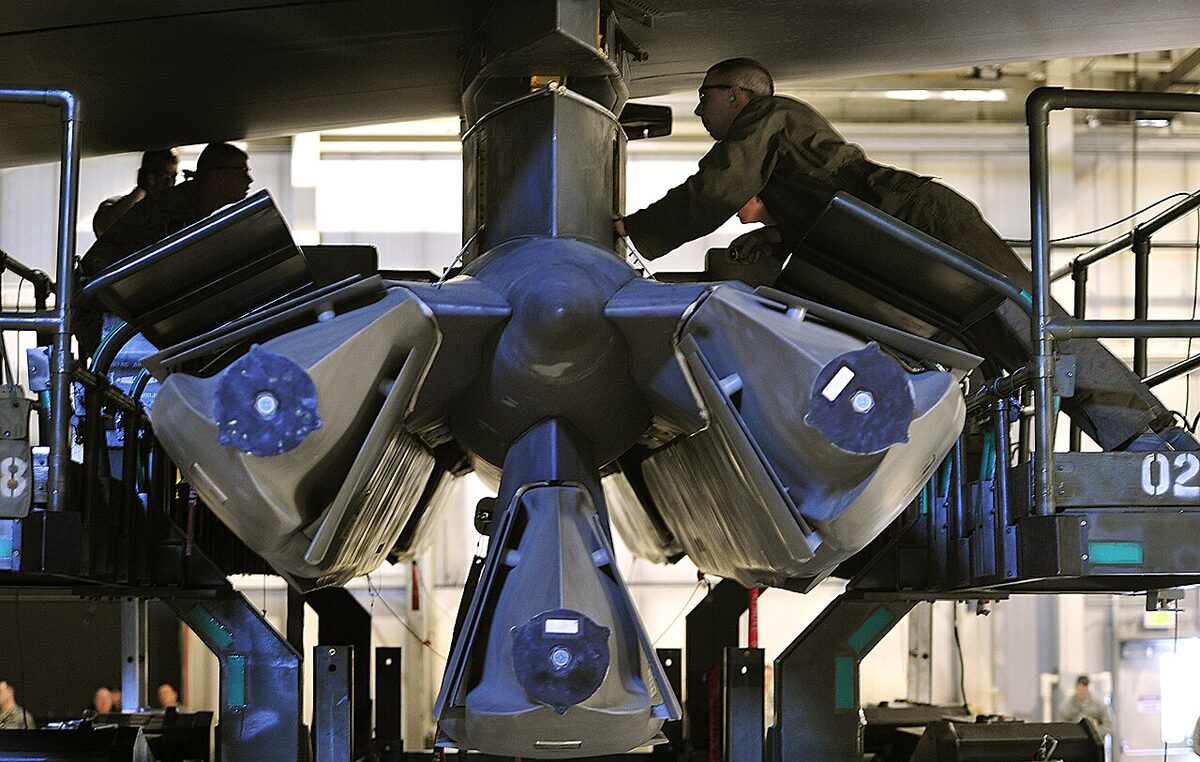
A Florida nonprofit is betting that additive manufacturing can make low-cost missiles cheaper and faster to build. ASTRO America announced on October 7 that it has executed a Cooperative Research and Development Agreement (CRADA) with Northrop Grumman, Florida State University's InSPIRE program and the Air Force Research Laboratory's Air Warfare Directorate Mission Effects Division (AFRL/RAB). The target is Northrop Grumman's Gray Wolf missile, and the goal is to reduce what it costs, and how long it takes, to build and qualify subsonic munitions. The release puts the collaborative investment at nearly $9 million, a figure 3D Printing Industry repeats.
The work runs under an initiative called DART, short for Design for Affordable and Rapid Throughput. Despite the press-release polish, the program's stated scope is fairly concrete: assess, develop and put into practice advanced manufacturing methods for affordable, high-throughput subsonic munitions, with a particular focus on cutting the production and qualification cost of adaptable subsonic missile bodies and components.
Four processes, one airframe
ASTRO America's release names the manufacturing toolkit explicitly.
Additive solid-state deposition. The name points to metal processes that build up material without fully melting it, a different route from the fusion-based systems most people associate with metal printing. The release does not specify which solid-state process or machines will be used, so the details of this leg of the program remain open.
Powder bed fusion. The most familiar of the group. Laser or electron-beam powder bed systems are generally used for complex, consolidated geometries, and the release lists the technology without saying which machines or materials the partners will use.
Novel casting. The release pairs additive with "novel casting" without detailing what that means.
Subtractive methods round out the list. Printed and cast parts commonly need machining on mating surfaces, threads and datums before they are usable, so having machining in the toolkit is unsurprising, though the release does not say which parts would get it.
The interesting idea here is not any single process but the mix. A missile body is a stack of very different components, and a program that can choose among solid-state deposition, powder bed fusion, casting and machining is a more realistic route to lower unit cost than one that assumes printing is the answer to everything.
Why Gray Wolf
Gray Wolf was developed by Northrop Grumman and the AFRL Munitions Directorate, which has since been renamed the Air Warfare Directorate. According to ASTRO America, the missile was developed with a goal of minimizing per-unit cost, and it uses a flexible, open architecture designed to support a range of payloads and carriage on multiple US Air Force and US Navy platforms.
Those design goals make it a plausible testbed. A weapon built from the start to be cheap and modular is one where manufacturing process changes could move the cost needle, and where swapping in a printed or cast component may be less likely to collide with a closed, proprietary design. That is inference rather than something the partners have stated. The release also says the processes applied to Gray Wolf may inform future approaches for other munition systems.
TCT Magazine, which covered the agreement on October 8, framed the aim as improving the resilience of the US defence industrial base.
A new lab near Eglin
The work will be carried out in a new production laboratory near Eglin Air Force Base in Northwest Florida, with technical support from FSU InSPIRE. The release, datelined Panama City, Florida, carries statements from Dr. Abdalla R. Nassar, Vice President and General Manager of ASTRO South, and Drew Allen, Executive Director of FSU InSPIRE.
The division of labor is only partly spelled out. ASTRO will coordinate with InSPIRE on testing and evaluation of materials and subsystems, including mechanical, thermal and aerodynamic testing. Nassar's statement credits the transformative investment from Triumph Gulf Coast in InSPIRE, and the release says the collaboration is supported by Triumph Gulf Coast.
ASTRO America itself is a nonprofit research institute and think tank founded in 2018, according to 3D Printing Industry, and the release describes it as supporting collaborations between government agencies and companies. Here it sits alongside a prime contractor, a university program and an Air Force lab.
Context: not the only printed missile effort
DART does not exist in a vacuum. 3D Printing Industry points to the Rapidly Adaptable Affordable Cruise Missile (RAACM), which CoAspire and Divergent Technologies designed and built using 3D printing under a contract with the US Air Force. According to that report, removing conventional tooling from assembly cut labor and production costs, the first fuselages, wings and fins were delivered within 10 weeks, and the missile completed a flight test within 14 weeks. Taken together, the efforts suggest the Air Force is pursuing more than one path toward munitions that can be produced faster and more cheaply, with additive manufacturing as a central lever.
The difference in approach is worth noting. 3D Printing Industry says RAACM was designed using 3D printing, while DART adapts a mix of processes to a missile that already exists, weighing additive against casting and subtractive methods rather than committing to one method in advance.
What It Means for Makers
Nobody reading FilamentFeed is going to print a missile component on a desktop machine, and that is not the point. The relevance is in where industrial additive is heading and which problems are getting funded.
First, qualification is a cost center, and this program targets it. DART explicitly aims to cut qualification cost alongside production cost, and the plan includes mechanical, thermal and aero testing of materials and subsystems. It is reasonable to expect that kind of test data, and the methods behind it, to matter for how metal AM gets specified in aerospace, though the release makes no such promise.
Second, hybrid workflows are the norm. A program pairing solid-state deposition and powder bed fusion with casting and subtractive machining is a reminder that "printed part" in industry often means "printed, then finished."
Third, defense demand looks like a growing source of funding for additive manufacturing work, with a new laboratory near Eglin built for this effort. Whether that money pushes process maturity, materials and machine capability forward in ways that eventually reach commercial and prosumer equipment is a hope rather than something these sources claim.
Bottom Line
The CRADA is a research agreement, not a production contract, and the public details so far do not spell out timelines, part counts or cost targets. The release itself says additional details on scope and milestones will be shared as the collaboration advances. What it does establish is a nearly $9 million collaborative investment, a new lab in Northwest Florida, and a defined mission: find out which combination of additive, casting and machining can make a low-cost missile cheaper and faster to build and qualify. The results from that test program, more than the press release, will be the thing to watch.
Sources
- Press Release: ASTRO America Executes Research Agreement to Advance Affordable, Rapid Missile Production (ASTRO America)
- ASTRO America $9M CRADA to 3D Print Gray Wolf Missile Parts (3D Printing Industry)
- AFRL/RAB & Northrop Grumman to support ASTRO America efforts to additively manufacture munitions (TCT Magazine)
