
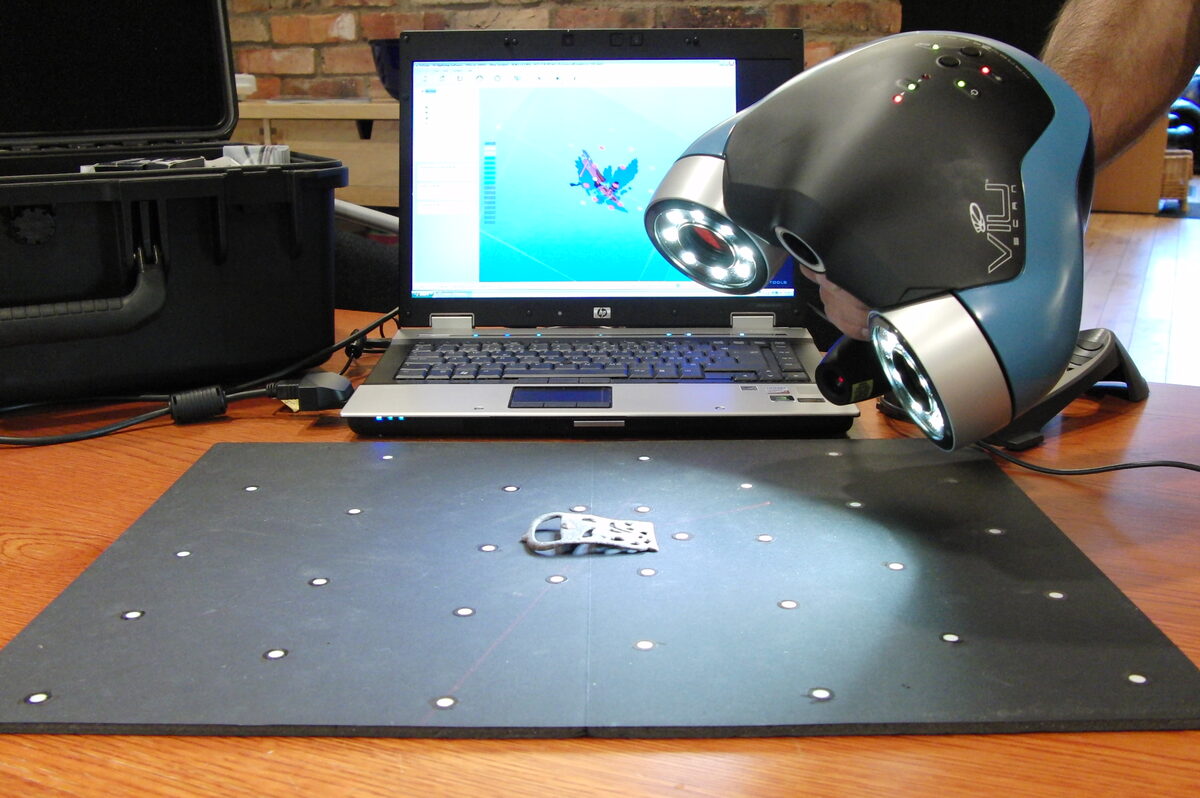
A startup led by two of the people who built Markforged into one of the best-known names in industrial 3D printing has come out of stealth with a tool aimed at a much older and messier problem: turning a physical object into a proper CAD file. Backflip AI announced general availability of CAD Copilot on August 4, 2026, pitching it as software that converts 3D scans and mesh files into parametric CAD models complete with feature trees — not just a cleaned-up mesh, but a model built from the same Extrude, Revolve, Pattern, Chamfer, and Fillet operations an engineer would use if they'd modeled the part by hand.
The company was founded in late 2024 by Greg Mark and David Benhaim, who previously built Markforged, the composite and metal 3D printing company that went public in 2021. Backflip AI has raised a $30 million Series A led by Andreessen Horowitz and NEA, and is based in San Francisco, according to reporting from VoxelMatters.
What Reverse Engineering Actually Costs Today
Anyone who has tried to recreate a broken bracket, a discontinued housing, or a worn-out mechanical part in CAD knows the drill. You either measure it by hand with calipers and rebuild it feature by feature, or you scan it and get a mesh — a dense cloud of triangles that looks like the part but behaves nothing like one in a CAD system. Meshes don't have design intent. You can't select "the fillet" and change its radius, because as far as the software is concerned there is no fillet, just thousands of tiny flat faces approximating a curve. Getting from that mesh to something a CAD program treats as a real, editable part — a process engineers call reverse engineering or reconstruction — has historically required a skilled CAD technician working through the geometry by hand, a service that VoxelMatters reports commonly runs around $1,500 per part. That labor cost is the gap Backflip AI says it's closing. The company claims CAD Copilot can take the same starting point — a 3D scan or mesh file — and output a fully feature-tree'd parametric model for roughly $10 worth of processing. Going from $1,500 to $10 works out to a reduction of more than 99%. That's the kind of number that, if it holds up in practice across a range of part geometries, would change the economics of reverse engineering from a specialist service into something closer to a routine step in a workflow.
How It Fits Into an Existing CAD Workflow
Backflip AI isn't asking makers or engineers to abandon their existing tools. CAD Copilot ships two ways: as an add-in for Autodesk Fusion, which plugs directly into a CAD package millions of hobbyists and small shops already use, and as a standalone web application that exports STEP files — the neutral, widely supported format that virtually every CAD system can import. That means a user isn't locked into Backflip's own interface to get value out of it; a scan goes in, a STEP file with real parametric features comes out, and it can be opened and edited in Fusion, SolidWorks, Onshape, or whatever else a shop standardizes on. The company's site lists plug-ins for Onshape and other CAD software as "coming soon," which would extend native integration to additional platforms.
On the business side, Backflip AI has structured pricing to hook individual users before it goes after larger accounts. New accounts get three free reconstructions to test the tool on their own parts — two in fast mode and one in thinking mode, per VoxelMatters' reporting — after which paid plans start at $20 a month and scale up through Builder, Pro, Business, and Enterprise tiers. The Enterprise tier is presumably where the security and compliance features come into play: Backflip AI's site states it does not use enterprise customer data to train its models and says a SOC 2 Type II audit is targeted for completion later this year — the kind of assurances a vendor needs to get past the IP-protection review at a large manufacturer. That review has apparently already happened at least once. Backflip AI says it is deployed at a large automotive manufacturer, where an automated scanning system is digitizing roughly half of the parts that company processes today, a share VoxelMatters reports the manufacturer expects to approach full coverage by the end of the year. Automotive is a plausible early beachhead for this kind of tool — car makers and their suppliers sit on decades of tooling, fixtures, and legacy parts that predate digital CAD records entirely, and reverse engineering them for replacement, repair, or redesign is a constant, unglamorous cost center.
What It Means for Makers
For the home and small-shop side of the market, the near-term relevance is more about workflow than headline cost savings — few individual makers were paying $1,500 for professional reverse engineering to begin with; they were eyeballing calipers or living with meshes they couldn't cleanly edit. What CAD Copilot offers that audience is a shortcut past the tedious part of reconstruction: scan a part with a phone-based or dedicated 3D scanner, run it through the Fusion add-in or the web app, and get back a STEP file with a real feature tree instead of a mesh you have to either print as-is or laboriously rebuild by hand. That's directly useful for anyone repairing, modifying, or reverse-engineering physical objects — replacement parts, vintage hardware, one-off fixtures — who wants an editable model rather than just a scanned shape. The caveats are the ones that apply to any AI-driven geometry tool: how well it performs is going to vary by part complexity, scan quality, and how forgiving the source geometry is to a feature-recognition algorithm. Backflip AI hasn't published independent benchmarks alongside the launch, and the three-reconstruction free tier is the practical way for makers to find out how it handles their own parts before committing to a subscription. Given the founders' track record building Markforged into a public company, and now institutional backing at Series A scale, it's a tool worth watching rather than dismissing as vaporware — but the $1,500-to-$10 cost claim, like any vendor figure, is worth testing against your own parts rather than taking at face value.
