
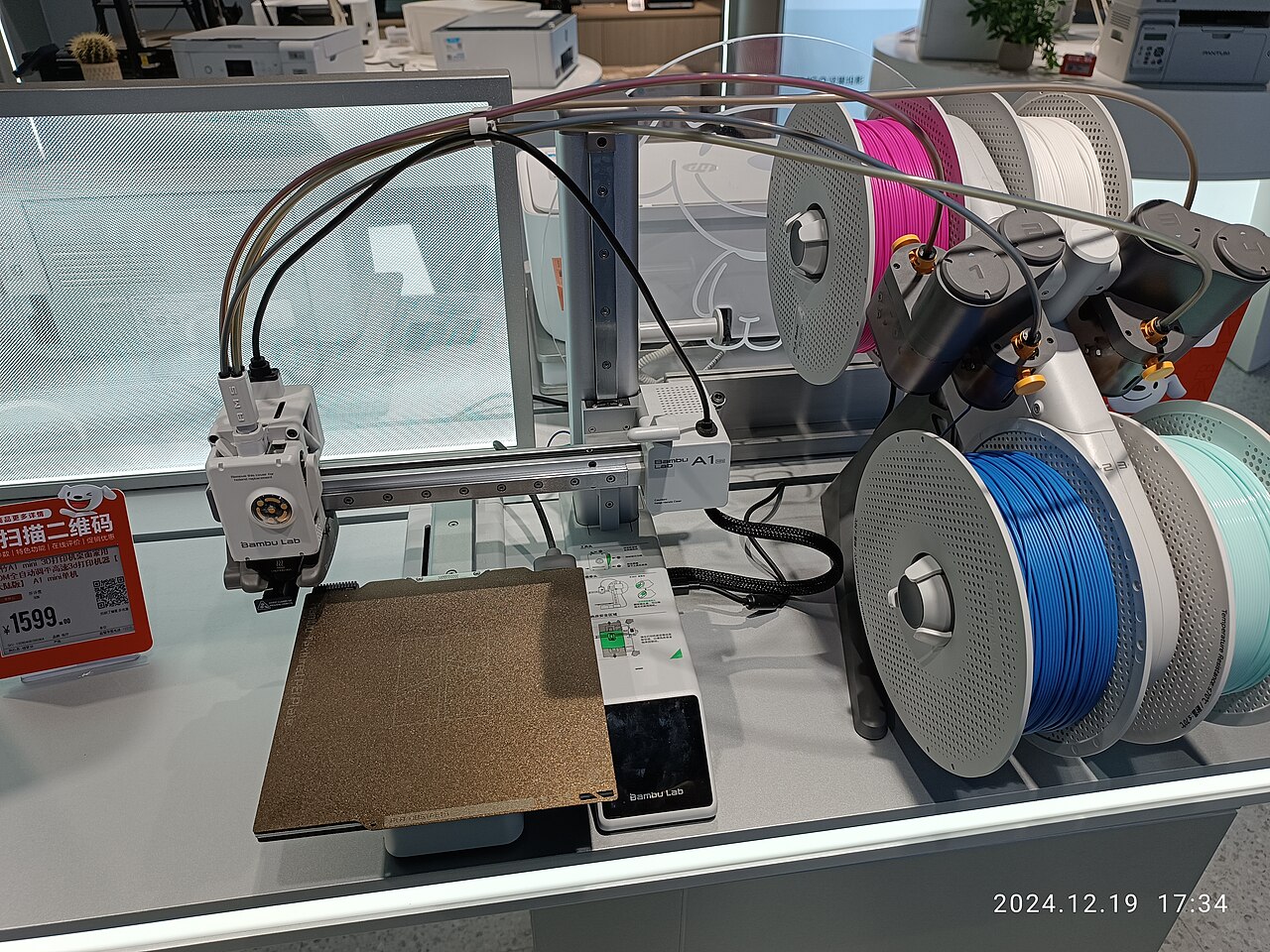
Three weeks after the H3C arrived, Bambu Lab has released a cheaper version of the same idea. The company announced the P3C on November 24, 2026. It is a smaller tool changer built on H3C architecture, and the company pitches it at hobbyists, families and small studios, though its launch post also names print farm starters. The base model with five tools costs $1,149. A seven-tool combo with a 2.85 mm TPU tool costs $1,299 through December 2, rising to $1,319 after December 3. The H3C launched on November 3 at $2,499, so the P3C comes in at about half the price, and Bambu says so in its own headline.
A price cut that large always costs something. In the P3C's case, the cuts are clear and, for many buyers, sensible. What remains is a tool changer that prints well in color and handles flexible filament unusually well.
What You Get for the Money
The P3C is a tool changer, not a single-nozzle printer with a filament-swapping unit attached. According to Bambu Lab's product page, it prints with up to seven materials through seven independent filament paths and switches between them in about six seconds, with tools that stay docked, loaded and pre-heated. Each material has its own path, so a color change does not mean retracting one filament, cutting it and purging the nozzle the way a single-hotend setup does. That is the main argument for any tool changer: less waste, less time lost per swap, and the freedom to mix materials.
The build volume is 256 x 256 x 260 mm, and the bed heats to 110 C. Tom's Hardware's review puts the machine at 26.5 kg. For comparison, the H3C offers 330 x 320 x 325 mm, a 120 C bed and 36.28 kg. Nozzles range from 0.2 to 0.8 mm, though the standard tools ship with 0.4 mm nozzles only, and the other sizes are optional extras. Because each tool is separate, you can run different nozzle sizes in the same print, which Tom's Hardware lists among its pros.
The seven-tool combo with TPU is configured unusually. It ships with six 1.75 mm tools and one tool for 2.85 mm filament, plus a spool of TPU 75A. Bambu is clearly treating soft TPU as a key use case, not an afterthought.
The TPU Angle
Ultra-soft TPU is a demanding material on desktop machines. The P3C tackles it with its FlexFeed extruder, which uses what Bambu calls Active Grip Control, electronically regulating the clamping force on the filament. The company claims up to 3x the flow rate on ultra-soft TPU. Tom's Hardware calls the extruder possibly the best it has reviewed and describes the TPU printing process as outstanding.
Bambu's launch example shows how the parts fit together. A watch was printed in a single job: a 0.2 mm nozzle for the fine dial, a 0.4 mm nozzle for the rigid body, and a second 0.4 mm nozzle fed with 2.85 mm filament for the soft TPU strap. The company also shows a robot with print-in-place TPU 75A joints, meaning it comes off the build plate as a posable assembly rather than as parts to glue together.
Tom's Hardware lists an excellent TPU solution first among its pros, ahead of quick color changes and mixed nozzle sizes. It is the strongest reason to pick the P3C over cheaper multicolor options.
What Got Cut
The cuts that bring the P3C down from H3C pricing are significant. Tom's Hardware says the P3C drops the heated chamber, the filament dryer and automatic filament loading. The AMS 3P has no motor, so filament is loaded and unloaded by hand all the way to the nozzle.
The missing heated chamber matters most for engineering plastics. Tom's Hardware says the P3C does not get hot enough to print PPS, which the H3C supports, although the reviewer did print ABS and ASA on it. A 110 C bed helps with warp-prone materials, but it is not the same as a heated enclosure. Buyers who plan to print high-temperature engineering parts regularly should read the H3C's extra cost as paying for that capability.
Drying is not completely gone. The product page lists optional filament drying at 75 C, and Tom's Hardware prices the optional dryer at $159.90, so it is an add-on purchase rather than a standard feature. The same is true of the optional tools beyond printing: Bambu lists add-ons for cutting, drawing and debossing, which positions the P3C as a small studio tool and not only a filament printer.
Manual loading is the cut you will notice every day. Tom's Hardware lists loading filament as tedious and says changing tools is a pain, literally, because the tools attach to the dock magnetically and must be placed by hand. The review says loading all of the slots takes a long time. On a machine with up to seven filament paths, that work adds up every time you change your material setup.
Plan for the Height
Check the specs before ordering. Tom's Hardware reports that the P3C needs 1,212 mm of vertical space, almost 4 feet, for the AMS lid to fully open, and the reviewer says it is tall enough to need a step stool to reach the back filament slots. The review lists the height as a con. Measure your space first.
What It Means for Makers
The P3C makes tool changing a realistic choice at roughly half the H3C's price. Its strengths are well defined: fast six-second swaps with minimal purge, mixed nozzle sizes in one print, and soft TPU handling good enough to print soft and rigid parts together in a single job.
Its weaknesses are just as well defined. Without a heated chamber, it is not the machine for printing a lot of the most demanding engineering plastics. Without motorized loading, it takes more hands-on work. And its height may limit where you can put it.
For the hobbyists, families and small studios Bambu is targeting, those trade-offs look reasonable. If your work is multicolor models, functional parts that combine flexible and rigid sections, or detailed prints that benefit from a 0.2 mm nozzle alongside faster ones, the P3C offers much of the H3C's appeal at roughly half the price. Tom's Hardware's bottom line is that it is best for anyone who wants multicolor, multi-material printing without paying H3C money. If you need a heated chamber, PPS support or a larger build volume, the H3C is still the machine to buy. The difference of about $1,200 to $1,350 is the price of the chamber, the space and the automation.
The gap between the five-tool and seven-tool TPU models is $150 at the launch price of $1,299. The combo adds the dedicated 2.85 mm tool for TPU 75A, the hardware behind the P3C's best feature. For most buyers interested in this printer, it is the configuration to get.
