
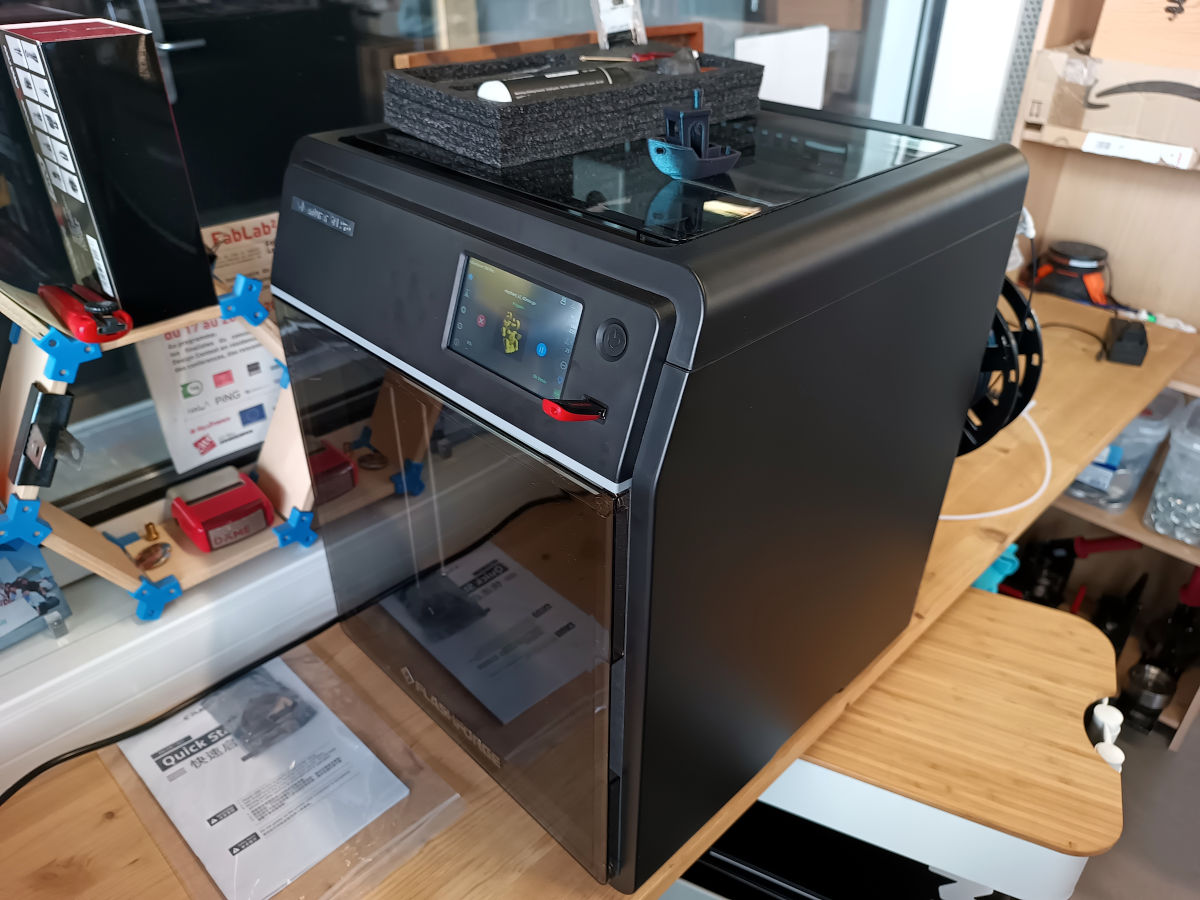
Most people who install a Klipper firmware mod on their 3D printer are happy just to get a nicer web interface and faster print speeds. A smaller subset can't resist poking at the Linux system underneath — and that's exactly what happened on a Flashforge AD5X, where a hobbyist discovered the printer's onboard Linux environment was missing basic command-line tools like less and more, then solved the problem by cross-compiling busybox with the Zig programming language's toolchain, as detailed in a July 15 Hackaday writeup by Al Williams.
The starting point for the project is Z-Mod, an open-source firmware modification that layers on top of stock Flashforge firmware rather than replacing it outright. Once Z-Mod is installed, the printer gets a real Klipper-based brain, a Fluidd or Mainsail web interface, input shaping, multi-color and infinite-spool support on the AD5X, and — critically for tinkerers — full root access to the printer's embedded Linux system. That root access is what exposed the gap: the AD5X's stock Linux image ships a minimal busybox build that lacks pagers like less and more, tools most Linux users take for granted when reading long log files or config output over an SSH session.
Z-Mod isn't limited to the AD5X — the same project also supports the Flashforge Adventurer 5M and 5M Pro, with tested firmware compatibility spanning versions 2.7.5 through 5.0.3 on those two printers, versus 1.0.2 through 3.1.0 on the AD5X. Beyond the core Klipper swap, Z-Mod's broader feature set includes adaptive mesh calibration, PID tuning, belt diagnostics, nozzle collision detection, power-loss recovery, firmware and file integrity checks, Telegram notifications, plugin support, and an alternative camera setup, with the AD5X's multi-color printing implemented via a purge/exchange method across up to four colors. It's this same rooted environment — not a general Linux distro, but a genuine embedded root shell on the printer's controller board — that left the hobbyist behind this project staring at a busybox install too minimal for comfortable everyday use.
Rather than trying to shoehorn a prebuilt ARM or x86 binary onto the printer, the project rebuilt busybox from its C source specifically for the AD5X's processor: a 32-bit MIPS R3000 core running in mipsel (little-endian) mode with the mips32r2 instruction set and NaN2008-compliant floating point. That's a specific and somewhat old-school combination — MIPS processors are common in embedded and networking gear but rarely come up in maker-facing hardware discussions, which is part of what makes this a notable bit of reverse-engineering work.
The unusual part of the build isn't the target architecture so much as the compiler. Instead of the traditional GCC-based cross-compilation toolchain most embedded Linux projects use, the busybox rebuild was done with Zig — a general-purpose systems programming language that, in addition to compiling its own code, bundles a full C/C++ cross-compiler built on LLVM. Zig has been gaining a following for exactly this use case: point it at a target triple, and it can cross-compile C source for architectures you'd never touch natively, without needing to hand-roll a separate toolchain for every target. In practice that meant configuring busybox through the standard menuconfig process and then compiling it with a command along the lines of make CC="zig cc -target mipsel-linux-musleabihf -mcpu=mips32r2 -static -Os", letting Zig's bundled LLVM backend stand in for a purpose-built MIPS cross-toolchain. Williams noted he'd considered building a full crosstool-ng toolchain instead, but set that approach aside as a possible follow-up rather than the path taken here. The build environment itself ran on Buildroot 2020.02.1, the same embedded Linux build system many printer vendors already use to assemble their firmware images, which kept the resulting busybox binary compatible with the AD5X's existing root filesystem.
That compatibility didn't come for free. Williams' writeup documents a gap in Zig's support for the NaN2008 floating-point convention on MIPS — Zig doesn't appear to ship a working nan2008-compatible runtime library for the architecture, and the resulting busybox binary triggered illegal-instruction failures when actually executed on the printer rather than failing to compile outright. The workaround wasn't a code fix but a binary patch: using the dd command to directly edit a byte in the compiled binary's ELF header so it declared itself as using the NaN2008 encoding, correcting a flag so the kernel would recognize and load the executable properly. It's a reminder that cross-compilation toolchains, however slick, still have edge cases in less-traveled corners of the target matrix — and that sometimes the fastest fix is a scalpel taken to the binary itself rather than a wait for an upstream patch.
What It Means for Makers
None of this is required to run Z-Mod or use an AD5X day to day — Fluidd, Mainsail, input shaping, and multi-color printing all work without anyone needing to cross-compile a shell utility. This is a project for the subset of AD5X owners who have already rooted their printer via Z-Mod and want the onboard Linux environment to behave like a normal Linux box when they SSH in to debug something, tail a log, or poke at configuration files. Having less and more available sounds trivial, but anyone who's tried to read a multi-thousand-line Klipper log by scrolling through raw cat output — or editing a config file with nothing but a bare-bones vi — understands why it matters.
More broadly, the project is a useful data point for anyone doing embedded cross-compilation work on maker hardware: Zig's cross-compiler is powerful enough to target an oddball MIPS core straight from C source without a bespoke toolchain, but it isn't yet a drop-in replacement for GCC on every architecture and floating-point convention combination — NaN2008 MIPS support has real gaps that current users need to know how to work around with a manual ELF-header patch rather than a clean rebuild. For the Z-Mod project itself, this kind of downstream tinkering is a sign of a healthy ecosystem: with 403 stars, 46 forks, and 40 releases on GitHub, Z-Mod has built a big enough user base that people are now extending the modified printer's Linux environment in directions the original maintainers never had to build for. Anyone following this path should keep in mind that it requires root access via Z-Mod, targets a specific firmware version range (AD5X v1.0.2 through v3.1.0), and involves editing a binary's ELF header by hand — not a beginner's Saturday-afternoon project, but a clearly documented one for makers comfortable with embedded Linux.
