
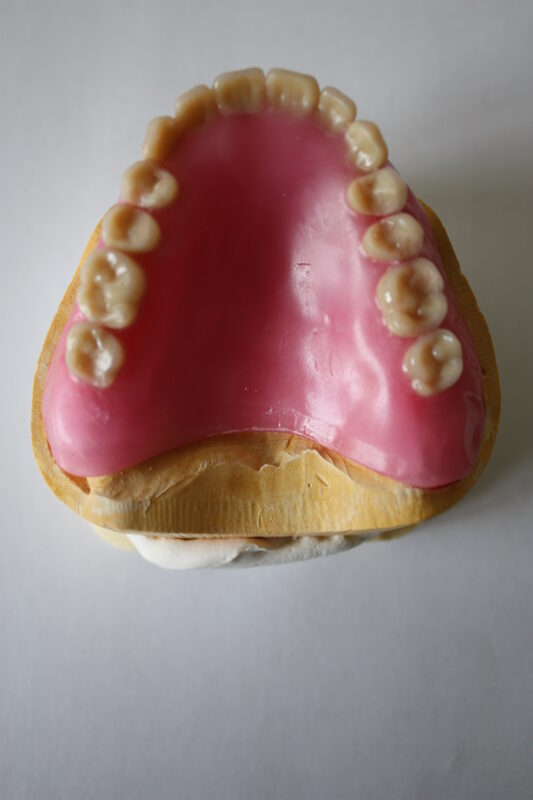
Carbon has launched DB 4000, a new denture base resin engineered for its M-Series Digital Light Synthesis (DLS) printers, targeting one of the more stubborn problems in digital dentistry: printed denture bases that crack or fracture under the sustained mechanical stress of daily wear. The single-cure material is FDA Class II cleared and compliant with ISO 20795-1's Hi-Impact classification, and Carbon says it delivers a 31 percent improvement in toughness over the current category leader — a claim that, if it holds up in dental labs at scale, would address one of the most common complaints leveled at 3D-printed denture bases since the workflow went mainstream.
Denture bases occupy an unusual niche in the additive manufacturing world. Unlike a prototype bracket or a jig, a denture base is a load-bearing device that sits in a patient's mouth for years, absorbing repeated bite forces, thermal cycling, and the occasional accidental drop onto a bathroom sink. Toughness — the material's ability to absorb energy and resist crack propagation before failure — matters more here than in almost any other dental application. Traditional heat-cured PMMA (polymethyl methacrylate) has been the default material for decades precisely because it handles that abuse well. Getting a photopolymer resin to match or beat it has been the central engineering challenge for every dental materials company chasing digital denture workflows.
The Numbers Behind the Toughness Claim
Carbon's headline figure is a work of fracture of 4,000 J/m² measured at 37°C — body temperature, which is a meaningful testing condition given that mechanical properties in polymers can shift noticeably between room temperature and oral conditions. Work of fracture measures the total energy a material absorbs before it breaks, which is a more direct proxy for real-world durability than tensile strength alone; a material can be strong right up until the moment it isn't, while a tough material tends to deform, yield, or resist crack propagation before catastrophic failure. Carbon frames the 4,000 J/m² figure as 31 percent higher than the current category leader, positioning DB 4000 as the toughest resin in its class rather than simply another entrant.
The rest of the mechanical spec sheet reads as a balanced profile rather than a one-trick material. Flexural strength comes in above 65 MPa and flexural modulus above 2,000 MPa — both comfortably clearing the ISO 20795-1 thresholds for Hi-Impact denture base resins — while fracture toughness is rated at 3.7 MPa·m^0.5. Stacked together, those numbers describe a resin that's stiff enough to hold its shape under bite load but ductile enough to absorb an impact without splitting, which is the specific combination denture bases need and the one commodity photopolymers have historically struggled to hit simultaneously.
Dimensional accuracy is the other half of the pitch. Carbon cites 97 percent global accuracy within ±130 µm and 95 percent intaglio accuracy — the fit surface against the patient's gums — within ±100 µm. Intaglio accuracy in particular is the number labs watch closely, since a poor-fitting intaglio surface means chair time spent on adjustments or, worse, a remake. Tighter tolerance there directly reduces the rework labs have to absorb on a workflow that's supposed to be saving them time in the first place.
How It Fits the Workflow
DB 4000 is built for Carbon's M2, M3, and M3 Max printers, all running the company's DLS process, which uses a continuous light-and-oxygen printing method rather than layer-by-layer curing. Carbon ships the resin as a single-cure material — meaning it doesn't require the dual-cure post-processing steps some competing denture base resins do — and outlines a workflow of design, print, fuse teeth, cure, finish, and ship. The "fuse teeth" step is notable: it points to labs printing base and teeth as separate components and bonding them, a common approach in digital denture production that keeps the aesthetic tooth material separate from the structural base material, each optimized for its own job. DB 4000 ships in four gingival shades, giving labs a baseline color-matching range without needing a separate stocking SKU for every shade variant.
In coverage of the launch, VoxelMatters reported that Carbon CTO Jason Rolland characterized the material's development as "the product of an obsessive focus on the mechanics that actually determine whether or not a denture base holds up in the real world" — language that frames DB 4000 less as an incremental SKU refresh and more as a direct response to durability complaints that have dogged digital denture resins since labs started moving away from heat-cured PMMA. VoxelMatters also noted the US market launch comes with validated use on Carbon's M-Series printers in dental labs, and that Carbon is pitching a more competitive cost per part than leading alternatives — a detail that matters as much as the mechanical specs to labs weighing whether to switch materials mid-workflow.
What It Means for Makers
For the dental-lab operators and digital-denture technicians who make up Carbon's core audience here, DB 4000 reads as a low-friction upgrade rather than a workflow overhaul. It runs on the same M2/M3/M3 Max hardware labs are already using, follows the same design-print-cure pipeline, and clears the same regulatory bar (FDA Class II, ISO 20795-1) that current denture base resins already meet — so there's no new qualification hurdle beyond validating the material itself. The pitch is a straightforward swap: better toughness and tighter intaglio fit, at a cost per part Carbon claims undercuts competing high-impact resins, without touching the rest of the production line.
The catch, as with any manufacturer-published spec sheet, is that these are Carbon's own numbers from its own product page. The 31 percent toughness claim and the accuracy figures haven't yet been independently reproduced by a third-party lab or an ISO-accredited test house in public reporting, and "category leader" isn't named. Labs evaluating a switch will want to see how DB 4000 performs against incumbent resins under their own clinical conditions — chairside fit, bond strength to fused teeth, and long-term wear — before treating the spec sheet as the final word. For a material meant to sit in someone's mouth for years, that verification step isn't optional.
