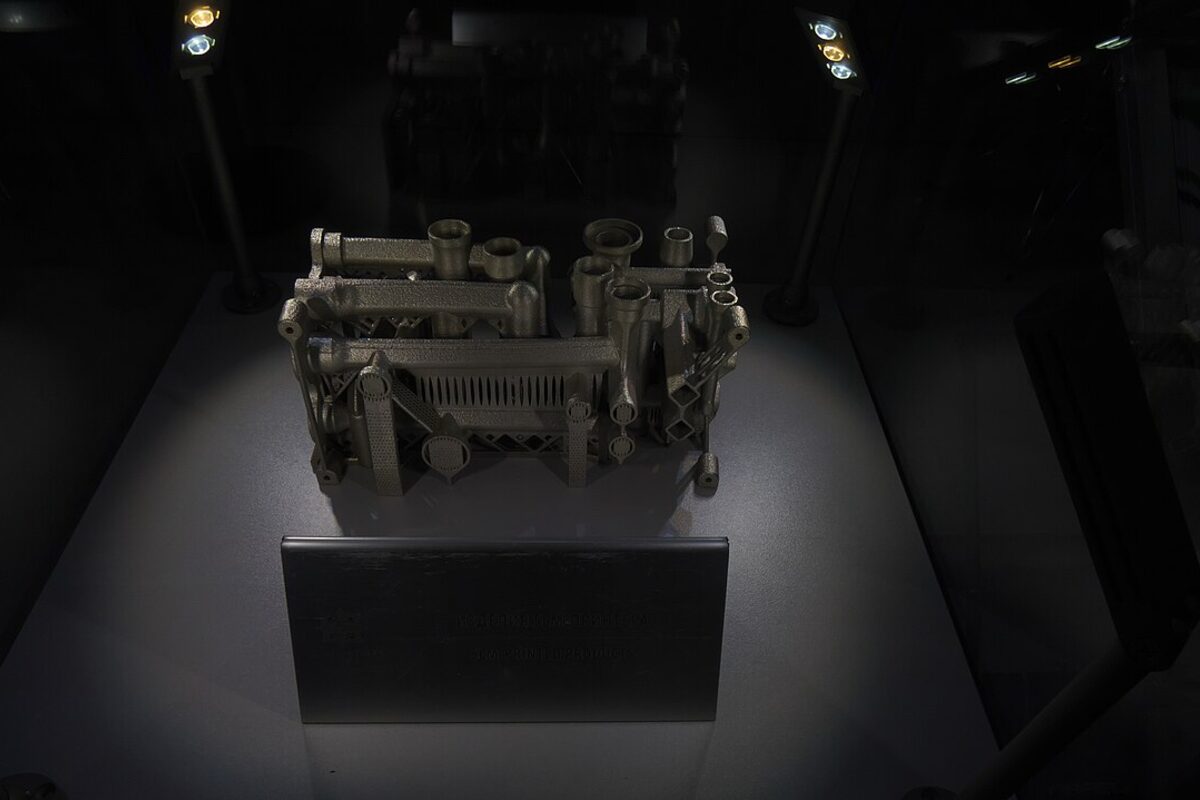
Ask a metal powder bed printer to trace a circle and it usually doesn't trace one. It traces a polygon of short straight laser vectors that gets close enough to a circle. On November 11, Dyndrite and Xact Metal announced an integration meant to stop that. Dyndrite's LPBF Pro software can now send native arcs, Bezier curves and a set of lower-level laser commands straight to the scan card on Xact Metal machines. The companies call it the world's first truly available full G-code toolpath integration for a laser powder bed fusion (LPBF) OEM.
The announcement carried a Seattle and State College, Pennsylvania dateline. Most of the vocabulary is aimed at metal AM engineers. The idea underneath it will still be familiar to anyone who has watched a desktop FDM slicer turn a smooth curve into a run of tiny line segments.
The Problem With Straight Lines
Dyndrite gives one number to show the scale of the issue. To hold 1 micron of accuracy on a circle with a 10 mm radius, toolpaths built from straight vectors need about 222 of them. A native arc needs one.
That ratio matters because every vector is an instruction the scan system has to receive, start, run and stop. Dyndrite also says each chord adds geometric error, and that every corner forces the scan mirrors to slow down, which spikes line energy and heat. Its listed benefits of native curves include reduced file size and print times and reduced wear and tear on the optical subsystem.
The press release also includes a hatching example. A thin ring that would normally be filled with straight hatch lines can instead be scanned with arcs that follow the wall, so that 150 short straight lines become 8 continuous arcs. Dyndrite says plainly that its figures are illustrative schematics, not measured build data, and that the arc example is a capability illustration, not a recommendation. Read the numbers as a picture of the geometry, not as benchmark results.
What "Full Toolpath Control" Covers
Arcs get the headline, but the integration goes further. According to Dyndrite and TCT Magazine's report on the partnership, LPBF Pro can now drive:
- Native arcs and Bezier curves, so curved geometry is described as curves instead of approximated polylines.
- Wobble, a beam-path motion option that sits alongside arcs and Bezier curves beyond plain linear moves.
- Delay and skywriting settings per mark, jump and polyline, which control how the laser and mirrors behave around each move. Users can tune these per segment type instead of applying one global value.
- Dynamic set point and pulsing, for changing laser behavior along a path.
Xact Metal's description adds stir welding, power ramping and parametric curves. In the companies' framing, that adds up to complete laser and scan-card control, and Xact says it believes the result is a commercial industry first in LPBF.
The real change is access, not any single feature. Dyndrite CEO Harshil Goel argues that scan cards have been far more capable than OEMs have made available for years. This integration lets third-party software reach much closer to the hardware.
Why an OEM Would Open Up
Machine makers can have obvious reasons to keep that layer locked. Validated parameter sets are a selling point, and opening the controller invites users to produce bad parts and blame the printer. Xact Metal CEO Juan Mario Gomez frames the decision in terms of customer freedom.
"We're opening our platform because we believe customers should have the freedom to get everything possible out of their machines," Gomez said.
For Dyndrite, the deal pays off a long effort. Goel said his team has spent more than nine years working with OEMs to open their systems, and that the announcement marks the culmination of a year of collaboration, discussion and planning with Xact Metal. Getting closer to the scan card turns Dyndrite's software from a file generator into something nearer to a motion controller.
The Metallurgy Pitch
The boldest claims concern the parts, not the files. Dyndrite and Xact say finer toolpath control can improve surface finish and the consistency of low-angle geometries, reduce porosity and other defects, and make it possible to print applications previously deemed "unweldable" in LPBF.
The reasoning is plausible even though neither source gives data for it. In LPBF, each scan vector is a tiny weld track, and the thermal history of the melt pool largely determines whether the material cracks, traps pores or leaves a rough skin. Dyndrite's own example is heat build-up: where the laser returns before the last pass has cooled, metal overheats, and arcs that follow a thin wall make every pass a full lap of the ring, spreading heat more evenly. Continuous arcs, skywriting and tools like wobble and power ramping give process engineers more control over how heat goes into the powder bed. That should matter most on shallow overhangs and with alloys that tolerate little thermal abuse.
Still, "possible to print" is not the same as "qualified for production." The announcement includes no measured porosity figures and no build-time comparisons from real parts. Dyndrite itself notes that any hatch pattern must deliver the metallurgical strength a part needs and be validated for the application. This is a capability announcement. Validated recipes, if they come, will come from users and application teams running experiments on these machines.
What It Means for Makers
Few FilamentFeed readers have an LPBF system in the garage, and this integration doesn't put one there. It still matters beyond the metal AM world, for three reasons.
First, it is a clear case of the gap between geometry and motion that every slicer user eventually hits. The 222-to-1 circle example is the same argument in a setting where each segment means a moving laser spot and a weld track.
Second, the open-platform argument is the interesting part. Gomez's case that owners should be able to get everything out of their hardware is the one the hobbyist world has made about open firmware for over a decade. Seeing an industrial OEM make it publicly, with a third-party software vendor, suggests that closed controllers aren't the only option in high-end AM.
Third, if makers or small shops ever get access to metal printing, perhaps through service bureaus, they could feel the effects as cost and quality. If the claimed benefits hold up, shorter print times and less optics wear would mean cheaper machine hours, and better low-angle surfaces could mean less post-processing.
Bottom Line
Dyndrite and Xact Metal have opened a layer of the LPBF stack that machine makers often keep closed. LPBF Pro can now send native arcs, Bezier curves, wobble, skywriting, per-segment delays and power control to Xact Metal's scan systems. The efficiency case is easy to accept: one arc in place of a couple hundred vectors is simply less work. The bigger promises, including fewer defects, better low-angle geometry and printable "unweldable" applications, are reasonable hypotheses that still need measured builds to back them up. For now, Xact Metal owners have a much larger set of process controls to explore.