
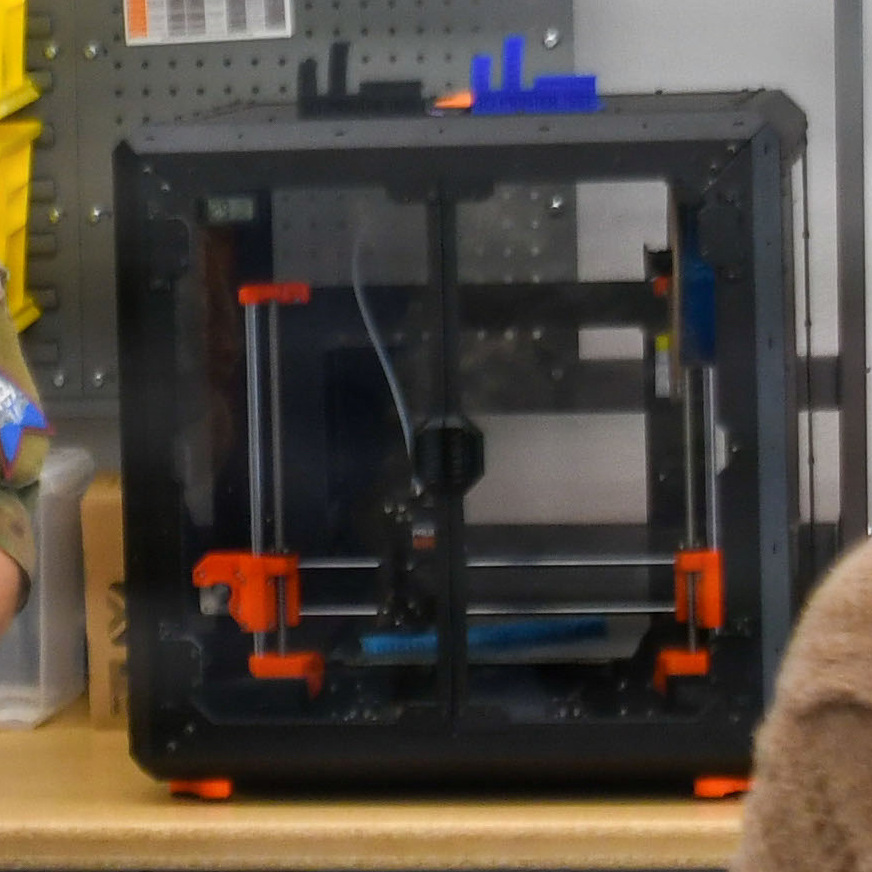
Is the golden age of desktop FDM printing already behind us? That's the provocative question Jenny List poses for Hackaday, arguing that "the resolution of a consumer FDM printer may be close to its mechanical limit" — and that the gap between what a printer could do in 2020 and what one can do in 2026 is strikingly small compared to the leaps that defined the decade before it.
It's a claim worth sitting with, because on paper 2026 looks like a good year for FDM. Input shaping is now standard on mid-range machines, letting lightweight CoreXY gantries hit print speeds and accelerations that would have shredded a 2018-era printer's frame. Multi-tool and multi-color systems that once lived exclusively on expensive industrial rigs now ship in enclosures that cost less than a nice office chair. By any spec sheet, the technology looks like it's still climbing.
List's argument is that spec sheets are the wrong yardstick. The real test is the size of the jump between generations — and by that measure, FDM's trajectory has flattened. Consider the machines that actually defined FDM's earlier eras: the MakerBot Cupcake, the Ultimaker 2, the Prusa Mini. Each of those represented a genuine step change in what an ordinary hobbyist could produce — order-of-magnitude improvements in reliability, tolerance, and print quality within a few years of each other. A 2026 CoreXY machine, by contrast, is recognizably the same category of tool as a well-tuned 2020 printer: faster, yes, and increasingly capable of jobs that used to require SLA resin, but not fundamentally different in what it can physically achieve. Layer height limits, nozzle diameters, and the basic physics of melting and extruding a thermoplastic filament haven't moved much at all.
The Case Study: Creality's SPARKX i8
You don't have to take List's word for it — a real-world example from just two weeks earlier makes the same point in miniature. Creality's newly teased four-color SPARKX i8 was independently examined by Makers101 on August 20, and the findings read like a case study in exactly the pattern Hackaday describes.
Strip away the marketing and the SPARKX i8 is, mechanically, the same machine as its predecessor, the i7: identical chassis, identical build volume, identical 500 mm/s top speed. The one substantive change is a new four-channel printhead, dubbed QuarTeks, that merges separate filament paths just 1.7 mm from the nozzle tip — close enough to cut color-switching time down to under a second. That's a genuinely useful engineering improvement for anyone doing multi-color prints. But Makers101's analysis also found that Creality's marketed claims around the upgrade don't hold up to scrutiny. The "up to 5x faster" headline turns out to depend entirely on which competing printer it's measured against — anywhere from 1.25x faster than a four-toolhead changer to 6.2x faster than a four-color bed slinger, with Creality never specifying which comparison produced the "5x" figure. And the "0g waste" claim, the review found, is misleading in a different way: the purge material doesn't disappear, it just gets redirected into the printed part's infill instead of a separate waste tower — the waste still exists as consumed filament, it's simply hidden inside the model rather than printed as a visible tower.
In other words: real hardware progress, wrapped in claims that outrun what the hardware actually does. That's precisely the texture of "innovation" List describes across the category — recent consumer FDM gains increasingly repackage existing platforms with a new feature bolted on, rather than delivering the kind of fundamental leap that separated a Cupcake from an Ultimaker 2.
What It Means for Makers
None of this means FDM printers are getting worse, or that this year's machine isn't a genuine upgrade over one from six years ago — it clearly is, especially in speed, noise, and firmware polish. But if you're a maker deciding where to put your next equipment dollar, the practical takeaway from both pieces is the same: don't assume the *next* FDM generation is going to solve a problem that resolution, tolerance, or surface finish is causing you today. The core mechanics of melt-and-extrude have converged toward a plateau, and a lot of what gets marketed as a leap is closer to a refinement — a faster tool-change, a merged printhead, a firmware feature that used to be an expensive industrial-machine exclusive and now isn't. That has a few concrete implications:
- If you need finer detail or a smoother surface than your current FDM printer delivers, waiting for a future FDM model to close that gap may be a longer wait than it used to be. Resin (SLA/UV) printing remains the more direct route to that kind of fidelity today.
- If you need functional, load-bearing parts in nylon or other engineering materials without support scarring, SLS is the technology actually built for that job, not a hypothetical next-gen FDM machine.
- If a vendor markets a big percentage improvement — "5x faster," "0g waste" — read it the way Makers101 read Creality's SPARKX i8 claims: check what chassis, build volume, and top speed didn't change before crediting the number that did.
- Multi-color and tool-changing capability trickling down to budget machines is real and worth having — it's just not evidence that the fundamental FDM process is still improving at the rate it once did.
List's piece is careful not to declare 3D printing itself stalled — only classic single-nozzle FDM. The counter-argument she raises is that the broader field still has plenty of runway: as she puts it, "UV printing is coming through and will deliver incredible results, as will SLS printing" — resin and powder-bed processes that haven't been anywhere near as thoroughly optimized as FDM has. If FDM's mechanical ceiling really is close, that's arguably where the next round of genuine, generation-defining leaps is more likely to come from — not from another CoreXY frame with a faster gantry and a new paint job.
For makers, the pragmatic read is this: keep buying FDM printers for what FDM is good at, keep an eye on marketed "innovations" with a skeptical eye toward what the base hardware actually changed, and if your project's bottleneck is resolution, material properties, or geometry that a planar nozzle can't reach, it may be time to look at a different process rather than wait on the next FDM refresh.
