
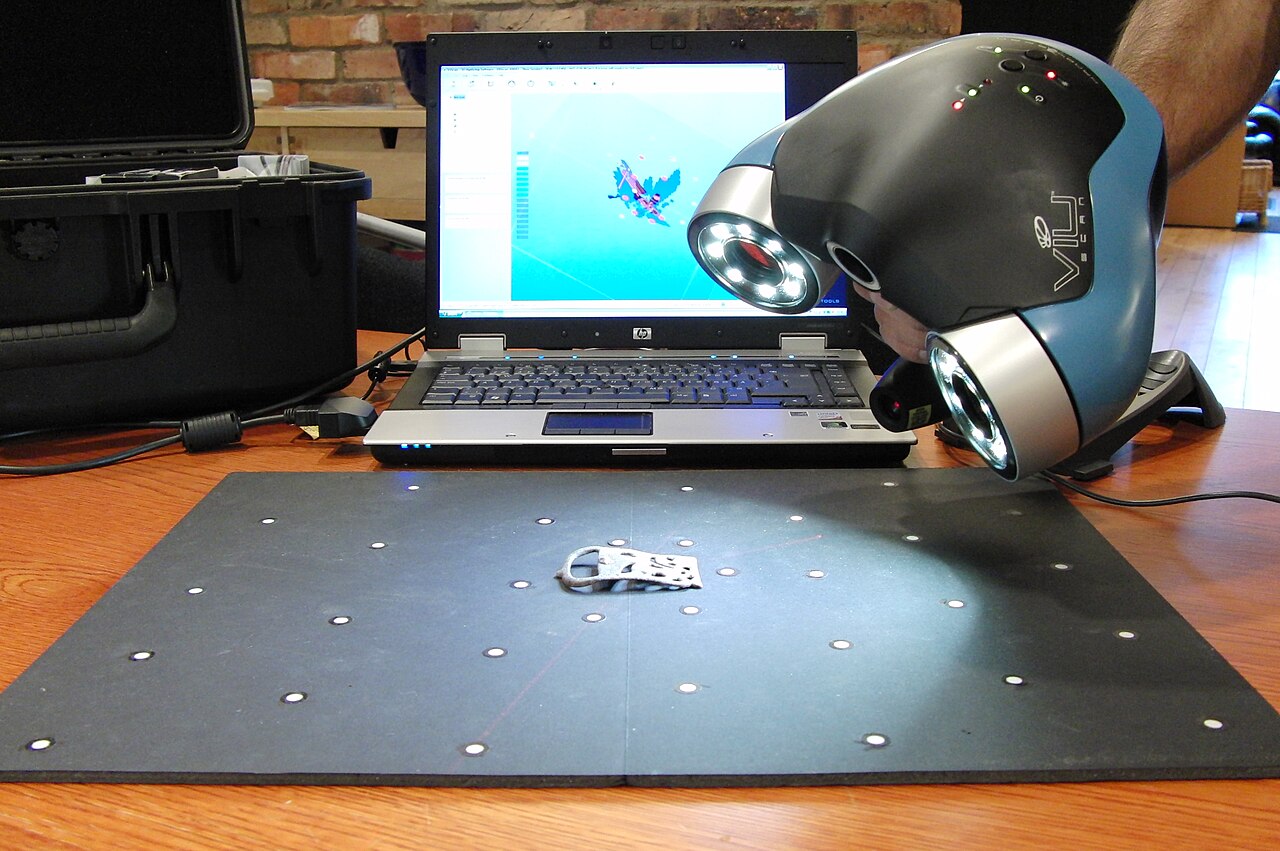
Reverse-engineering a physical part into a clean, editable CAD model has always been the slow, unglamorous bottleneck in digital manufacturing — the step where a scan point cloud goes to die on someone's workstation for a week. Hexagon says it can now do the same job in hours. In a briefing tied to the Farnborough International Airshow, the company's Portable Metrology Division announced a validated workflow pairing its ATLASCAN Pro handheld 3D scanner with its Geomagic Design X reverse-engineering software, pitched at aerospace and defense maintenance, repair, and overhaul (MRO) teams that need to recreate obsolete parts fast. The company claims the combination rebuilds CAD models up to eight times faster than mainstream CAD tools, turning around a single component "in a matter of hours."
The target market tells you exactly what problem this is meant to solve. Aircraft stay in service for decades, but the tooling, drawings, and suppliers behind their smaller components frequently do not. When a galley door latch cracks or a seat shroud goes out of production, an MRO shop is often left with a broken original and no digital model to work from. The pitch here is a repeatable pipeline: scan the surviving part, reconstruct a parametric model, and hand that model to a machinist or an industrial 3D printer.
How the Pipeline Fits Together
The ATLASCAN Pro is the capture end — a handheld 3D scanner meant to digitize physical geometry into a dense mesh. That mesh is where most reverse-engineering efforts stall, because a triangle soup is not a usable engineering model. It has no design intent, no editable features, no clean surfaces. Geomagic Design X exists to bridge that gap, and Hexagon is leaning on several of its features to make the speed claim credible.
Region Segmentation and the software's Modelling Wizards attempt to automatically identify distinct geometric regions of a scan — planes, cylinders, fillets, freeform patches — so the tool can suggest how to rebuild them rather than leaving an engineer to trace everything by hand. Auto Sketch pulls 2D sketch geometry off the scan data, the raw material for extrusions and revolves. For the organic, non-prismatic surfaces common in cabin trim and structural fairings, NURBS surfacing fits mathematically smooth surfaces to the mesh. And an Accuracy Analyzer runs a deviation check, comparing the reconstructed model back against the original scan so the operator can see where the CAD diverges from the physical part — the difference between a model that merely looks right and one that is dimensionally trustworthy.
Crucially, the workflow does not end inside Geomagic. Its LiveTransfer feature ports the finished model into the mainstream CAD packages MRO engineers actually use — SOLIDWORKS, Siemens NX, Autodesk Inventor, and PTC Creo — so the reconstructed part lands in the same environment as the rest of a program's engineering data rather than trapped in a reverse-engineering silo.
Why Aerospace, and Why Now
Hexagon's example parts are deliberately mundane: seat shrouds, armrests, tray tables, galley doors, latches, and hinges. None of these are flight-critical primary structure, and that is the point. Cabin and secondary components are exactly the low-risk, high-frustration category where obsolescence bites hardest and where additive manufacturing has the clearest runway. They are also the parts a maintenance organization is most likely to be allowed to recreate and print in-house.
That in-house capability is no longer hypothetical. Hexagon frames its announcement against a broader shift in defense aviation toward digitally rebuilt spares. The company points to the U.S. Air Force reverse-engineering F-35 canopy frames, and to the Royal Air Force fitting its first in-house 3D-printed part to a Typhoon in 2025. Those milestones signal that military operators increasingly see scan-and-print as a legitimate sustainment strategy for aging fleets, not a novelty — and a faster scan-to-CAD front end is what makes that strategy scale beyond one-off showcase parts.
What It Means for Makers
The eight-times-faster figure is a vendor claim measured against unnamed "mainstream CAD tools," so treat it as a marketing benchmark rather than an independent result — the honest way to read it is that guided, semi-automated reconstruction beats hand-tracing every feature, which has been true of dedicated reverse-engineering software for a while. What is genuinely useful here is the shape of the workflow, and it generalizes well beyond a hangar.
Anyone who has tried to recreate a discontinued part from a mesh knows the two hard problems: getting a clean editable model out of scan data, and getting that model into software you can actually iterate in. Hexagon's stack addresses both, and the underlying pattern — segment the scan, auto-generate sketches, fit surfaces, verify deviation against the original, then export to a real CAD kernel — is the same regardless of whether the part is an aircraft armrest or a bracket for a vintage machine. The Accuracy Analyzer step in particular is the discipline most hobbyist reverse-engineering skips and shouldn't: a reconstructed model that hasn't been checked against its source is a guess, and a printed guess wastes filament and time.
The catch, as always, is cost and access. This is professional metrology hardware paired with seat-license reverse-engineering software, priced for aerospace programs, not for a garage. Hexagon says the ATLASCAN Pro and Geomagic Design X pairing is available now with regional support and maintenance. For most independent makers the takeaway isn't the specific product — it's confirmation that scan-to-print is maturing into a documented, repeatable pipeline, and that the free and low-cost tools further down the market are chasing the same feature set: automatic region detection, sketch extraction, surface fitting, and deviation analysis. When those capabilities trickle down, the week-long slog of turning a broken part into a printable model gets a lot shorter for everyone.
One caveat on sourcing: Hexagon's own newsroom page returned an access block at the time of writing, so the technical specifics above were confirmed through trade coverage reproducing the company's release rather than read directly off the manufacturer's site. The feature list and speed claim originate with Hexagon; the independent reporting is where the details were verified.
