
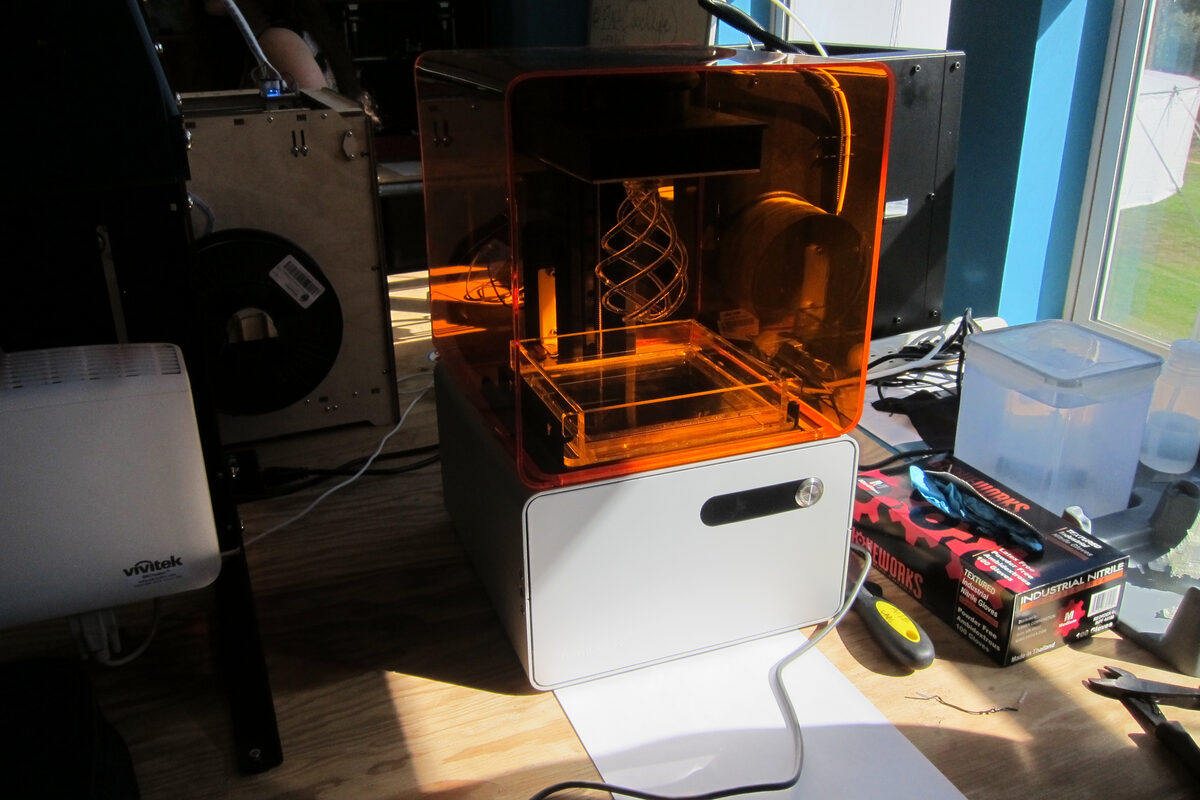
HeyGears has launched the UltraCraft Reflex RS Turbo, a resin printer built specifically around the workflow that keeps hobby printing forums busiest: batches of tiny, high-detail miniatures that need to come off the plate looking clean, fast, and repeatable. The headline claim is a new "Dynamic Motion Algorithm 3.0" that HeyGears says shaves up to 33% off print times, without giving up the fine detail miniature and collectible printers care about most.
That's a notable claim for the resin category, where speed gains have historically come at the cost of layer quality, cured-resin distortion, or peel-force artifacts on tall, thin geometry — exactly the kind of features that show up on a 32mm tabletop figure's spear or cloak.
What's Under the Hood
The Reflex RS Turbo's optical stack starts with a 10.3-inch 8K "Amber Screen" rated at a 566:1 contrast ratio, paired with an XY resolution of 29.7 microns. In practical terms, that resolution is well into the range where individual pixels stop being a limiting factor for most miniature detail — mold lines, facial features, and armor etching should resolve cleanly at typical scales. HeyGears lists an average print speed of roughly 4.5 seconds per layer using a 405nm light source, and a build volume of 222 x 122 x 228mm, which is comfortably sized for full-plate batches of 28mm–32mm figures with room for larger terrain pieces or bust-scale prints.
The more unusual spec is the Z-axis: HeyGears specifies a C5-grade Z-axis module holding layer positioning errors to no more than ±2 microns, a figure the company says was tested with a 50kg load across ten thousand cycles rather than measured idle. Precision this tight is common in CNC and metrology equipment but less typical in consumer resin printers, which more often rely on lighter-duty lead screws. That kind of load-tested accuracy matters most at high layer counts, where even small amounts of Z-axis backlash or wobble compound into visible layer lines or dimensional drift over a tall print. HeyGears rates overall dimensional accuracy at ±15 microns across a supported layer-thickness range of 30 to 100 microns, giving makers room to trade speed for even finer resolution on layers where surface finish matters more than throughput.
Dynamic Motion Algorithm 3.0: What's Actually Changing
HeyGears hasn't published every detail of how Dynamic Motion Algorithm 3.0 works, but the company describes it as a system that assesses each layer's printing difficulty — based on factors like cross-section shape, part spacing, and the number of parts on the plate — and then selects from 18 optimized motion control parameters to hold quality while speeding up the print. In other words, rather than running every layer through a fixed, one-size-fits-all lift-and-cure sequence, the printer adjusts its motion profile layer by layer depending on how demanding that layer's geometry actually is. That kind of adaptive approach is a plausible route to a double-digit time reduction without a blanket cut to cure time, which is the piece of the process that governs whether resin actually hardens correctly.
3DPrint.com's coverage, published September 15, 2026, also confirms a cluster of workflow features riding alongside the speed claim: floating-screen auto-leveling, 0.1N residue detection, automatic resin refill, automatic model repair, and smart auto-supports. Together these point toward a printer designed to minimize the manual babysitting that resin printing has traditionally demanded — bed leveling by feel, watching resin levels, manually patching non-manifold meshes, and hand-placing supports on delicate features like weapon tips and thin capes.
Auto-Leveling, Refill, and Repair: The Hands-Off Pitch
Floating-screen auto-leveling addresses one of the more persistent annoyances in resin printing: getting the build plate parallel to the screen without trial-and-error paper tests or first-layer squish guesswork. The 0.1N residue detection spec suggests the printer can sense small amounts of leftover cured resin or debris on the screen or FEP with enough sensitivity to catch problems before they cause a failed print — roughly the force of ten grams resting on the sensor, in the neighborhood of a couple of coins' weight, which is a fine enough threshold to flag debris well before it scars a screen or ruins a layer.
Automatic resin refill removes another manual step from long batch jobs, letting the printer top off the vat mid-print rather than requiring the operator to babysit resin levels through a multi-hour run. Automatic model repair and smart auto-supports extend that hands-off philosophy into the slicing stage, aimed at users who want to drop in a mesh — including files from marketplaces with inconsistent mesh quality — and get a printable result without manually hunting for non-manifold edges or hand-placing every support point. HeyGears pairs the hardware with its own Blueprint preprocessing software, which also offers an "Open Material Mode" for makers who want to hand-tune exposure and lift parameters for third-party resins rather than rely entirely on the automated profile — a nod to the fact that experienced miniature printers often have strong opinions about specific resin brands and don't want the automation locked down.
What It Means for Makers
For miniature and collectible printers, the practical calculus here is straightforward: the same detail level in less machine time, with fewer manual interventions per print. A 33% time reduction on a typical overnight batch print translates directly into either more throughput per week for makers selling prints or commissions, or simply less time waiting between design iterations for hobbyists dialing in supports and orientation.
The ±2 micron Z-axis accuracy claim is worth watching for independent verification once the printer reaches reviewers and forums — Z-axis precision specs are measurable, and the miniature-printing community tends to stress-test exactly this kind of claim with tall test prints and dimensional accuracy checks. Likewise, the 33% speed figure is a HeyGears-reported number; how it holds up across different resin types, layer heights, and exposure settings in the field will determine whether it's a marketing ceiling or a realistic everyday gain.
Pricing puts the Reflex RS Turbo at $799 (regular $999) for the printer alone, with a "Reflex RS Turbo Combo" bundle pairing the printer with HeyGears' UltraCraft Wash and Cure stations starting at $1,647 (regular $2,007). That positions it in the upper-midrange of the consumer resin market — a tier where buyers are typically already invested in the hobby and weighing incremental gains in speed and automation against established competitors, rather than shopping for a first printer.
