
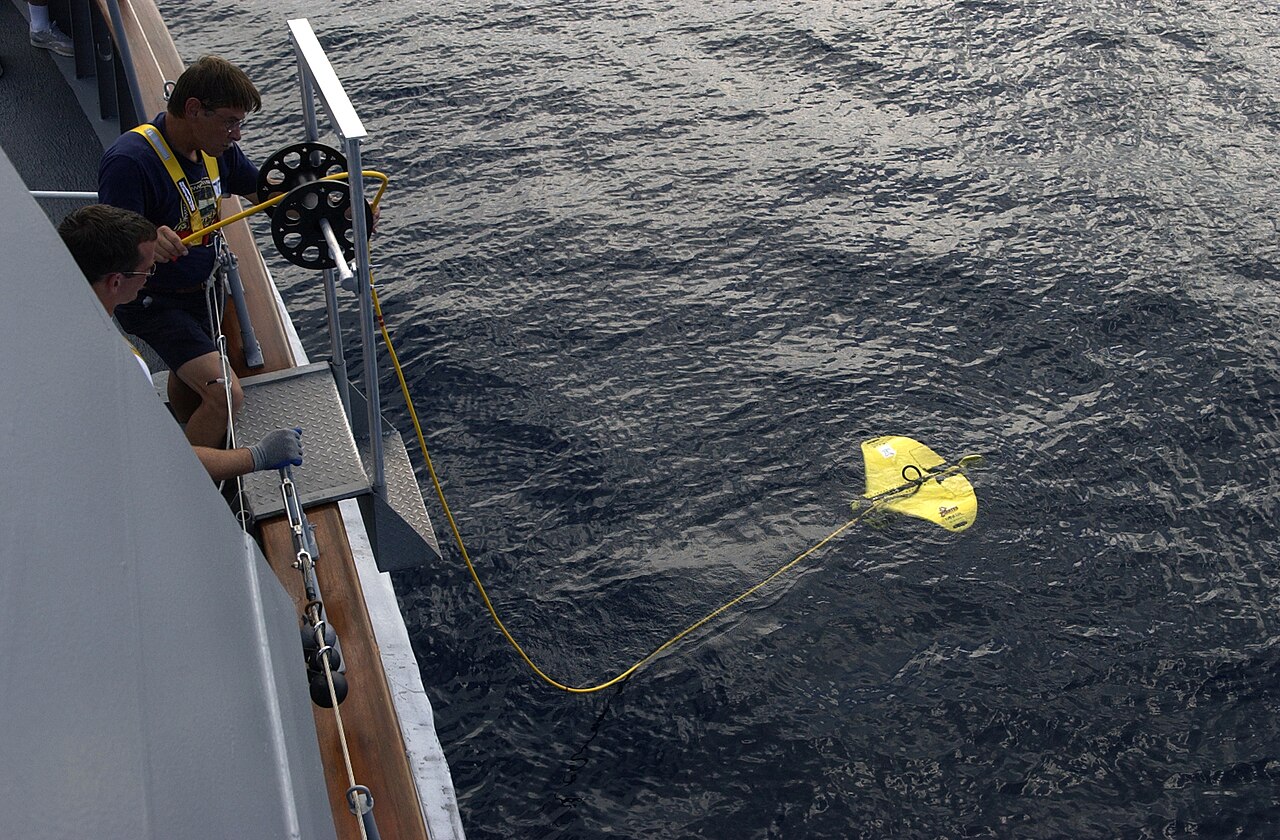
A fast-attack submarine has launched a remotely operated vehicle from a flooded torpedo tube, and the part that made it work came off a commercial resin printer. According to a release from Commander, Submarine Force Atlantic, sailors aboard USS Pasadena (SSN 752) ran a Blueye X3 ROV out of a torpedo tube on Aug. 24, 2026. They used a custom waterproof housing printed in Rigid 10K resin on a Formlabs Form 4L. The Navy put the project's cost at under $1,000 in materials and labor. The alternative the team first considered, a temporary alteration to install a fiber optic penetrator, typically costs approximately $200,000 per submarine.
The Navy's release is dated Sept. 9 from Norfolk. The additive manufacturing trade press picked up the story on Oct. 10, when VoxelMatters covered it. The test itself is about seven weeks old. It deserves a close look because it shows a printed part standing in for an expensive hardware modification.
The problem: getting a tether through the hull
A tethered ROV needs a continuous connection between the vehicle and its operator. On a surface ship that's trivial: you drop the cable over the side. A submarine is different. Any conductor running from the dry interior of the boat to the flooded space outside has to cross a pressure boundary, and on a warship nobody touches the pressure boundary casually.
According to the release, the team initially considered a Temporary Alteration known as a Fiber Optic Penetrator, which would let the crew communicate with the ROV through the torpedo tube breach door. That is formal, structured work, and the release puts the typical cost at approximately $200,000 per submarine. That is a steep price for every hull that wants to try the capability.
The Pasadena team took a different path. Instead of installing the alteration, SIMA Additive Manufacturing developed a custom solution that let the crew keep communicating with the ROV. The team worked on a much smaller problem: keeping the ROV's connections protected and the signal intact while the tube is flooded with seawater.
How the system was built
The DVIDS account splits the work across several groups:
- SIMA Additive Manufacturing designed and printed the custom waterproof housing in Rigid 10K resin on a Formlabs Form 4L.
- SIMA 2M Shop integrated low-voltage wiring into the printed housing and the ROV's tether system.
- A separate wiring harness outside the torpedo tube kept the signal connected through several attachment points.
- Blueye Robotics provided technical help connecting the harness to the Blueye controller.
SIMA is the Shore Intermediate Maintenance Activity, a Navy maintenance organization. Sailors from Pasadena worked alongside it, with technical representatives from Blueye Robotics. The release describes a collaboration among sailors, maintenance shops and an industry partner, not a defense prime building a one-off prototype. The system uses a commercial printer, a commercial resin, standard low-voltage wiring and a Submarine Force Atlantic-owned Blueye X3.
The economics depend on one detail the Navy states plainly. The sub-$1,000 figure covers materials and labor, and the release says it came in that low because the command already owned the ROV. So the headline number is the cost of the integration, not the cost of the whole capability from scratch.
Where the ROVs came from
The project builds on Green Remora, started by Vice Adm. Rob Gaucher while he commanded the U.S. submarine force. It originally examined ways to give submarine scuba divers better underwater search tools for hull security sweeps and external equipment inspections. Under that umbrella, COMSUBFOR Atlantic acquired two Blueye ROVs and kept testing their capabilities, including this torpedo tube launch. The command is developing a formal ROV Personnel Qualification Standard (PQS) card. PQS is how the Navy formally qualifies sailors on equipment and tasks. A card in the works suggests the service expects ROV operation to become a trained skill rather than a one-off demonstration.
The release quotes Fire Control Technician 2nd Class David Baker, who said the project "showed that Sailors can take technology already available to the fleet and adapt it to meet an operational need." It also quotes Chief Fire Control Technician Will McCrary, who called it "proof of concept for rapid prototyping at the deckplate level."
What It Means for Makers
Take away the hull number and this is a familiar story to anyone who has printed a functional enclosure. There's an off-the-shelf device, an awkward installation constraint, and a printed adapter that makes the two fit. A few points stand out.
The printer is not exotic. The release names a Formlabs Form 4L and Rigid 10K resin, commercial products rather than a bespoke defense system. The interesting work is in the design and the wiring integration, not in special equipment.
The value is in the comparison, not the part. A printed housing on its own is unremarkable. A printed housing that lets a crew skip an alteration costing approximately $200,000 per submarine is a different conversation. Makers pitching additive work to employers or clients should notice how the Navy framed it. The story wasn't "we printed a thing." It was "we avoided an expensive alteration."
Integration is the hard part. The print was one piece of a system. The DVIDS account credits a separate shop for the low-voltage wiring, an external harness for the signal path and Blueye for the controller connection. Anyone who has sealed cable entries into a printed enclosure knows water usually gets in at the wire pass-through, not through the shell. The Navy didn't publish its sealing details, and it's no surprise that it didn't.
What we don't know. The release doesn't say how many dives the housing has survived, what pressure it saw inside the flooded tube, or how long it's expected to last in service. It also notes that submarine personnel will continue to meet all applicable torpedo tube operating requirements. One test on one boat is a proof of concept. The PQS card suggests the Navy plans to keep going, but durability data will decide whether a printed housing becomes standard kit or stays a clever workaround.
Bottom Line
A Navy team used a commercial resin printer to build a housing that let a submarine launch an ROV from a torpedo tube for under $1,000 in materials and labor, with the ROV already owned. The alternative the team first considered, a fiber optic penetrator, typically costs approximately $200,000 per submarine. This isn't a breakthrough in printing technology. It's a good example of printing doing what it does best: producing a one-off interface part quickly and cheaply, close to the people who need it.
