
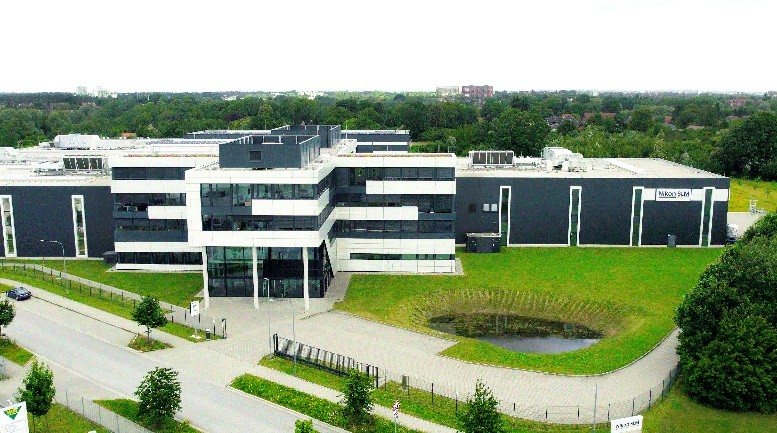
Nikon SLM Solutions has confirmed that it will use Formnext 2026 to launch a new family of metal printers. The company's Formnext 2026 event page, published September 29, names the system MACHX. It describes MACHX as a laser powder bed fusion (L-PBF) platform built for the mid-size part segment, "without the tradeoffs of over- or under-scaled equipment." The unveiling is set for Tuesday, November 17, at 10:00 at Hall 12.0, Booth D119 in Frankfurt.
That is close to everything the company has said so far. TCT Magazine published its Formnext preview on November 2 and added two details. First, the MACHX name covers a series, and TCT understands that several machines will be introduced. Second, the series will add to Nikon SLM's existing SLM 280, SLM 500 and NXG platforms; it will not replace them. TCT notes that many details remain under wraps, two weeks before the show opens, and the event page gives no specifications, pricing or delivery dates.
A Product Aimed at the Middle
The most telling part of the announcement is its positioning, not any spec. The company's website currently lists five machines: the SLM 280 2.0, the SLM 280 PS, the SLM 500, the NXG XII 600 and the NXG 600E. That range already covers a lot of ground. Nikon SLM still believes there is a group of parts that none of these machines serves well, and it is building a separate series for that group instead of adding another variant of an existing platform.
The phrase "over- or under-scaled equipment" carries a lot of the message. Industrial metal buyers know the problem in general terms. A machine that is too small forces a part to be redesigned, split into sections or sent elsewhere. A machine that is too large costs more to buy and to run for a part that fills only a fraction of its build plate. The event page makes a similar argument, saying mid-size parts are too demanding for a small system and do not need the build volume of the company's largest one. Nikon SLM has not said where MACHX sits on build volume, laser count or throughput, so it is impossible to judge whether the claim holds. The marketing language makes the intent clear, though: MACHX is meant to be the right fit, not the biggest or the fastest machine.
The plan to release several machines suggests the company sees "mid-size" as a range, not a single box. TCT says the machines have been engineered to be more easily scalable. In practice, this could mean a shared architecture offered in more than one configuration. Until the launch, that is an inference, not a confirmed detail.
The event page names five target markets: defense, aerospace, aviation, automotive and energy. That is the expected customer list for industrial L-PBF, and it suggests MACHX is a production tool for regulated, high-value parts, not a lab or prototyping machine.
What Nikon SLM Hasn't Said Yet
For a launch this close to the show, a lot is still missing. Before anyone can compare MACHX with existing machines, buyers will need answers to these questions:
- Build envelope. "Mid-size" means little without dimensions, especially next to a lineup that already includes both 280- and 500-class machines.
- Optics. The number of lasers, their power and how much their fields overlap usually decide whether a metal printer is a production machine or a development machine.
- Materials. The company has not published which alloys are qualified at launch.
- Series breakdown. TCT reports that several machines are expected but does not say how many or how they differ.
- Price and timing. No pricing or shipping date has been released.
The 10:00 slot on November 17 is when these questions should get answers. Anyone who prices metal parts or capacity for a living should watch it.
The Rest of the Opening-Day Docket
MACHX is not the only launch on day one. According to TCT's Formnext preview, Stratasys is expected to launch a new machine on the afternoon of the first day, listed at 13:00 at Hall 12.1, Booth D129. TCT gives no details about that machine, so even less is known about it than about MACHX.
Stratasys will also hold the first European demonstrations of the F870, a large-format printer unveiled in September. The printer has a fully heated 1000 x 610 x 610 mm build chamber, which is large enough for big fixtures, tooling and full-size enclosure parts. TCT says it is supported by materials including Nylon 12CF, ASA, ABS and a new FDM material called ABS Draft (Gray), and that Stratasys describes it as having a low cost of ownership compared with similar systems.
At the small end of the hall, Admatec Additive Solutions is premiering its first desktop ceramic printer, the Admaflex Discovery, at the same Hall 12.1 and Booth D129 listing. TCT describes it as designed to be "upgradable from the start": customers can begin with a smaller, more affordable form factor and later expand the same system to a larger, more powerful configuration. That suggests a modular approach for a market where the first purchase is often a test of whether the technology is worth pursuing. TCT lists the price at $92,500, with orders open from November 2026 and shipments expected from spring 2027.
What It Means for Makers
Most FilamentFeed readers will never own a MACHX. It is an industrial L-PBF system aimed at defense, aerospace and similar industries, and the hobbyist market has nothing in that price range. It is still worth following, for three reasons.
First, machines that match their workloads more closely matter to everyone downstream. If MACHX lets service bureaus and contract manufacturers run mid-size metal parts more efficiently, that capacity could eventually reach small shops and serious hobbyists who order printed metal brackets, manifolds or tooling inserts. That depends on the specs, which are still unknown. A manufacturer building a whole series around fit instead of size is still a notable sign of where metal AM is going.
Second, the F870 demos show large-format FDM continuing to move toward production work. Many makers will recognize ABS, ASA and carbon-filled nylon from their own machines. Seeing them run in a heated chamber a meter long shows how far the same basic process can be scaled.
Third, the Admaflex Discovery is the announcement closest to the maker mindset, even at $92,500. TCT says Admatec is targeting first-time users of technical ceramic printing, including universities, research institutes, national laboratories and industry adopters. A desktop ceramic printer designed to be expanded later is easier to justify than a machine that has to be replaced outright once the work outgrows it.
Bottom line: Nikon SLM has confirmed a name, a market segment and a time slot, and little else. The useful information arrives at 10:00 on November 17 in Hall 12.0. FilamentFeed will report the specifications once the company publishes them.
