
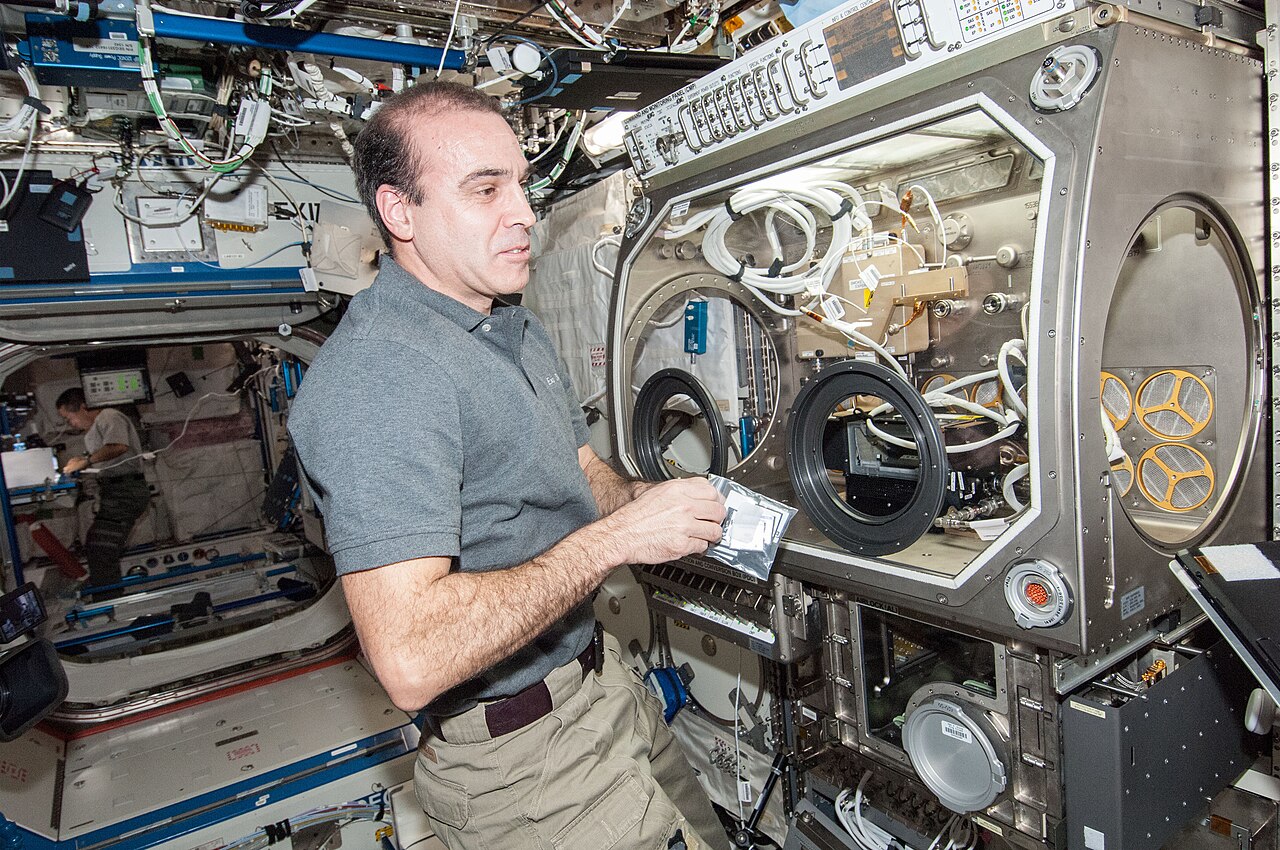
Every metal 3D print built from powder depends on a deceptively simple event: small particles have to melt completely and blend into the surrounding material. When they do not, defects form. In a release issued from Kennedy Space Center, the ISS National Lab announced that the National Science Foundation (NSF) is funding a research project that will study exactly that process in microgravity, with the goal of building more accurate models of how metal powder particles melt and mix.
A note on timing: the official release is dated Sept. 24, 2026. Trade coverage from TCT Magazine followed on Sept. 28.
Two Projects, One Big Idea
The announcement covers two newly selected projects sponsored by the ISS National Lab and funded by NSF. The release headline frames them around electronics cooling and drug delivery, but one of the two has a direct line to metal additive manufacturing.
That project is led by Patricia Weisensee of Washington University in St. Louis. Its title is a mouthful: "ISS: Beyond Buoyancy: The Role of Non-Gravitational Transport Phenomena on the Melting Dynamics of Small Particles." Strip away the formal language and the question is straightforward. What governs how a tiny particle melts and mixes when gravity is not doing most of the work?
The second project, led by Chen Li of the University of South Carolina, is about the slip ratio in microgravity two-phase flows, with electronics cooling as the application. It is not a printing project, so we will leave it there.
Why Gravity Gets in the Way
The release states the core printing problem plainly: in metal 3D printing, powder particles must fully melt and mix, or defects form. Anyone who has looked at a cross-section of a metal part with porosity or unfused regions knows what that means in practice.
The trouble for researchers is that on Earth, gravity creates fluid flows. According to TCT Magazine's coverage, those flows make it difficult to separate and observe the effects of other forces such as surface tension.
Microgravity offers a way to pull those threads apart. Per the release, the environment isolates surface-tension effects from gravity-driven flows. With those flows out of the way, the research team can isolate the non-gravitational effects and develop more accurate models of how the particles melt and mix.
What the Research Is and Is Not
It is worth being precise about what was announced. This is a funded research project aimed at improving models. Neither the release nor the TCT report describes a new printing process, a machine, a material, or a product. Nor do they claim that the work will eliminate defects. Both describe the aim as more accurate models of how particles melt and mix, and the release says the insights could help improve advanced manufacturing techniques. That is a modest framing, and a fair one for basic fluid-transport research.
The release also points to spillover into two other areas: drug delivery and microplastic recycling. The release describes them as applications that involve dissolving particles in liquids, which is why a project pitched at metal printing sits under a drug-delivery headline. Further detail on how those applications connect was not provided in the material we reviewed, so we will not speculate.
A Long-Running Partnership
The projects come out of a collaboration that has been running for more than ten years. According to the release, the ISS National Lab and NSF have funded nearly 100 NSF-funded projects together, and the work has produced more than 350 peer-reviewed publications. TCT likewise notes that the new effort builds on over a decade of ISS National Lab and NSF collaboration.
The release includes comments from William Olbricht, Deputy Head of the NSF Engineering Directorate, and Michael Roberts, Chief Scientist of the ISS National Lab. Those statements are part of the institutional framing of the program, and we are not reproducing them here beyond noting that both officials are quoted in the announcement.
What It Means for Makers
If you print metal, or you are considering it through a service bureau, nothing in this announcement changes your process this year. There is no new parameter set, no firmware update, and no material release attached. Anyone promising otherwise on the strength of this news is getting ahead of the facts.
What the announcement does tell you is where some of the field's hardest unknowns still sit. The project exists to build more accurate models of how metal particles melt and mix, which implies the current picture is incomplete. Better physical models are the kind of upstream result that, over time, could inform process choices. That is our reading of why the work matters, not a claim made by the researchers, and we would treat it as a long-horizon possibility rather than a near-term payoff.
The practical takeaways are modest but real:
- Incomplete melting and mixing is a recognized defect source. The release names it directly, so it is a legitimate thing to look for when inspecting or qualifying metal parts.
- Surface tension is hard to study on Earth. On Earth, gravity-driven flows make it difficult to separate and observe surface tension, which is why the researchers are going to the ISS.
- Results are not imminent. The sources describe selection of the projects, not outcomes. We saw no results reported in either source.
Bottom Line
This is basic-science funding with a clear line to a persistent problem in metal additive manufacturing. The pitch is simple: remove gravity, isolate surface-tension effects, and build models that better predict when particles will melt and mix completely. Whether that translates into fewer defects on a production floor will depend on results that do not yet exist. We will watch for the first data from the ISS work and report when there is something concrete to weigh.
Sources
- NSF Funds ISS National Lab-Sponsored Projects to Advance Applications in Electronics Cooling and Drug Delivery (ISS National Lab via PR Newswire, Sept. 24, 2026)
- ISS research effort to explore role of non-gravitational transport phenomena on the melting dynamics of 3D printed metal particles (TCT Magazine, Sept. 28, 2026)
