
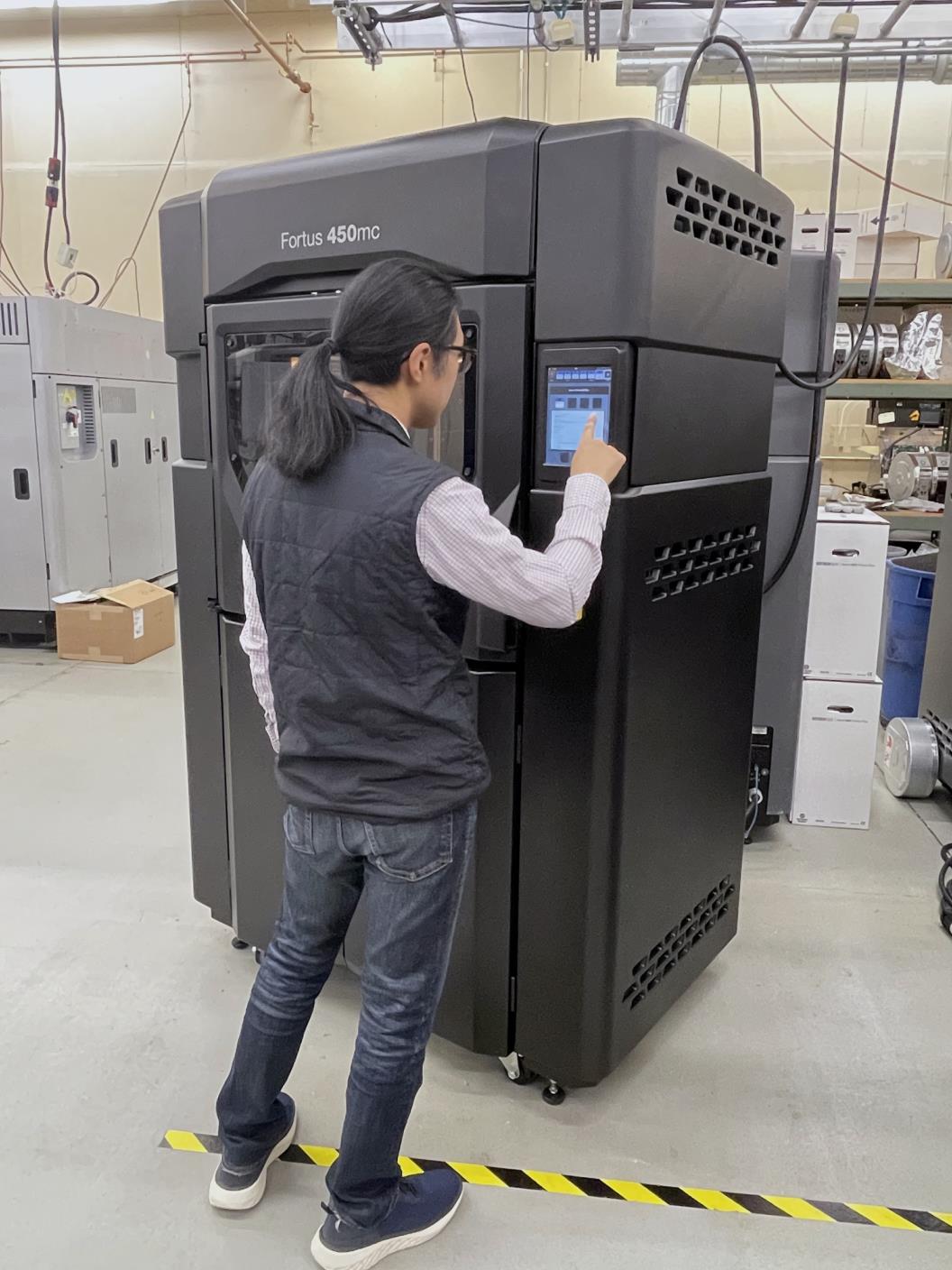
Stratasys has introduced the F870, a large-format FDM system built for factory-floor tooling and end-use parts, and the company isn't waiting for a trade show to prove it out. Toyota Production Engineering and Rivian Automotive are already running the machine ahead of its public debut at IMTS 2026 in Chicago next week, putting two automakers' names on a printer that hasn't yet been formally shown to the public.
That sequencing — production evaluators before the show floor — says something about where Stratasys is aiming the F870. This isn't a desktop-adjacent prosumer release. It's a bet that manufacturing engineers who currently order CNC-machined jigs and fixtures, or wait weeks for tooling vendors, will instead walk a 1000 x 610 x 610mm (39.4 x 24 x 24in) build volume onto their own floor.
What's Actually New Here
The headline spec is the build volume paired with a fully heated chamber — Stratasys is calling it the longest build capacity available in a machine with full chamber heating, which matters more than it sounds. Large-format FDM printers have existed for years, but most trade off either size or thermal control to get there: heat only the bed, or heat a smaller enclosure, and warping and delamination creep in as parts get longer. A meter-long build in a chamber that's uniformly hot end to end is a different engineering problem, and it's specifically the problem automotive tooling runs into — long fixtures, jigs, and body-panel-adjacent tools that need to hold dimension across their full length.
Material support reinforces the tooling focus. The F870 runs Nylon 12CF (carbon-fiber-filled nylon, a workhorse for stiff, load-bearing fixtures), along with ASA and ABS for parts that need UV and impact resistance. Stratasys also introduced a new material alongside the printer: FDM ABS Draft (Gray). Neither the press release nor TCT Magazine's coverage spells out what the "Draft" designation is optimized for — no cost, speed, or mechanical-property figures are given — but the naming points toward faster, lower-cost iteration rather than final mechanical performance, the kind of material a shop would reach for on a check fixture that's still getting revised. That reading fits the naming convention; it isn't something either source states outright.
Toyota and Rivian's Early Access
According to the launch materials, Toyota Production Engineering in Georgetown, Kentucky, and Rivian Automotive in Plymouth, Michigan are the named early adopters, both evaluating the F870 for tooling, fixtures, and prototyping rather than for end-use production parts. Toyota's evaluation spans factory-floor tooling, manufacturing aids, and what the release calls "advanced prototyping workflows," while Rivian's is described more specifically as production-support applications — large fixtures, assembly tools, and inspection gauges. That's a meaningful distinction: automakers have spent a decade using additive manufacturing for exactly this category of job — the internal-use tools that never leave the plant, don't need automotive-grade certification, and get modified constantly as a line changes. It's the segment where FDM has already proven itself against machined aluminum on cost and lead time, and where a bigger, cleaner build volume is a direct productivity lever rather than a novelty.
Stratasys Chief Business Unit Officer Rich Garrity and Toyota North America Additive Manufacturing Engineer Dallas Martin both provided quotes in the announcement, and Stratasys frames the F870 as designed explicitly for scaling factory-floor applications — language aimed squarely at manufacturing engineering teams rather than at the prototyping-lab audience that bought earlier F-series machines. TCT Magazine's coverage of the launch, reported by Sam Davies, corroborates the same framing: the F870 is being positioned as a factory-floor and manufacturing-aids machine first, with Toyota and Rivian cited as the first named users.
Neither source detail what specific tools or fixtures either automaker has printed so far, how long each has had access to the machine, or whether either company has committed to purchasing units — "evaluating" is the operative word in both pieces of reporting. That's worth keeping in mind as a caveat: this is a launch announcement with two credible logos attached, not a case study with measured outcomes yet.
What It Means for Makers
For hobbyists and small shops, the F870 itself is not the story — it's an industrial system that will carry an industrial price tag and almost certainly won't show up on a maker's bench. But there are two things worth tracking here.
First, the fully heated large chamber is a technology direction, not a one-off. As thermal management at scale becomes a selling point for the top of the FDM market, expect that engineering to trickle down over a generation or two the way enclosed chambers and heated beds did before it — today's flagship differentiator is often tomorrow's mid-tier feature.
Second, FDM ABS Draft (Gray) is worth watching as a signal about workflow, not just materials — with a caveat. Neither Stratasys's release nor TCT's coverage details what the "Draft" grade actually trades away, so treat this as a reasonable read of the name rather than a confirmed spec: a lower-cost, faster-printing material tier optimized for iteration rather than final mechanical properties. If that holds, it's a pattern worth borrowing regardless of printer size: cheap, fast material for the third fixture revision, tougher material once the design is locked. Anyone running a multi-material setup at home can apply the same logic without waiting for Stratasys to sell it in a spool.
The bigger takeaway is competitive positioning. Large-format, high-temperature-chamber FDM aimed at automotive tooling puts the F870 in direct contention with big-area additive manufacturing (BAAM) style systems and large-format competitors chasing the same factory-floor budget lines. Toyota and Rivian's involvement — even at the evaluation stage — is the kind of reference-customer signal that machine buyers at other automakers and Tier 1 suppliers will notice, and it's precisely why Stratasys got the names into the announcement before the ribbon was even cut at IMTS.
What to Watch at IMTS
Stratasys will show the F870 at IMTS 2026, Booth 338460, in Chicago from September 14–19. That's where the harder questions should get answered: pricing, throughput figures, whether Toyota or Rivian will speak on the record about specific parts, and how the F870 stacks up against Stratasys's own existing large-format line, as well as rivals chasing the same tooling market. Until then, what's confirmed is the build volume, the chamber architecture, the material lineup, and two very recognizable early testers — enough to make the F870 worth watching, not yet enough to call it proven.
Sources
- Toyota and Rivian Adopt Stratasys' New F870 to Accelerate Factory-Floor Manufacturing Applications at Scale — Stratasys press release via AOL/PR Newswire
- Stratasys launches new F870 FDM 3D printer; Toyota & Rivian among first users — TCT Magazine
