
Tripo AI has launched Tripo Agentic Canvas, an AI agent that assembles 3D-generation jobs into node-based workflows instead of handing back one model at a time. According to the company's press release, distributed through PR Newswire on November 3 (via mirror), the canvas is built around Tripo's own 3D-native foundation models. It takes ideas, reference images and existing assets and turns them into connected workflows that run from generation and refinement through to export. Coverage from 3D Printing Industry and VoxelMatters lists 3D printing among the target uses, specifically the preparation of printable models. That puts the launch in front of makers as well as game studios and product teams.
We read the release on AiThority because Tripo's own site, tripo3d.ai, returned an HTTP 403 when we tried to load it. What follows is based on the release text and on reporting from two trade outlets. We have not tested the product.
From one-shot prompts to a pipeline
Most text-to-3D and image-to-3D tools work as a slot machine. You type a prompt or upload a picture, wait, and get a mesh back. If it is wrong, you change the prompt and pull the lever again. Anything after that, such as cleaning up topology, unwrapping UVs or getting textures to behave, usually happens by hand in other software.
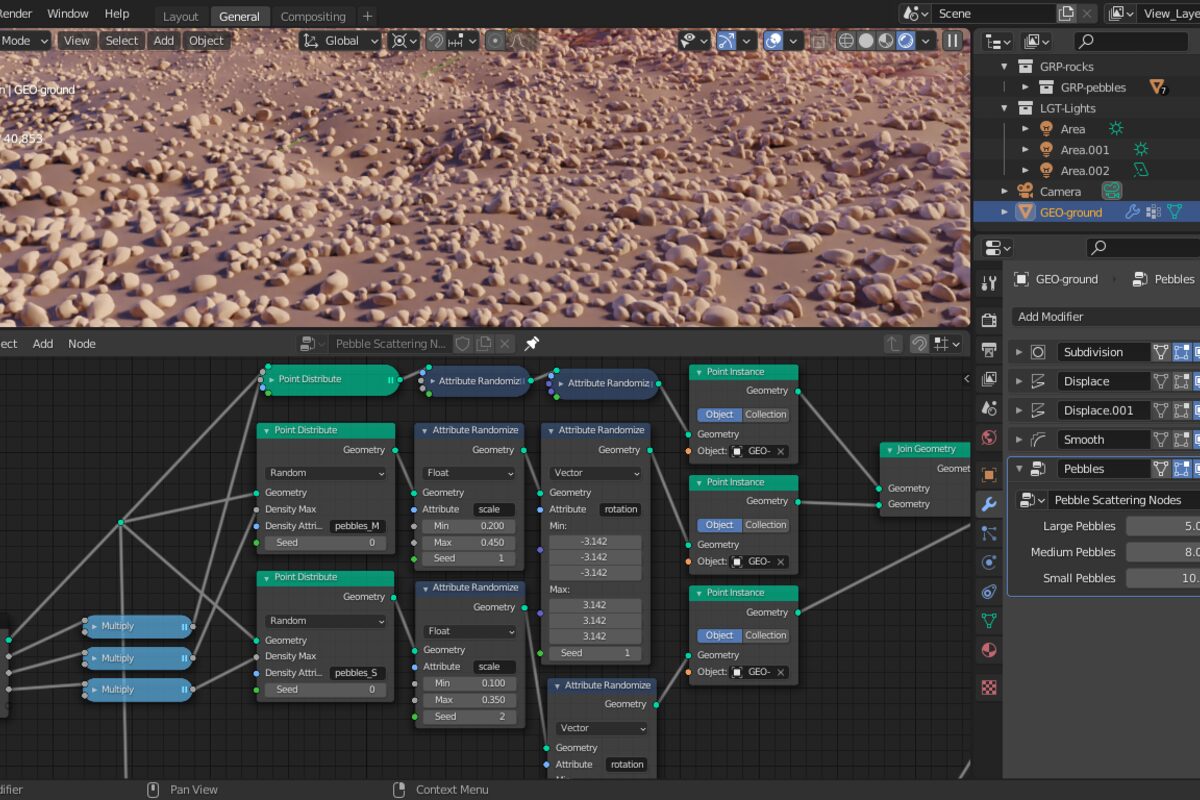
Agentic Canvas is Tripo's attempt to bring those downstream steps into the same workspace and make them repeatable. 3D Printing Industry describes it as an extension of Tripo Studio, moving the company's tooling from single models to chained operations. The design is the familiar node graph that Blender's shader editor, Houdini and many compositing tools have made standard. Each node performs one operation, and its output feeds the next node in the chain.
The release names the operations available as nodes:
- Texturing, for applying surface color and detail to a generated mesh.
- Retopology, for rebuilding the mesh's polygon structure.
- Smart UV, for automated UV unwrapping.
- PBR processing, for physically based material maps.
- Segmentation, for dividing a model into parts.
- Rigging, for adding a skeleton so the model can be posed or animated.
The "agentic" part is that the AI can draft the graph itself. Users can ask the agent to generate a workflow. They can then inspect each node, change it, and run the result. Once a workflow works, it can be saved, duplicated and reused, and batch processing applies a workflow across multiple assets. In practice, a sequence you get right once can be applied to many assets.
The conversational layer
Both outlets describe a node called AI 3D Lab, which provides conversational tools for inspecting and refining specific assets or generating new results from upstream nodes. The node can also turn those conversations into reusable task instructions. If that works as described, an exchange like "thicken the base and close up the gaps around the handle" could become a stored step instead of a one-off fix you have to remember and repeat.
This is the most interesting idea in the launch, and also the hardest to judge without hands-on time. Turning natural-language corrections into deterministic, repeatable operations is a hard problem. How reliably the agent turns a conversation into an instruction that gives the same result on the next asset will decide whether the feature saves time or just adds a step.
Who it is aimed at
VoxelMatters, which identifies Tripo as a San Francisco company, lists a wide set of target uses: game development, 3D printing, product design and e-commerce, film, animation and visualization. Its examples include producing game assets, preparing printable models, generating consistent product variations and refining characters and props. Both outlets note that Tripo offers an API for developers, so the same capabilities can be built into other tools and pipelines rather than used only through the canvas.
That breadth is worth noting. Most of the listed node types, including PBR maps, rigging and UV unwrapping, matter most for real-time and rendered content. A printer ignores UVs and material maps entirely, and a rig is only useful to a maker who wants to pose a figure before exporting a static mesh. The 3D printing use case sits next to these features rather than being the reason they exist.
What It Means for Makers
For people who print, the value of AI-generated models has always depended on the cleanup afterward. A generated mesh that looks fine in a viewer can still need real work before it slices well. It may have thin features, odd internal geometry or a base that does not sit flat. None of the coverage says which specific print-prep operations Agentic Canvas performs, or whether it outputs watertight, manifold geometry by default. "Preparing printable models" is named as a use case, but the published node list does not include anything as specific as wall-thickness checks or mesh repair. Makers should treat print readiness as something to verify in their own slicer, not something the announcement promises.
The workflow model itself is a real improvement for some kinds of maker work, though. Consider anyone producing a series of related objects: a set of tabletop miniatures in one style, a line of figurines for an Etsy shop, or several versions of a part for a client. A saved graph that turns each new reference image into a segmented, retopologized mesh in the same way is more useful than re-prompting from scratch every time. Batch processing across multiple assets is aimed directly at that kind of work, and VoxelMatters' mention of consistent product variations points the same way.
Segmentation also deserves attention from printers specifically. Splitting a model into parts is often how a large or complicated print becomes possible on a hobby-sized bed, or how a multi-color piece gets planned. How useful Tripo's segmentation node is for that will depend on where it chooses to cut, and the sources do not go into that.
Bottom Line
Tripo Agentic Canvas moves AI 3D generation away from single prompts and toward the node-graph pipelines that experienced 3D artists already use. It adds an agent that can draft those graphs and a conversational node that can turn feedback into reusable instructions. Saved, shareable and batch-capable workflows plus an API make it a candidate for anyone generating models in volume. For makers, the 3D printing claim is still a stated use case rather than a documented feature set. The open questions are how clean and printable the exported geometry actually is, and how much hand repair is still needed before slicing.
Sources
- Tripo AI Unveils Agentic Canvas to Make AI 3D More Accessible and Scalable (Tripo AI press release via PR Newswire, via mirror on AiThority, Nov 3, 2026)
- Tripo AI Launches Agentic Canvas, an AI Agent That Builds Reusable 3D Model Workflows for 3D Printing and Games (3D Printing Industry, November 2026)
- Tripo AI launches Agentic Canvas for node-based 3D workflows (VoxelMatters, Nov 3, 2026)
