
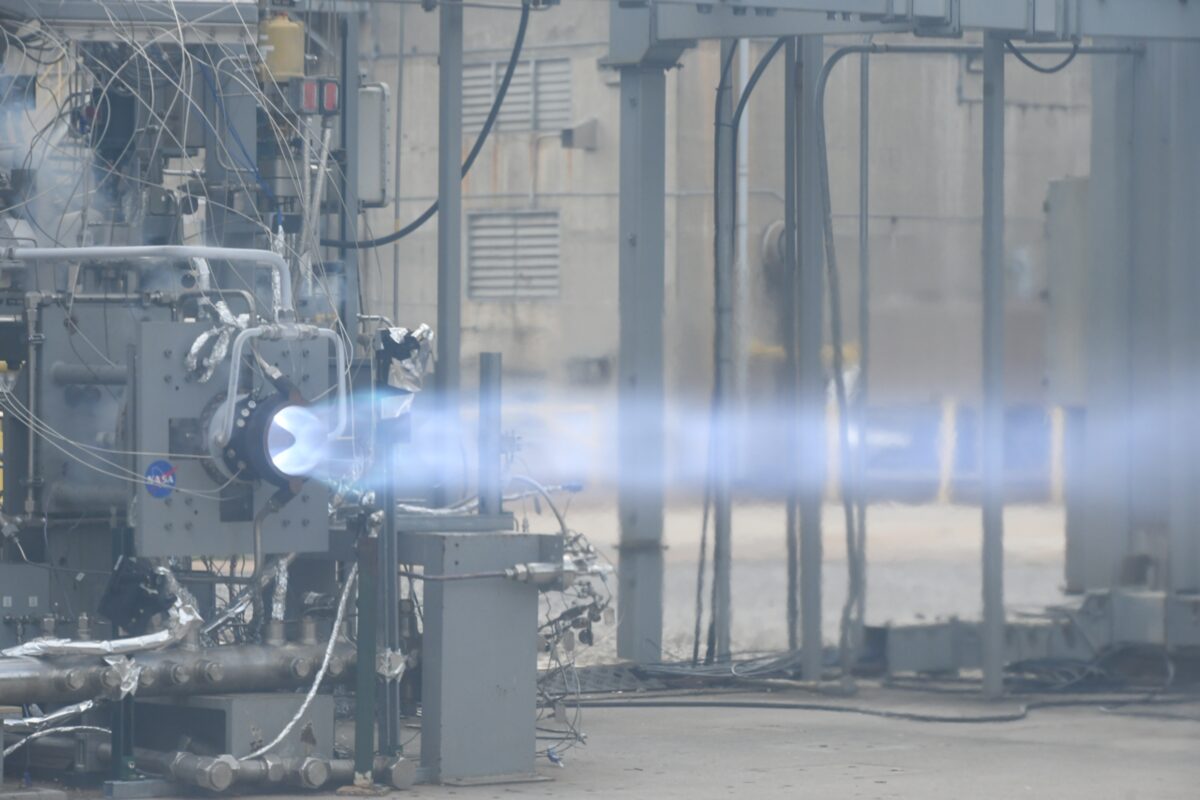
Venus Aerospace has closed a $91 million Series B to take its Rotating Detonation Rocket Engine (RDRE) — an engine built largely from 3D-printed components — from last year's flight demonstration into full-scale propulsion production. The round, announced July 8, 2026, was led by Mercury Fund, with Lockheed Martin Ventures, MESH, PEAK6, Draper Associates, Starboard Star VC, and Green Sands Equity participating. It brings the Houston company's total capital raised to $171 million, on top of $80 million secured previously.
For a company whose core engineering bet has always been additive manufacturing, the round is as much a validation of 3D printing as a production method for rocket propulsion as it is a bet on the underlying detonation-engine physics.
What a Rotating Detonation Engine Actually Does
Conventional rocket engines burn propellant in a steady, subsonic deflagration — a controlled flame front that releases energy relatively slowly. Venus Aerospace's RDRE instead sustains a continuous supersonic detonation wave that races around an annular combustion chamber, consuming fresh propellant as it goes. Detonation releases energy far more abruptly than deflagration, and because the wave is self-sustaining once initiated, the engine can extract more useful work from the same mass of propellant. According to TCT Magazine's coverage of the raise, Venus claims the design is roughly 15% more efficient than conventional rocket engines, while also being reusable and throttleable — two properties that have historically been difficult to combine with detonation-cycle propulsion, which tends to produce engines that are either simple and expendable or complex and fragile.
Rotating detonation engines are not a new idea in propulsion research; the concept has circulated in academic and government labs for decades, in part because the extreme pressures, temperatures, and detonation-wave dynamics inside the chamber make it a brutal environment for conventional castings and welded assemblies. Venus's pitch is that it has turned a lab curiosity into hardware that actually flies, and that 3D printing is a big part of how it got there.
Why 3D Printing Is the Manufacturing Story
Per the PR Newswire release announcing the round, Venus's RDRE components are 3D printed from standard materials, a choice the company frames explicitly around domestic, supply-chain-resilient manufacturing rather than exotic alloys or specialty feedstocks sourced overseas. That framing matters in the current defense-industrial climate: propulsion programs sold to the Pentagon and to space customers increasingly need to demonstrate that critical hardware can be produced entirely within domestic supply chains, without dependency on single-source foreign materials or components.
Additive manufacturing has become a standard tool for making rocket engine hardware over the past decade — companies from Relativity Space to Rocket Lab to legacy primes have all leaned on metal 3D printing for combustion chambers, injectors, and turbopump housings, largely because the geometries required for efficient cooling channels and swirl injectors are difficult or impossible to machine conventionally. What differentiates Venus's use case is the RDRE's geometry itself: an annular chamber that must survive a continuously rotating detonation wave imposes thermal and pressure gradients unlike those in a traditional bell-nozzle engine. Printing the chamber as a near-net-shape part, rather than assembling it from separately machined and welded sections, gives Venus tighter control over wall thickness and internal channel geometry in a part that has very little margin for structural weak points.
Venus reached its first flight demonstration in roughly five years on the $80 million raised prior to this round, according to TechCrunch's report on the Series B. The company, founded in 2020, flight-tested the RDRE in May 2025 in what it describes as the first flight-proven demonstration of a high-thrust RDRE. That flight is the technical proof point this new round is meant to build on — moving from a single demonstrated flight article to a manufacturable propulsion system line.
TechCrunch's report also puts the remaining engineering gap in concrete terms: Venus's longest single RDRE test run to date has lasted 32 seconds, drawn from more than 600 ground tests, while the company says customers will ultimately need engines that can fire continuously for six to fifteen minutes. Closing that gap — from tens of seconds of sustained detonation-wave combustion to double-digit minutes — is arguably the core engineering problem this funding round exists to solve, more than any single flight milestone.
Where the Money Is Going
The company says the new capital will fund development and production scaling of the RDRE for a range of applications: munitions, space launch, orbital transfer, and landers. That's a deliberately broad target list, reflecting the fact that a reusable, throttleable detonation engine with a claimed efficiency edge is attractive to both the defense-propulsion market (where Lockheed Martin Ventures' participation is a signal) and the commercial space-launch and in-space mobility markets. Lockheed Martin Ventures' Chris Moran struck a similar note in the funding announcement, saying Venus "has progressed very quickly in its technology development" — a notable endorsement from a defense-prime-affiliated fund with a close view of how nascent propulsion technologies typically mature.
Former NASA Deputy Administrator Pam Melroy is joining Venus's board as part of the round, adding a former senior civil-space official to a cap table already stacked with defense-adjacent investors. CEO Sassie Duggleby and Mercury Fund's Blair Garrou were both quoted in the funding announcement, though neither offered specifics on production timelines, contract customers, or unit economics for the engine line.
What It Means for Makers
Venus Aerospace isn't a desktop-printer story, and nobody is going to run this hardware on a Bambu or Prusa. But it's a useful data point for anyone tracking where metal additive manufacturing is actually earning its keep in industry rather than just generating conference-keynote hype. A rotating detonation engine is about as demanding an application as exists for a printed metal part: it has to survive repeated supersonic detonation cycles, extreme thermal gradients, and — per Venus's reusability claim — do so more than once. That a well-funded propulsion startup is betting its entire Series B thesis on printed hardware, using standard (not boutique) materials, is a signal that print quality, repeatability, and post-processing for high-cycle, high-stress metal parts have matured enough to underpin a flight-qualified engine rather than just a one-off prototype or wind-tunnel test article.
It's also a reminder that "domestic supply chain" and "3D printed" are increasingly paired talking points in hardware fundraising, particularly for anything touching defense procurement. Expect more propulsion, munitions, and aerospace-structures startups to lean on the same combination — printed geometry as both a performance enabler and a supply-chain argument — as they pitch investors and government customers in the current funding environment.
Sources
- Venus Aerospace Raises $91M to Mature the World's First Flight-Proven High-Thrust RDRE Into Full Propulsion Systems – PR Newswire
- Venus Aerospace raises $91m to fund development & production of 3D printing-enabled high-thrust rocket engine – TCT Magazine
- Venus Aerospace raises $90M Series B to build a new kind of rocket engine – TechCrunch
