
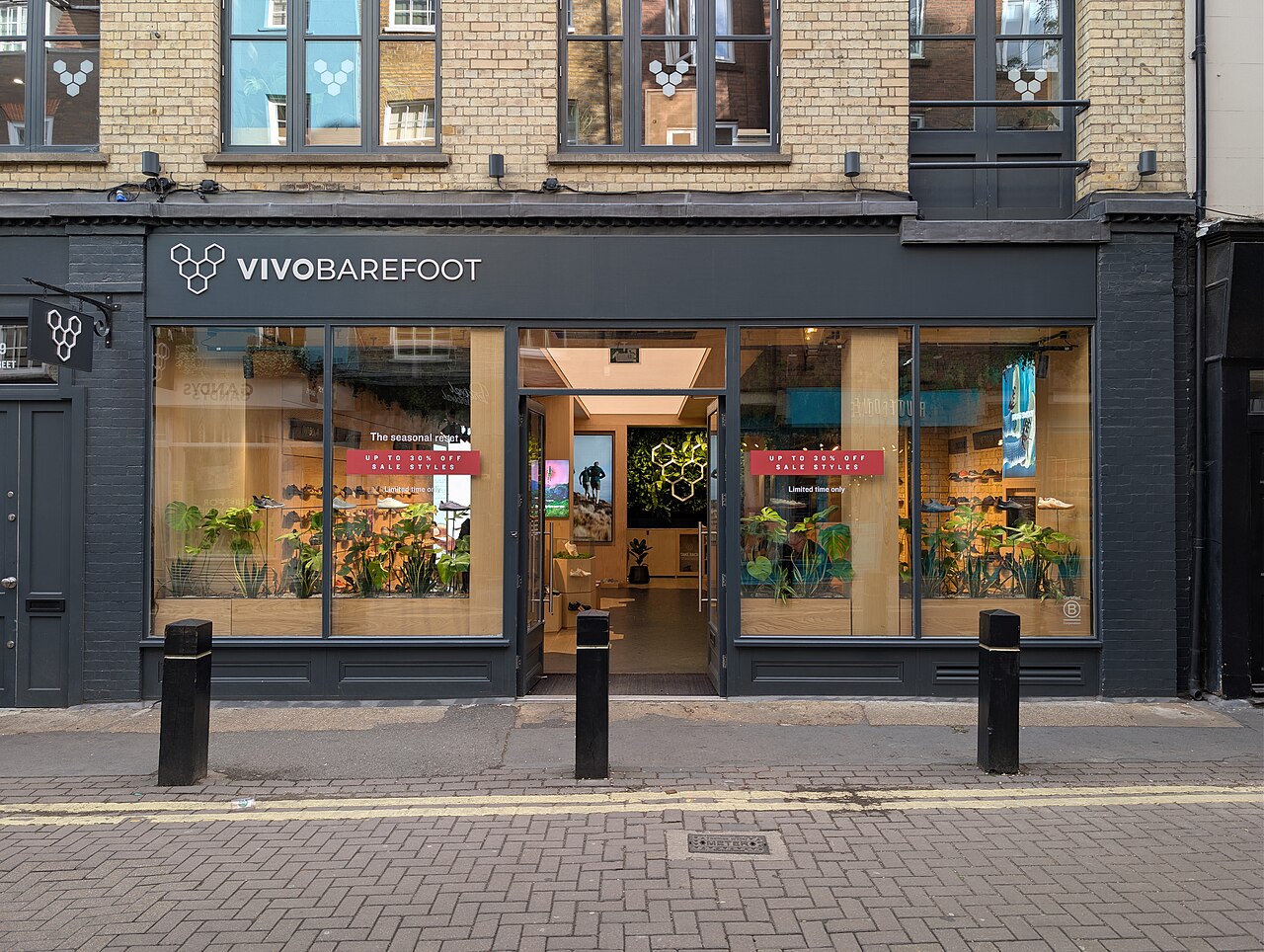
The first time Vivobarefoot tried to sell a 3D-printed sandal made to fit one person's foot, people wanted it. The material didn't work. In an interview published by VoxelMatters on October 19, co-founder Asher Clark describes what happened with the company's Tabi Gen 01: a selective laser sintering (SLS) sandal that sold well from a very small footprint but came out too heavy, too abrasive and too expensive. Its replacement, Tabi Gen 02, uses a different printing process. Carbon's Digital Light Synthesis (DLS) replaces SLS, and contract manufacturer OECHSLER now prints the parts. Readers should know up front that VoxelMatters labels the piece as sponsored content, and FilamentFeed could not read any Vivobarefoot or Carbon page to check the claims independently. The figures below are the companies' own.
Gen 01: Demand Without a Viable Material
Earlier VoxelMatters coverage of the Gen 02 launch describes Tabi Gen 01 as a split-toe, flip-flop-style sandal printed with SLS. It was limited to 590 pairs and retailed for GBP 140, or about $190. In the interview, Clark says that with only two foot scanners in operation, the company sold 120 pairs in 21 days and took more than 1,300 paid reservations.
That is a small sample, but it is a useful one. A custom-fit product depends on getting a customer's foot in front of a scanner, so two scanners put a hard ceiling on throughput. Pulling in paid reservations at roughly ten times the number of pairs actually sold suggests demand was not the problem. The problem was the part itself. Clark lists three faults with the SLS material: weight, abrasiveness and cost. For a sandal worn against bare skin, abrasion is not a cosmetic issue. Any maker who has run a fingernail over an unfinished powder-bed print knows the texture he means.
Why DLS, and Why a Contract Manufacturer
Gen 02 is printed with Carbon's DLS process. The launch coverage names the material as CARBON BL6 PU foam, while the October interview says the sandal is made from EPU Pro, an elastomeric polyurethane developed by Carbon. The two sources do not agree, so treat the exact material name as unsettled. According to the interview, the new sandal is lighter than its predecessor and is built as a single piece, with the toe post, integrated straps and flex zones all part of the design. The companies also say the single-piece design facilitates recycling. Neither article gives a recycling method or figures, so that claim is best read as a stated design goal, not a demonstrated result.
The handoff from development to production is the more interesting part for anyone thinking about how printed consumer goods scale. In the interview, Carbon's Chris Robertson describes a two-stage path. First, Carbon's pre-development lab in Erlangen, Germany evaluated the use case, refined the design direction and tested several material options. The project then moved to OECHSLER, which runs a fleet of Carbon DLS printers in a dedicated production hall. OECHSLER's Andreas Knoechel adds that printing is at most 50 percent of the job; the rest is post-processing and quality control. This split is common in industrial additive work. The process owner proves that a geometry and material combination is viable, and a contract manufacturer with installed capacity takes over volume production. For Vivobarefoot, it means the company doesn't have to own or operate printers at all. Its contribution is the scan-to-design pipeline and the customer relationship.
The interview doesn't break out unit costs, print times or yield for Gen 02. It also doesn't say how much lighter the new sandal is. Those omissions matter. The original complaint was partly about expense. The launch article lists Gen 02 at GBP 110 on the VivoBiome site, against GBP 140 for Gen 01, and Clark puts current lead time at four to six weeks. A lower retail price is not the same as a lower production cost, though, and neither article says whether the move to DLS solved the cost problem.
Scan, Print, Ship
The customer-facing workflow stays close to Gen 01's. Buyers have their feet scanned with Volumental scanning hardware at a Vivobarefoot store, and the scan drives the printed geometry. Gen 02 launched in April 2026, and availability is limited to three locations. The two sources disagree on which three. The October interview names London, Bristol and Tokyo. The earlier launch article lists London, Bristol and Prague. FilamentFeed could not confirm which list is current, and anyone planning a trip for a scan should check with the company first.
The sandal is also not presented as finished. Clark says the team is still testing and refining grip, abrasion resistance, durability and comfort over long wear, and that customer feedback has flagged grip and durability as needing work. He says he won't give dates or specs for a Gen 03 until they are proven. That candor is worth noting. It also means Gen 02 is still effectively a paid field trial, with early buyers supplying the wear data.
The Sustainability Pitch
Clark frames the project partly as a waste argument. He says roughly 30 percent of materials are wasted in conventional shoemaking and that 19 billion pairs of shoes go to landfill every year. Those are his figures, quoted in a sponsored interview, and neither article cites an underlying study. The logic behind the pitch is straightforward. Clark notes that a pair "doesn't exist until you order it," so there is no stock and no wasted inventory, and a single-piece part is in principle easier to recycle than a glued assembly of foams, textiles and rubber. Whether that holds up at scale depends on details neither article supplies, including print failure rates, support material and what actually happens to a worn-out sandal.
What It Means for Makers
For people who print at home, the Tabi story is a clear case study in why process selection is a product decision and not only a manufacturing detail. Vivobarefoot had a working scan-to-print pipeline and customers willing to pay up front. It still had to switch technologies, because the SLS material was, in Clark's words, too heavy, abrasive and expensive for this product. The move to a resin-based polyurethane with designed-in flex zones follows a pattern familiar from lattice midsoles. When a part has to be soft, light and comfortable, the material and the geometry have to be developed together.
The structure of the program also shows where the value sits. Vivobarefoot owns the customer, the scan data and the design logic. Carbon supplies the process and the early engineering. OECHSLER supplies printers and production discipline. Independent designers selling custom-fit wearables are in a similar position. Scanning and parametric design are the parts that can be differentiated. Printing can be outsourced once the material question is answered.
The open questions are still the important ones: unit cost, durability under real wear, and whether three scanning locations can grow into a business. Clark says testing continues, and the partners have published no numbers for Gen 02 sales. Until they do, Tabi Gen 02 shows that custom footwear can be manufactured. It does not yet show that it pays.
