
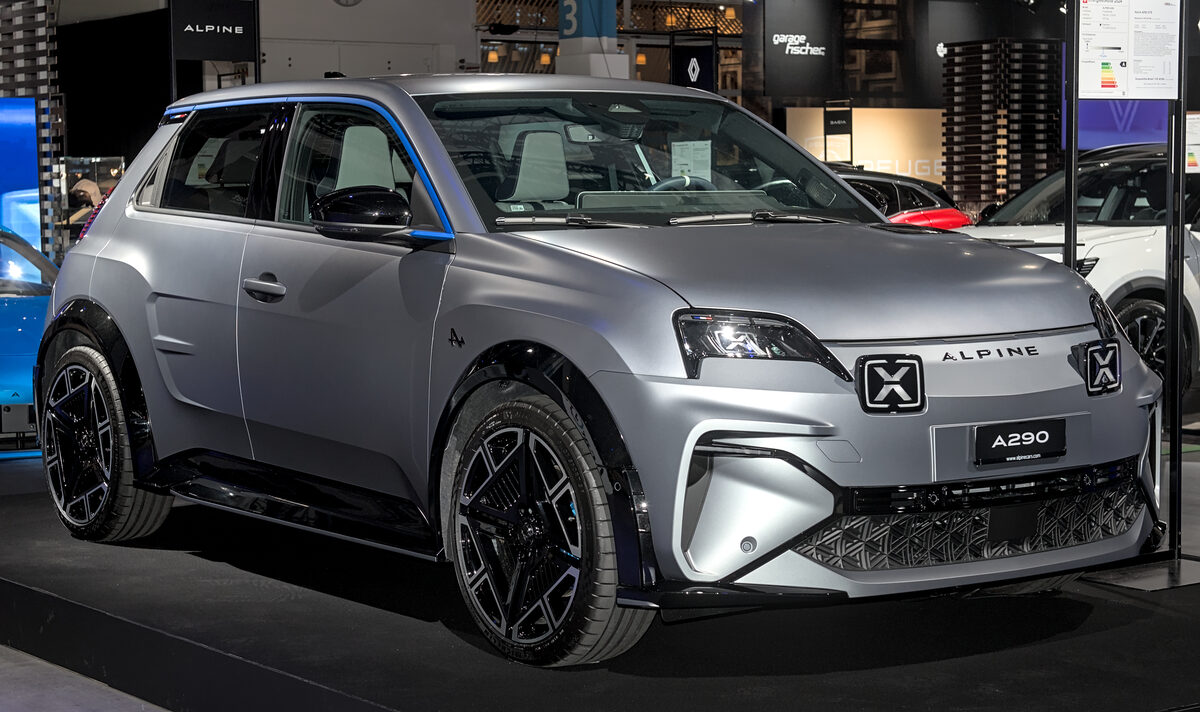
Alpine and Lacoste have unveiled a one-off Alpine A290 Rallye dubbed "Beware of the Crocodile," and the headline feature isn't the livery — it's what's bolted underneath it. The car's rally seats are built around 3D-printed lattice structures manufactured by ERPRO, engineered to shave weight while adding both comfort and structural performance, all hidden beneath Lacoste's signature embroidered petit piqué fabric.
It's an unusual pairing on paper: a French motorsport brand best known for hot hatches turned rally cars, and a French fashion house best known for tennis shirts and a reptile logo. But the collaboration, announced by Alpine's media office on June 29, 2026, leans into shared French heritage and uses the car as a rolling showcase for craftsmanship on both sides of that divide — one mechanical, one textile, with additive manufacturing doing the structural work in between.
What's Actually Under the Fabric
The A290 Rallye is Alpine's customer-facing rally racing model, the version built for teams and drivers who actually compete rather than just drive fast on public roads. That context matters for understanding why a 3D-printed seat structure shows up here rather than on a showroom trim. Rally seats have to do three jobs at once that are normally in tension: hold a driver rigidly in place through repeated high-g impacts and washboard surfaces, stay light enough not to eat into the car's power-to-weight ratio, and remain comfortable enough to survive hours behind the wheel on a stage. Traditional seat shells solve this with a mix of composite layup and foam padding, a combination that tends to force a trade-off between stiffness and weight.
Lattice geometry is the standard additive-manufacturing answer to that trade-off, and it's why ERPRO's involvement is the real news buried inside a fashion story. A 3D-printed lattice structure — a repeating internal scaffold of struts rather than a solid or foam-filled mass — can be tuned zone by zone. Denser, stiffer cell patterns go where the seat needs to resist load and keep a driver planted through a hard landing; more open, compliant patterns go where cushioning and airflow matter more than raw stiffness. None of that is achievable with molded foam or machined composite alone, because both of those processes produce essentially uniform material properties across a part. A lattice, printed rather than molded, lets the seat's internal structure vary the way a suspension tune varies — stiff here, soft there, matched to what the geometry of that specific zone needs to do.
The official release also confirms Lacoste's petit piqué fabric covers the seats and door panels, with crocodile motifs embroidered by the historic French workshop Potencier, and red anodized treatment applied to structural interior components elsewhere in the cabin. Independent design coverage from Designboom corroborates the crocodile motif as a recurring, semi-hidden design cue running through the car rather than a single obvious logo slap, and confirms the vehicle's one-off status — this is a showcase piece, not a production option list item.
Why a Fashion House Cares About Lattice Printing
Trade coverage from VoxelMatters, published July 3, frames the seat structures explicitly as an additive-manufacturing story rather than a fashion one, and that framing is worth taking seriously. VoxelMatters covers the AM industry for a living, and its interest here isn't the crocodile — it's confirmation that ERPRO's lattice work is being positioned as the functional core of the seat, not a gimmick footnote to a marketing stunt. When a specialist AM outlet leads with the printed structure and treats the couture fabric as the accessory, that's a signal about where the actual engineering value sits.
ERPRO's role here is exactly the kind of application additive manufacturing has been chasing in motorsport for years: producing a functional, end-use part rather than a prototype, using industrial-grade 3D printing to hit performance targets that subtractive or molded manufacturing struggle to match at a production run of one. A one-off rally seat is close to an ideal use case for that model. There's no tooling amortization to worry about because there's no production run — you're not stamping a die or building an injection mold for a single interior. Additive manufacturing's traditional weakness against mass production, its per-unit cost, simply doesn't apply when the unit count is one. What's left is pure upside: geometric freedom, tunable internal structure, and fast iteration, with none of the usual "but it won't scale" caveat that dogs 3D printing pitches aimed at high-volume parts.
What It Means for Makers
None of this is going to show up in a $40 filament roll or a weekend Bambu print, and nobody covering this collaboration is claiming otherwise. What it does confirm, again, is the trajectory the AM industry has been on for several years: printed lattice structures graduating from rapid-prototyping demos and lightweighting whitepapers into parts that actual paying customers sit in, at speed, in competition. That's a meaningfully different bar than a trade-show display piece.
For makers running desktop machines, the practical takeaway is less about the specific hardware and more about validation of technique. Variable-density infill — the same underlying idea as an industrial lattice, just executed at hobbyist resolution and material strength — is a slider every FDM and resin user already has access to in their slicer. Seeing a professional shop apply that exact principle to a load-bearing, safety-relevant automotive part, in a project a major consumer brand is willing to put its name on, is a useful data point for anyone weighing whether tuned internal geometry is worth the print-time cost on their own functional parts. It's also a reminder that brand collaborations are becoming a meaningful channel for additive manufacturing's visibility outside industrial and hobbyist circles — a fashion house's willingness to hide the engineering under embroidery, rather than hide the embroidery under the engineering, says something about how normalized 3D printing has become as a manufacturing method rather than a novelty to be shown off for its own sake.
Sources
- Lacoste and Alpine unveil a collaboration inspired by French ingenuity, where performance meets elegance — Alpine Media
- Alpine and Lacoste's one-off A290 Rallye features ERPRO 3D printed seat structures — VoxelMatters
- Lacoste reimagines Alpine's A290 Rallye through its iconic crocodile motif — Designboom
