
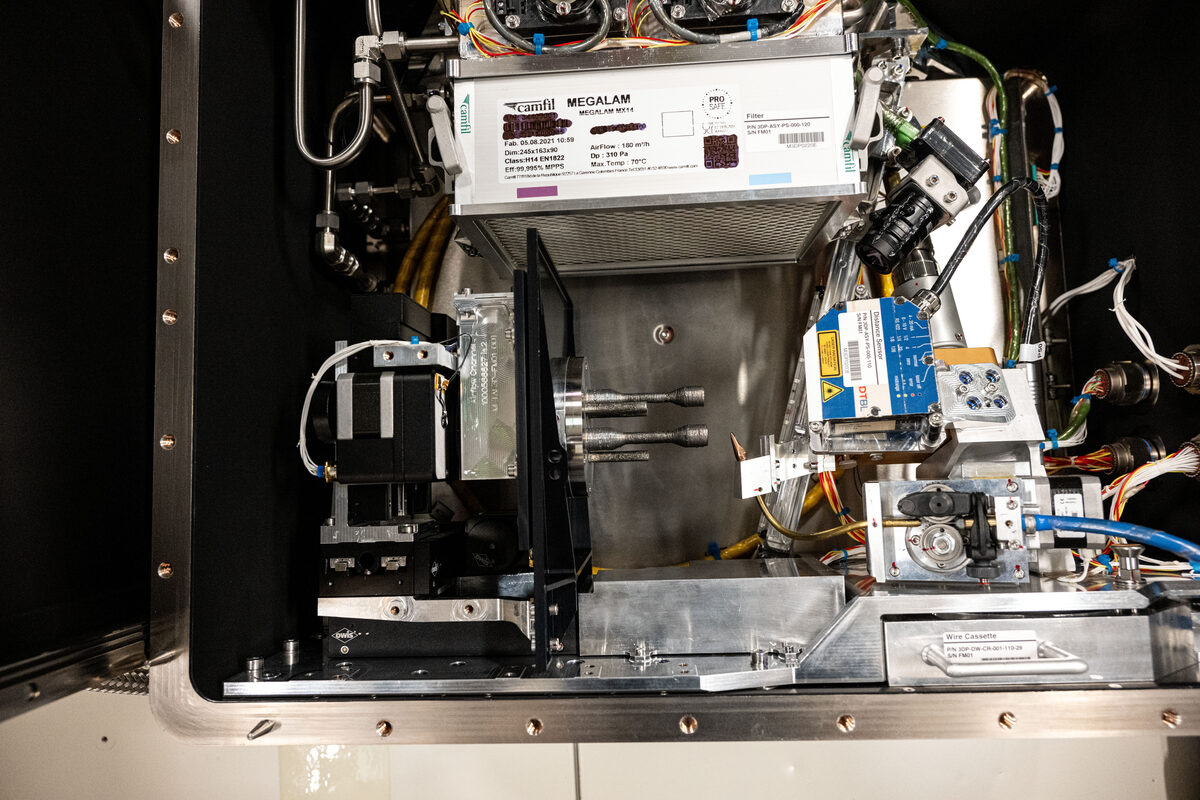
Apple has confirmed that the hinge cover on its newly unveiled foldable iPhone Duo is a 3D-printed component made from 100% recycled titanium, sitting over a hinge assembly of more than 100 parts and finished with a distinctive micro-blasted texture. The announcement, published on Apple's newsroom on September 9, 2026, is a small line in a much larger product reveal — but for anyone who has spent time around a metal printer, it's the most interesting sentence in the release.
According to Apple, the hinge itself — the mechanism that lets the Duo's 7.6-inch inner display fold and unfold while staying supported at its center — is "engineered from more than 100 components," delivering, in Apple's words, "a smooth, satisfying feel with every use." The cover that sits over that mechanism, visible whenever the phone is open, is the part made via additive manufacturing, and Apple specifically calls out its "contrasting micro-blasted finish," a surface treatment that gives the printed titanium a matte, slightly textured look distinct from the polished metal around it.
Trade coverage adds useful detail Apple's own copy skipped. TCT Magazine, writing the day after the announcement, confirmed the titanium in question is Grade 5 — the workhorse aerospace-grade alloy that dominates metal AM for a reason: high strength-to-weight ratio, good fatigue resistance, and a track record in powder-based printing processes. TCT also reports that the printed cover includes internal support ribs for reinforcement, a detail that matters more than it might sound like it should — and notes that ceramic fiber inserts in the phone's antenna splits provide additional frame rigidity elsewhere in the design, a reminder that the hinge cover is one piece of a broader push to engineer structural material only where it's needed.
Why Print a Hinge Cover Instead of Machining One
A hinge cover is, on paper, a simple part: a thin shell that hides a mechanism and takes some cosmetic abuse. So why print it in titanium rather than machine or stamp it, the way phone hardware has been made for a decade and a half?
The internal ribs TCT flagged are the likely answer. Additive manufacturing lets a designer put structural material only where it's needed — thin walls on the outside for the finished look, with reinforcing ribs on the inside that would be difficult or expensive to machine into a part this small and this thin. That's the standard pitch for metal AM in any weight-sensitive product: you get stiffness without the mass penalty of a solid machined equivalent, because the internal geometry can be organic and load-specific rather than constrained by what a cutting tool can reach.
For a folding phone specifically, every gram and every fraction of a millimeter around the hinge matters twice over — it affects how thin the device can be when open, and it's one of the few places on the phone that has to survive tens of thousands of open-close cycles without developing play or cracking. Apple is marketing the Duo as the "thinnest iPhone ever" — a claim both its own newsroom post and TCT's coverage repeat — which puts real pressure on every component in that hinge stack to be no bigger or heavier than it has to be.
The "100% recycled titanium" claim is also notable on its own terms. Recycled titanium powder for metal AM has been a live topic in the industry for years, mostly around cost and supply-chain resilience rather than marketing — virgin Grade 5 titanium powder is expensive and its supply chain runs through a small number of producers. A consumer product shipping at Apple's volumes using fully recycled feedstock is a meaningful signal about how mature that recycling pipeline has become, whatever the sustainability messaging around it.
TCT also notes that Apple's use of 100% recycled titanium here is "consistent with previous AM applications" at the company — pointing to Apple's earlier use of 3D printing for the USB-C port on the iPhone Air and for the cases of the Apple Watch 11 and Apple Watch Ultra 3. The Duo's hinge cover extends that existing practice rather than marking a first foray into the technology.
What It Means for Makers
None of this puts a Grade 5 titanium printer on your bench. Apple's process, whatever machine or bureau is behind it, is operating at a production scale and tolerance most hobbyists and even most professional shops won't touch. But the news is still worth filing away for a few reasons.
First, it's another data point — alongside prior consumer-electronics uses of metal AM — that additive manufacturing has moved well past prototyping and into cosmetic, load-bearing, high-cycle-count parts in mass-market products. When a company with Apple's manufacturing scrutiny and cost discipline chooses to print a part rather than machine or stamp it, that's a signal the economics and the reliability have crossed a real threshold, not just a novelty threshold.
Second, the specific design logic — thin outer walls plus internal reinforcing ribs, printed rather than machined because the geometry doesn't work any other way — is exactly the same logic that shows up in desktop and prosumer AM projects: brackets, drone frames, tooling jigs, and enclosures that need stiffness in specific directions without added mass. Seeing that logic validated at iPhone volume is a useful reference point when you're arguing internal rib design in your own print, even if you're working in PETG rather than titanium powder.
Third, watch the finish. A "micro-blasted" surface as a deliberate, visible design choice — rather than a treatment used to hide print artifacts — suggests confidence in the underlying print quality. That's worth noting for anyone doing post-processing on metal or even resin prints: surface finish can be a feature, not just cleanup.
Finally, this continues a pattern the AM industry has been building toward for a few years now: high-profile consumer electronics using metal 3D printing for structural, moving hardware rather than static or purely decorative parts. Each new example — hinges, brackets, internal frames — makes the case a little more concretely that metal AM belongs in the parts bin of mainstream product design, not just aerospace and medical devices.
Sources
- Apple Newsroom: Apple Unveils iPhone Duo (September 9, 2026)
- TCT Magazine: Apple's new foldable iPhone features a 3D-printed hinge cover, Sam Davies, September 10, 2026
