
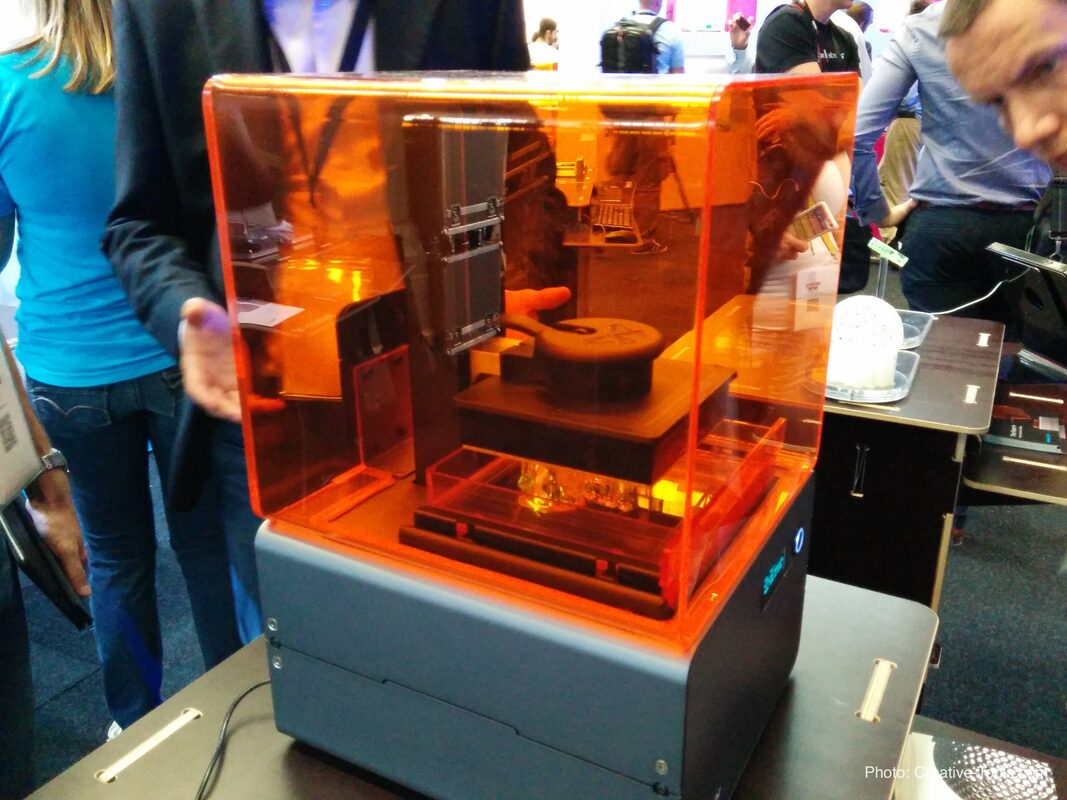
Axtra3D has validated KeySplint Hard Clear, a dental resin from Keystone Industries used for post-trauma tooth immobilization and retainers, for use on its Lumia.X1 Hi-Speed stereolithography system. The clearance, announced July 28, makes KeySplint Hard Clear the second material in Keystone's Keyprint dental-resin lineup to be formally validated for the Lumia.X1, following KeyModel Ultra earlier this year.
For a printer platform still building out its dental and orthodontic credentials, the addition is incremental but telling. Material qualification is the unglamorous, unavoidable gate that stands between a hardware vendor's speed and precision claims and an actual dental lab putting parts in patients' mouths. Every resin has to be characterized against a specific printer's optics, exposure profile, and layer-separation mechanics before a lab can use it with confidence — and before Keystone or Axtra3D will put their names behind the combination.
What KeySplint Hard Clear Is For
KeySplint Hard Clear is built for a narrow but demanding job: stabilizing teeth after trauma and serving as a retainer material. Keystone markets it as abrasion-resistant and biocompatible — necessary properties for an appliance that sits in a patient's mouth for extended periods and has to survive the mechanical wear of daily use without degrading or irritating soft tissue. The resin ships in two shades, Light Violet and Clear, but only the Clear variant has cleared validation for the Lumia.X1. Labs running Light Violet KeySplint Hard on other platforms will need to either requalify that shade separately or stick with Clear if they want to print on Axtra3D's hardware.
That's a meaningful caveat for anyone assuming "KeySplint Hard Clear is validated" means the whole product line is fair game. Dental resin validation, like most vendor material-printer pairings, tends to be scoped tightly to a specific formulation, not a brand family — a distinction that matters more in a regulated clinical context than it would for a hobbyist filament swap.
The Hybrid Angle
Axtra3D's pitch for the Lumia.X1 centers on what it calls Hybrid PhotoSynthesis, a print engine that combines laser-based and DLP-style light engines in the same machine, paired with a layer-separation approach the company calls TruLayer. In the validation announcement, Chief Strategy Officer Rajeev Kulkarni said the partnership with Keystone is "designed to improve dental lab productivity across multiple applications," adding that the combination of KeySplint Hard and the Lumia.X1 creates "wear-ready parts with minimal post-processing" while providing "consistent, stable outcomes" that reduce variability in results.
Keystone SVP of Sales Miguel Perez framed the KeySplint Hard Clear clearance as a continuation of the two companies' broader partnership, calling it "another important milestone in our trusted and productive collaboration, reinforcing our shared commitment to delivering innovative, high-quality solutions." That partnership model — a resin manufacturer and a printer OEM jointly validating and marketing specific material-hardware pairings — has become a common playbook in dental and orthodontic additive manufacturing, where regulatory and clinical liability concerns make "print whatever resin you want" a nonstarter in a way it isn't for engineering or hobbyist printing.
3D Printing Industry's coverage of the announcement, reported the same day by Paloma Duran, placed the clearance within that broader ecosystem framing: rather than developing every resin in-house, Axtra3D is positioning the Lumia.X1 as an open platform where third-party formulators like Keystone handle material R&D and Axtra3D certifies performance on its hardware, producing what the outlet called "a widening menu of validated, workflow-ready materials." That coverage also noted a parallel industry move, pointing out that competitor Nexa3D has taken a similar approach on its NXE 400 printer, opening it to Keystone's full KeyPrint line, including KeySplint Soft.
More Materials in the Pipeline
KeySplint Hard Clear isn't the end of the list. According to the VoxelMatters report, Keystone has four additional Keyprint materials still moving through validation for the Lumia.X1: KeyOrtho Model, KeyGuide, KeySplint Soft, and KeySplint Soft Clear. That spread covers a fairly complete dental workflow — orthodontic models, surgical guides, and both hard and soft splint materials — suggesting Axtra3D and Keystone are working toward a scenario where a dental lab could run most or all of its resin needs through Keyprint materials on a single Lumia.X1 rather than maintaining separate printers or third-party resin qualifications for each part type.
What It Means for Makers
This isn't a story about desktop hobbyist resin — KeySplint Hard Clear is a clinical dental material sold and validated for professional labs, not something showing up on a consumer resin shelf. But it's still worth tracking for anyone following the broader SLA/DLP materials landscape, for a few reasons.
First, it's a useful data point on how hybrid light-engine printers like the Lumia.X1 are being positioned: the value proposition Axtra3D is selling isn't raw speed alone, it's the claim that a single hybrid exposure system can be tuned to handle multiple distinct resin chemistries — model resin, hard splint resin, soft splint resin, surgical guide resin — without each one demanding a fundamentally different print engine. If that holds up under real dental-lab throughput, it's a template that could migrate toward engineering and jewelry-casting resin lines on the same hardware category over time.
Second, the vendor-pairing validation model on display here — where a resin only gets a printer's stamp of approval after joint testing, and even then only for a specific shade or SKU — is a preview of how liability-sensitive segments of the 3D printing market are likely to keep operating as additive manufacturing pushes further into regulated, patient-facing, or safety-critical applications. Makers accustomed to running whatever third-party resin fits their vat and calling it done should note that dental, medical, and eventually load-bearing engineering print chains are moving toward exactly this kind of closed, jointly certified material-hardware pairing — not because vendors want to lock users in for its own sake, but because an ill-fitting exposure profile on a resin meant to sit in someone's mouth for months is a different category of failure than a warped hobbyist print.
For dental labs specifically, the practical takeaway is narrower and more immediate: if you're running a Lumia.X1 and need trauma-splint or retainer material, KeySplint Hard Clear is now a supported option alongside KeyModel Ultra, with several more Keyprint materials expected to clear validation in the coming months.
