
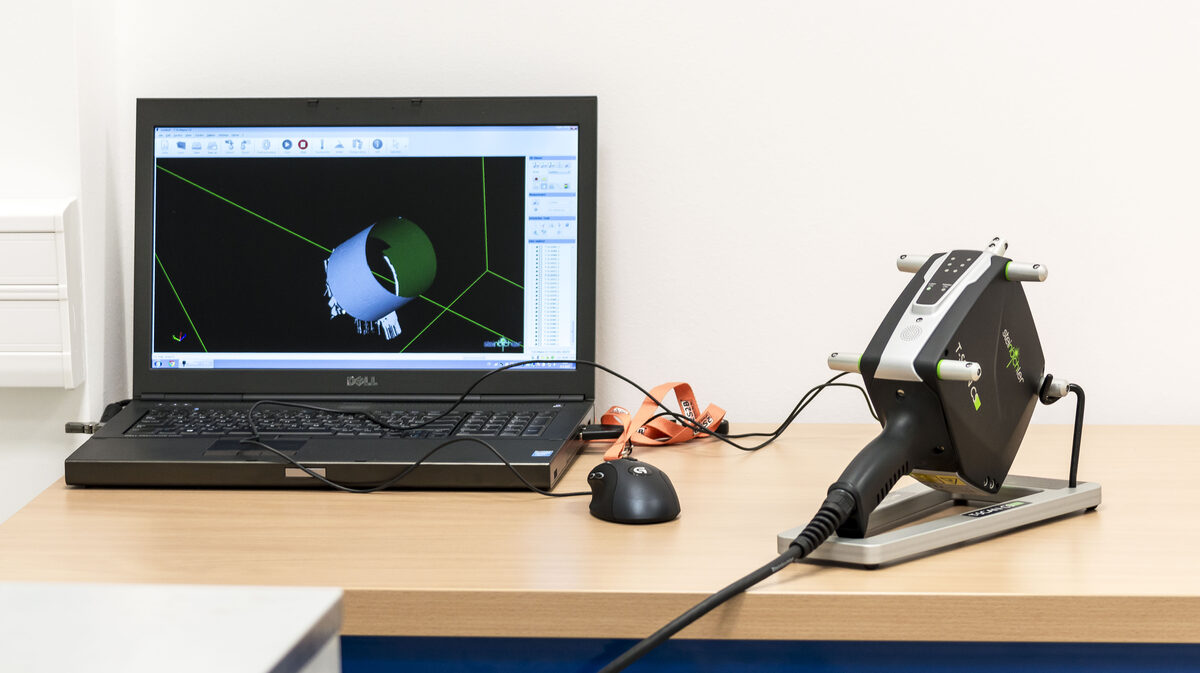
Reverse-engineering a physical part into usable CAD has always been slow, manual, and expensive — an engineer measuring calipers against a scan, rebuilding sketches by hand, guessing at design intent. Backflip AI says its second-generation CAD foundation model changes that math entirely, converting 3D scans, STL files, and raw mesh data into fully editable parametric CAD models in one to five minutes, at a claimed cost of about $10 per part instead of the roughly $1,500 a contract engineer typically charges for the same job.
The San Francisco company, led by CEO Greg Mark, announced the new model this week, positioning it as a distinct leap from the mesh-wrapping tools that dominate today's scan-to-CAD category. Most of those tools produce a static surface — a shell that looks like the part but carries none of the design logic an engineer would recognize. Backflip's pitch is that its model instead outputs a native, editable feature tree: extrudes, revolves, patterns, chamfers, and fillets, built with logical sketch constraints and external references, the same vocabulary a human designer would use inside Fusion 360 or SolidWorks.
What Changed From the Last Version
Backflip's history with this problem predates this week's release. The company launched from stealth in December 2024 with "Idea to Mesh," a tool that turned text and photo prompts into 3D-printable parts, alongside the $30 million Series A described below. By March 2025 it had pivoted to the reverse-engineering problem directly: a foundation model trained on more than 100 million synthetic 3D geometries, shipped as a SOLIDWORKS sidebar plug-in producing native, fully-featured parts with a customizable feature history, plus a web app exporting STEP files.
This release extends that scan-to-CAD line rather than replacing an unrelated product. According to Backflip and 3D Printing Industry, the change is in how the model works, not what it targets: a shift from cleaning up a captured surface to planning how the part gets built, and from one-shot conversion to an agent that iterates on its own output and checks itself before handing back a result. The company says the tool is now also live as an add-in inside Autodesk Fusion — a new integration alongside the existing SOLIDWORKS plug-in and web app — with an Onshape plugin and additional integrations coming later in 2026. Backflip's tool exports .STEP files, a neutral format readable by essentially any mechanical CAD package, so the output isn't locked to any one CAD platform even as native integrations expand.
The Technical Bet: 3D as a First-Class Primitive
In comments provided to 3D Printing Industry, Backflip founding engineer Kairo Morton framed the technical wager behind the release: "Most frontier models have limited 3D comprehension... We built ours with 3D CAD operations as a first-class primitive." That's a pointed jab at the broader wave of AI-for-CAD tools that bolt 3D reasoning onto models trained primarily on text, code, or 2D images. Backflip's argument is that a model has to be built around CAD operations from the ground up to reliably infer designer intent — recognizing that a rounded edge is a fillet operation applied after an extrude, not just a curved surface to be traced. That's also the hardest part of the reverse-engineering problem. A scan gives you point-cloud geometry with no history — no record of which surfaces came from which operation, in what order, constrained to what. Reconstructing a plausible, editable feature tree from that raw data is a much harder inference problem than surface-fitting a mesh, which is why most existing scan-to-CAD tools stop at the mesh-wrap stage rather than attempting full parametric reconstruction.
Pricing and Where It's Already Deployed
Backflip offers a free tier with four reconstructions, with paid plans — Builder, Pro, Business, and Enterprise — starting at $20 per month. The company also disclosed that the model is already running in production at an unnamed "top automotive manufacturer," which suggests the accuracy bar is clearing at least one demanding industrial user, though without an independent case study or named customer, that claim is worth treating as a vendor data point rather than a verified benchmark.
Backflip raised a $30 million Series A in December 2024, led by NEA and Andreessen Horowitz — venture-scale backing that tracks with the company's ambition to position itself as infrastructure for physical-to-digital workflows across manufacturing, not just a novelty scanning app. On the security side, Backflip says it encrypts data in transit and at rest and separates access by organization, does not train its models on customer enterprise data, and is targeting SOC 2 Type II certification later in 2026 — the kind of compliance checkbox that matters for the automotive and industrial customers it's courting, less so for a hobbyist uploading a scanned bracket on a Saturday.
What It Means for Makers
For the maker and small-shop crowd, the headline number — $1,500 down to $10 — mostly describes a market Backflip is targeting above the hobbyist level: manufacturers digitizing legacy tooling, shops reverse-engineering obsolete parts with no surviving drawings, engineers who need a clean STEP file fast rather than a mesh they'll have to rebuild from scratch anyway. But the underlying capability is directly useful further down the food chain too. Anyone who's scanned a broken bracket or a discontinued part to reprint a replacement knows the frustration of ending up with an STL that prints fine but can't be edited — no way to resize a hole, thicken a wall, or add a mounting tab without starting over in a mesh editor that fights you at every step. A tool that hands back a genuine, editable feature tree instead of a frozen shell removes exactly that bottleneck. The free tier's four-reconstruction cap is enough to kick the tires on a single project without committing, and the $20/month entry price puts the paid tier within reach of a serious hobbyist or small print shop, not just an enterprise engineering department. Whether the reconstructed feature trees hold up on genuinely complex geometry — thin-wall parts, organic surfaces, anything beyond fairly standard machined-part shapes — is the open question independent testing will need to answer. Backflip's own claims are specific and falsifiable, which is a good sign, but they're still self-reported. Makers curious to test the gap between marketing and reality can do so cheaply: the free tier costs nothing but four uploads.
