
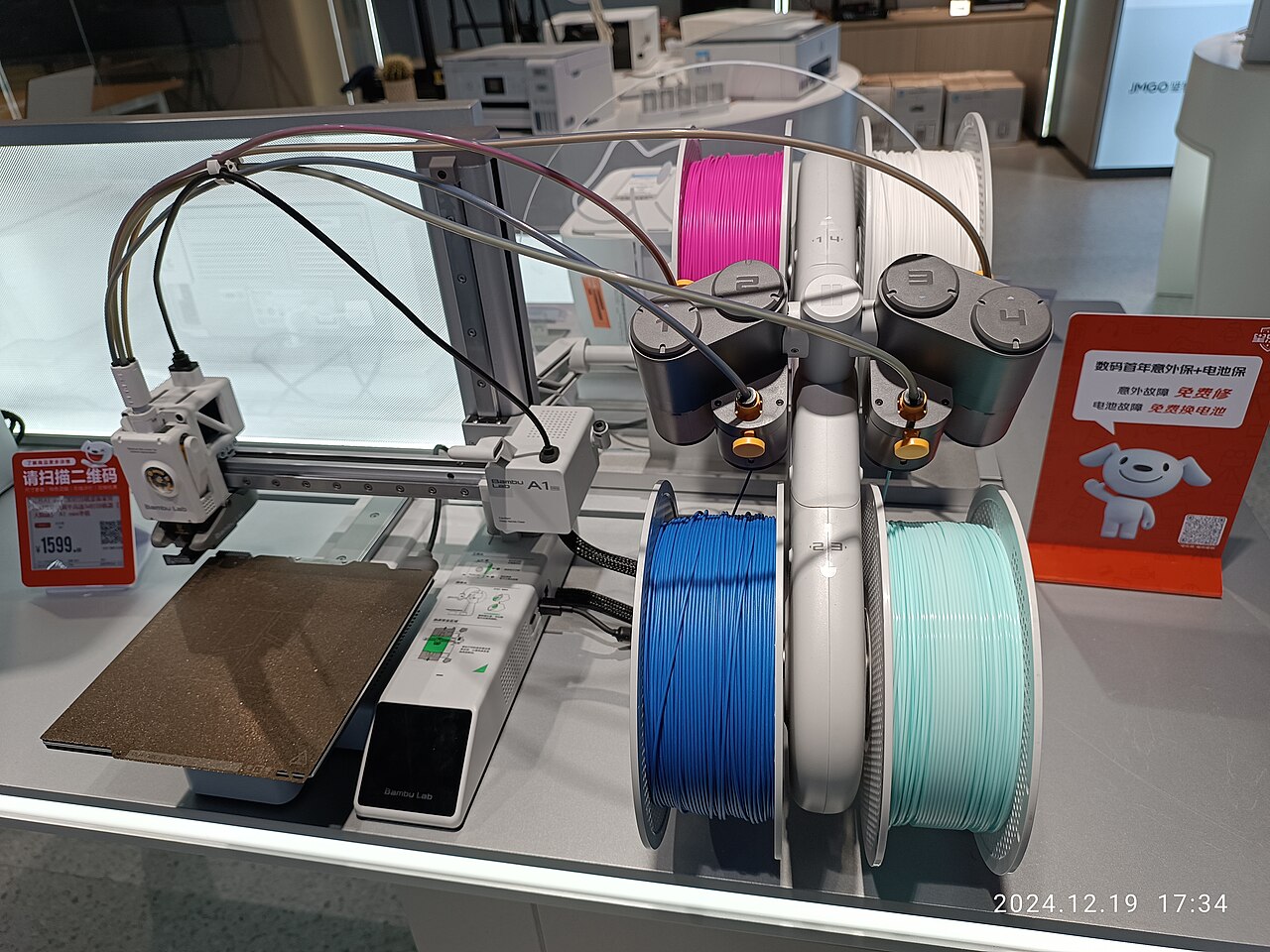
Consumer 3D printers have spent most of their history being reviewed by enthusiasts, tech editors and, occasionally, engineers. Bambu Lab now wants parents in that conversation too. In a post on its official blog dated October 12, 2026, the company announced that its P2S enclosed printer is a 2026 winner of the National Parenting Product Awards (NAPPA), and that Bambu Lab was also named a 2026 Parents' Picks Awards winner in four categories. The company titled the announcement "Our 3D Printers Just Won Two Parenting Awards," a framing that makes clear where it sees the next audience for its hardware.
Awards announcements are marketing by design, and this one is no exception. But the specific things parent evaluators singled out are worth a closer look, because they map closely onto the features that separate a printer a household can live with from one that demands a dedicated hobbyist.
Who Is Judging, and On What
According to Bambu Lab's post, NAPPA has been recognizing family products for 36 years, and its evaluators are parents, many of whom also work as educators, pediatric nurses or child development experts. That is a different panel from the reviewers who typically assess printers on dimensional accuracy, layer consistency or volumetric flow. To win, the post says, a product has to pass NAPPA's parent test: would they be comfortable using it with their own kids, would they buy it themselves, and is it well made and well designed.
The company says the separate Parents' Picks program looks at more than 50 criteria, from thinking skills and engagement to ease of use, quality and durability. The four categories Bambu Lab names are Best Products for Elementary Kids, Best Middle School and High School Products, Best Educational Products in the World (in both the elementary and the middle and high school sections), and Best Tech and Media Products.
The P2S product page on the NAPPA Awards site offers a view from the award body itself. It describes the P2S as Bambu Lab's "most affordable enclosed machine," notes its UL GREENGUARD certification, plug-and-play setup, multi-color capability and automated bed leveling, and pitches it as "the ultimate STEAM tool for home learning and making." That last phrase is the kind of language that makes experienced makers roll their eyes, but it signals clearly how the product is being positioned to a family audience.
What Parents Actually Praised
The evaluator comments collected on the NAPPA page are more revealing than the headline copy. Taken together, they read less like a spec sheet and more like a list of the friction points that tend to sink a printer in a non-hobbyist home:
- Documentation and software. Evaluators cited a clear manual and a user-friendly app. For households where nobody wants to learn slicer terminology on day one, this is the gate everything else depends on.
- Content to print. Parents pointed to an enormous print library, along with the ability to design their own prints. A ready supply of models lowers the barrier to a first successful print, while the option to load original work keeps the machine relevant once a child starts designing.
- Speed and noise. The P2S was described as fast and quiet. In a shared living space, acoustic output matters more than it does in a garage workshop.
- Size. One evaluator called it a large printer and noted it can print some pretty large items, which suggests build capacity as much as footprint.
- Enclosure. The fully enclosed print area came up specifically, which makes sense for a machine that may sit within reach of younger children.
- Multicolor. Parents highlighted multi-color output in a single print, and one evaluator said the printer holds five different filament colors.
The Feature Set Behind the Pitch
Bambu Lab's own description of the P2S fills in the hardware picture. The company lists the printer as fully enclosed and plug-and-play, with automatic bed leveling, a 5-inch touchscreen, AI-powered error detection and a built-in camera that can be viewed through the Bambu Handy mobile app. For a parent, the camera and error detection are arguably the most relevant items on that list: they allow a print to be checked remotely and give the machine a chance to flag common print problems rather than leaving it to run unattended.
The air-quality claim deserves a careful reading. Bambu Lab says the P2S is UL GREENGUARD certified for indoor air quality when printing with select Bambu Lab filaments, such as PLA Basic and PLA Pure. That is a narrower statement than "safe to run indoors with anything." The certification, as Bambu Lab describes it, is tied to specific materials, and makers who switch to other filaments or other brands should not assume the same result carries over.
The P2S Combo adds the AMS 2 Pro, Bambu Lab's automatic material system, and retails for $799 in the US through bambulab.com. The company says the Combo is what lets you print in multiple colors, which is the capability the parent evaluators praised.
Critical Reception Beyond the Parenting Circuit
Bambu Lab is also leaning on more conventional validation. Its post notes that the P2S received Editor's Choice awards from CNET, PCMag and Tom's Hardware. On the younger end of the market, the company points out that The Strategist named its A1 the best 3D printer for kids. Taken together, the company is presenting a lineup that it says satisfies both tech reviewers and parent panels.
What It Means for Makers
For readers of this site, the awards themselves are less important than what they say about the direction of the category. The features that earned parental praise here are not exotic: an enclosure, a camera, automatic leveling, a usable app, a large model library and multi-material handling. Bambu Lab is presenting that combination as a household product judged by parents, many of them educators and nurses, rather than by people who tune retraction settings for fun.
That shift carries some practical implications. If you are the person in your family or circle who gets asked which printer to buy for a child or a home learning setup, the P2S Combo at $799 is now being sold with an explicit family pitch and a set of third-party awards to back it. The enclosure and remote monitoring address real concerns about unsupervised printing near kids, and the GREENGUARD certification gives a concrete, if limited, air-quality reference point.
The caveats are equally practical. The certification covers select Bambu Lab filaments, not the full range of materials a curious teenager might eventually want to try. "Plug-and-play" describes the setup experience, not the ongoing maintenance any FDM printer will eventually need. And awards built on parent evaluations measure approachability and day-to-day experience, which is valuable but different from the print-quality testing experienced makers usually rely on. The Editor's Choice nods from CNET, PCMag and Tom's Hardware are the more relevant data points for that question.
The broader takeaway is that the family market is now an explicit target for at least one major printer maker. If that pitch lands, makers may see more hardware designed and marketed around enclosures, monitoring, certified materials and guided software, with the spec sheet sharing space with the parenting badge.
