
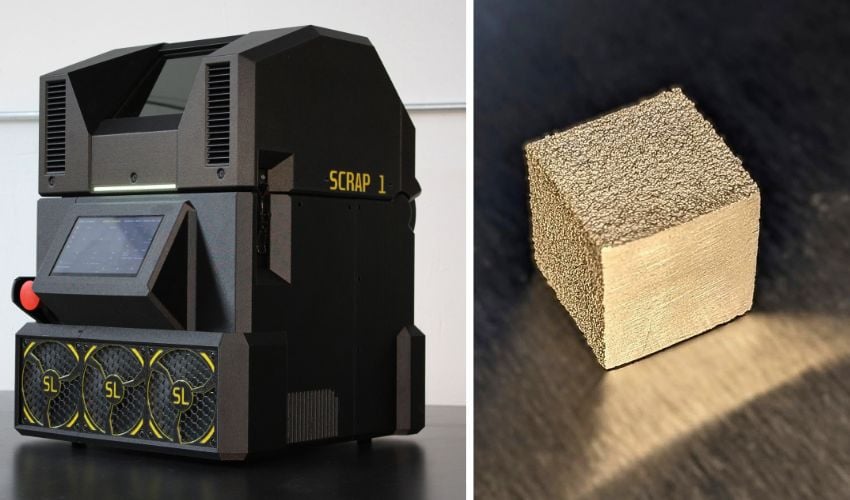
A Boulder, Colorado startup called Scrap Labs wants to put laser powder bed fusion, the process behind most industrial metal 3D printing, on a desk. Its first machine, the Scrap 1, is described as a desktop LPBF printer built almost entirely from FDM-printed parts. It prints metal directly, with no binders and no sintering step. The company's roadmap targets a production launch in June 2027, shipping first to the United States. What it will cost depends on which published figure you read, and the two don't agree.
Founder Matt Woods, formerly of SpaceX and Xact Metal, went through the project in an October 8 interview with 3Dnatives. Taken with the company's own site, that interview is enough to describe what Scrap Labs is building, where it says it stands, and what is still unsettled.
The Machine, as Described
According to 3Dnatives, the Scrap 1 is built around a fiber-coupled solid-state laser delivered by a high-speed precision gantry. The target specifications are a 200 W laser and a 100 mm build volume, with 316L stainless steel as the launch material. On its homepage, Scrap Labs shows 316L parts with a claimed density of over 99 percent, and the site notes that all specifications are targets and may change.
Every one of these numbers is a target. The machine has not shipped, and none of the figures above come from independent testing. Scrap Labs says it finished a proof of concept in December 2025, so the gap between a working prototype and a production machine is still ahead of it. Treat the spec sheet as a statement of intent.
The interesting choice is the gantry. In the interview, Woods says the design takes advantage of the motion-control gains made possible by open-source firmware such as Klipper, the firmware many hobby FDM printers already run. He presents that, together with the laser and gantry, as what makes the platform efficient enough to sit on a desk or workbench. Whether that approach holds up over long metal builds is not something the published material shows.
The same thinking explains the structure. Woods says FDM is now the core production method for essentially all of the machine's mechanical parts. He argues that this gives design freedom, including internal geometries, consolidated assemblies and intricate cooling designs, and that it is hard to match with sheet metal enclosures, injection molding, casting or CNC machining. He also says it simplifies assembly: even a compact machine like Xact Metal's XM200 has thousands of parts, from fasteners and seals to clamps and fixtures. It is an unusual approach for a machine whose job is to melt steel powder, and Woods himself calls the result an inverted materials stack: a machine built from polymers that is designed to melt metal.
Two Prices, Two Sources
The cost is where the published information diverges. The Scrap Labs homepage advertises initial "Founder" kits starting at $9,600. In the 3Dnatives interview published October 8, prices start at $14,200 for a DIY kit and $17,990 fully assembled.
FilamentFeed has not been able to reconcile these figures from the published sources. They could refer to different tiers, different points in time, or different kit contents, but neither source explains the difference. Anyone weighing a purchase or a deposit should get a current quote directly from the company and confirm exactly what it covers.
Even the higher of the two numbers is a large drop from what metal printing usually costs. Woods gave a reference point from his own career: at Xact Metal, he said, the best the company could do at the time was a metal printer at roughly $100,000, which he described as an order of magnitude cheaper than an EOS or comparable system. He says Scrap Labs is applying the same engineering rigor to cut the price by another order of magnitude. Even at the higher published price, the Scrap 1 would sit well below that roughly $100,000 point, if it reaches production anywhere near its advertised prices.
Woods credits several factors for the lower cost: using additive manufacturing to build the machine, the evolution of laser technology, and a lean team that he says is entirely self-funded and crowdfunded.
Where the Project Stands
Scrap Labs publishes a four-phase roadmap on its homepage:
- Phase 01, December 2025: proof of concept, marked complete.
- Phase 02, June 2026: alpha testers onboarded, marked as the active phase.
- Phase 03, December 2026: beta, planned.
- Phase 04, June 2027: production launch, initially shipping to the US.
By the company's own account, it is in alpha. A beta phase and about eight more months separate it from production. Hardware schedules slip routinely, and metal additive manufacturing is less forgiving than most hardware. The roadmap is best read as the company's plan, not a delivery date.
The commercial model is also worth noting. Scrap Labs says machines, materials, consumables, supporting equipment and accessories will be available directly through its website, with no vendor lock-in. The homepage also invites visitors to reserve a spot with a fully refundable deposit or join a free waitlist, and showed a live reservation count of 124 priority and founder depositors when we checked. A company promise of no lock-in is only worth what it delivers once machines are shipping.
What It Means for Makers
Scrap Labs says its goal is to make metal printing a capability rather than a luxury, so builders and makers can prototype and iterate on metal parts without six-figure systems. It is proposing a direct-metal LPBF machine at kit prices, built from FDM-printed parts of the kind many makers already know how to produce.
Several caveats come with that:
- It isn't shipping. Production is targeted for June 2027 and the company says it is in alpha now. Nothing in either source shows production hardware or independently verified results.
- The price is unclear. The homepage says $9,600 for Founder kits. 3Dnatives reports $14,200 for a DIY kit and $17,990 assembled. Ask the company before budgeting around either.
- The specs are goals. The 200 W laser, 100 mm build volume and 99-plus percent density on 316L are targets, not measured performance from a shipping machine.
- It is US-first. Initial production shipments are aimed at the United States, so makers elsewhere will be waiting longer.
Some questions go beyond what the published material covers: how a mostly polymer frame handles the conditions inside an LPBF machine over long builds, how powder handling and the process environment are managed on a desk, and what finished parts look like next to industrial output. Woods says the ventilation system has the lowest leak rate he has seen in a metal printer, but that is the founder's own assessment. Answering the rest will take alpha and beta results from users outside the company, and those haven't been published.
Bottom Line
Scrap Labs pairs a fiber-coupled laser on a precision gantry with Klipper-style motion control and a machine built from FDM-printed parts. The result, if it works, is a desktop metal printer priced in five figures instead of six. The founder's background in industrial metal AM, including SpaceX and Xact Metal, makes the pitch credible enough to follow. The conflicting prices and an unshipped product with target-only specs mean it should be watched, not pre-ordered, for now. The beta phase planned for December 2026 is the next milestone to check.
