
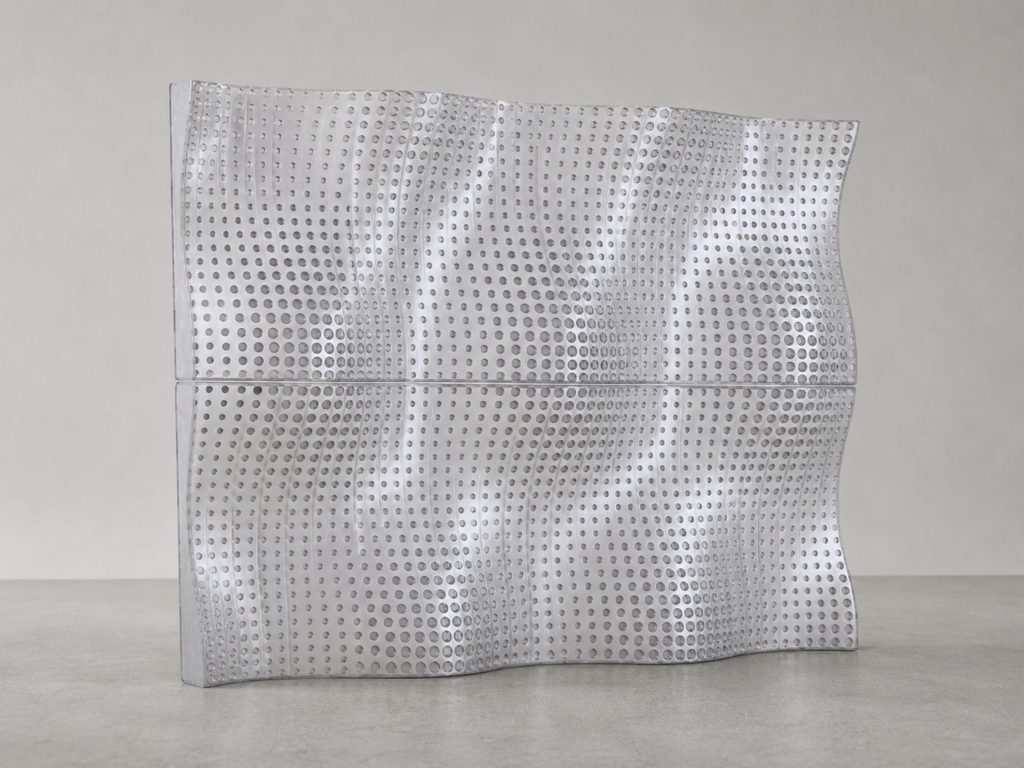
Large-format FDM has spent years looking for work that is more than oversized prototypes. Italian manufacturer Kentstrapper now has a concrete example: in its own post on the REVERSING research project, dated September 23, the company describes an interior acoustic panel printed on its Mille, a 1,000 x 1,000 x 1,000 mm machine. In standardized testing the panel reached a weighted sound absorption coefficient (alpha-w) of 0.90, which falls in Class A under ISO 11654, the top absorption class.
The result was reported by 3D Printing Industry on September 30, and the research is published in AM Perspectives and in the journal TECHNE. The maker's post therefore predates the trade-press coverage by a week.
What Was Actually Printed
The panel is not a flat tile. Its profile is sinusoidal, and it carries perforations of varying diameter. The University of Florence team designed it parametrically in Rhinoceros and Grasshopper, the usual pairing when geometry is meant to be tuned rather than drawn by hand. The title of the AM Perspectives paper, "Designing Sound with Geometry: A Hybrid 3D-Printed Acoustic Panel", states the premise: the shape does the acoustic work.
The word "hybrid" matters. The comparisons in Kentstrapper's post are made against mineral wool alone, which indicates the printed element works together with a conventional absorbent layer instead of replacing it. The printed part contributes the geometry, meaning the profile and the perforation pattern, while the mineral wool behind it does what porous absorbers do.
Print Parameters
The Mille has a one-cubic-meter build volume. Kentstrapper lists the following:
- Material: PETG
- Nozzle: 0.8 mm
- Deposition rate: low
- Split: eight sub-components, each 860 x 344 mm
- Per component: roughly 2.5 kg of material and 56 hours of print time
Those numbers invite some arithmetic. Eight components at 56 hours each is 448 hours of machine time, and at about 2.5 kg apiece the assembled panel comes to roughly 20 kg. That is our multiplication, not a figure from the maker. It does put the researchers' own caveat into perspective: 56 hours for a single 860 x 344 mm piece, printed on a large machine with a big nozzle, is slow by any production standard.
The Test Results
Testing took place in the reverberation chamber at Z-Lab, following ISO 354, the standard method for measuring sound absorption in a reverberation room. Kentstrapper reports the following:
- Weighted absorption coefficient alpha-w of 0.90, Class A under ISO 11654
- Reverberation time reduced by 41% at 500 Hz versus mineral wool alone
- Reverberation time reduced by 45% at 1,000 Hz versus mineral wool alone
- Speech Transmission Index (STI) improved from 0.47 to 0.52
3D Printing Industry frames the target as school and office retrofits, where intelligibility and reverberation are the common complaints. An STI move from 0.47 to 0.52 is a modest numerical shift, and the sources do not say how it maps to the rating bands in any particular room, so we will not claim more than the figures themselves.
The Project Behind It
REVERSING is a facade-retrofit research effort led by the University of Florence's DIDA department, with Prof. Rosa Romano as scientific director, according to 3D Printing Industry. The acoustic panel is one of its interior-side outputs. Kentstrapper names its fellow partners as Polistamp, Santelli Vetri and Z-Lab, and says funding comes from Regione Toscana under the PR FESR 2021-2027 program.
The trade-press piece adds useful context about where this sits. Kentstrapper printers are typically used for jigs and production equipment, so an architectural acoustic component is a departure from their usual customer base. The article also points to other additive-manufacturing work in building interiors and envelopes, naming Printerior's Circdal panels and WASP's Pacha Ibiza facades. The comparison places the Florence panel in a small but growing group of printed building elements, though the sources do not claim it outperforms any of them.
What It Means for Makers
The honest reading is narrower than a headline about "printed buildings" might suggest. The researchers themselves say the print time and material figures suit a prototype, not mass production. Nothing in the source material reports a cost per panel, a path to faster deposition, or a production run. What it does show is a data point: a PETG shell from an FDM printer, backed by mineral wool, with geometry generated in Grasshopper, can be tested to an international standard and land in the top absorption class.
For makers, three takeaways follow.
- Geometry is the lever. The panel's performance is credited to its sinusoidal profile and variable perforations, not to an exotic material, though the mineral wool backing does its share. PETG is a filament most shops already stock.
- Big nozzle, slow rate is a legitimate trade. A 0.8 mm nozzle at a low deposition rate is not a speed play. Here it comes with a low deposition rate that kept the corrugated surface stable, at the cost of days of machine time per panel.
- Standard testing is what makes it credible. Results from ISO 354 testing in a reverberation chamber give a credible, standardized basis for the claim. Anyone replicating the idea should not assume the same numbers without measurement.
The practical limit is plain. Replicating the exact panel needs the original Grasshopper definition, which the sources do not say is public, and a printer able to run for days on end. Still, the principle, tuned perforations over an absorbent backing, is within reach of anyone with a capable large-format machine and acoustic measurement access.
Whether the Mille or similar machines ever move from prototype to product in this niche will depend on print speed and cost, neither of which the published material quantifies. For now the project is a credible proof of concept from a manufacturer better known for shop-floor tooling.
