
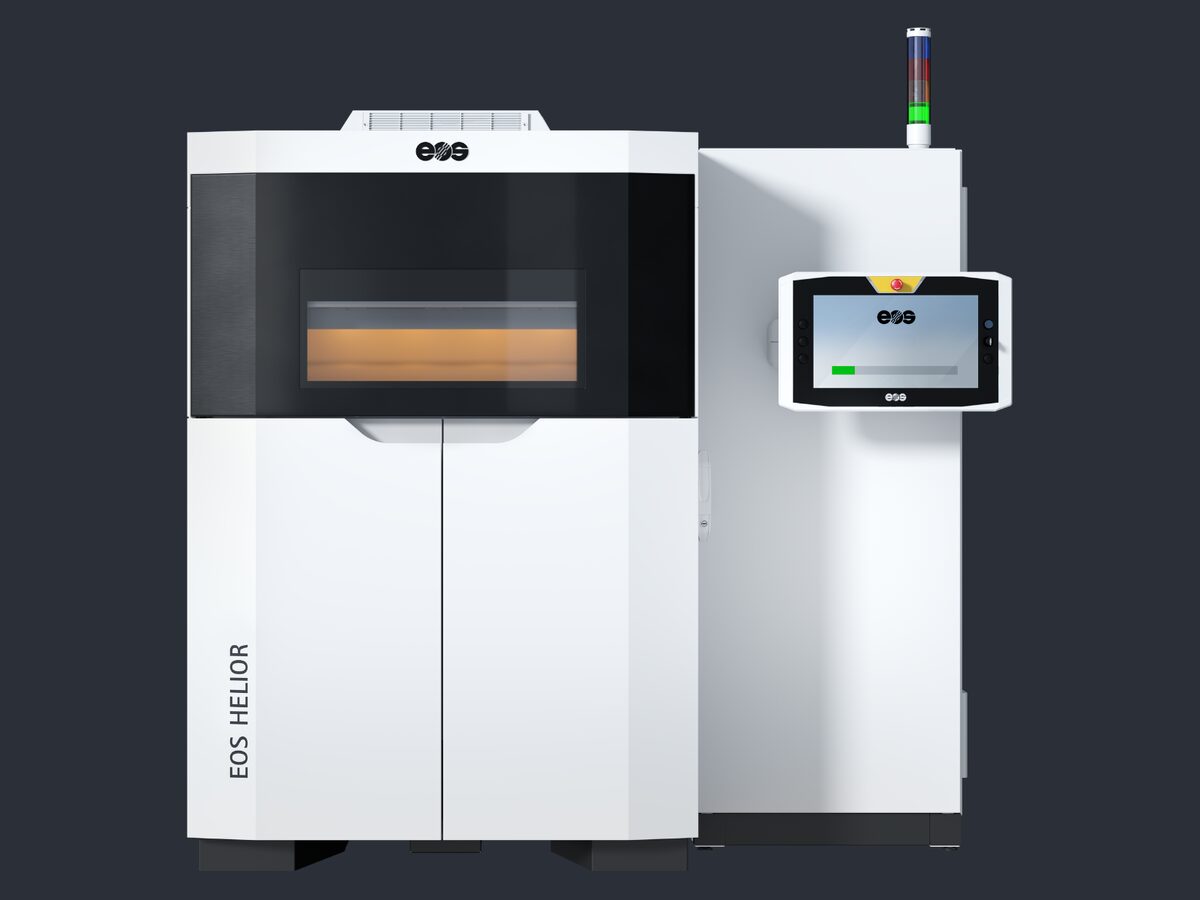
EOS opened Formnext 2026 on November 17 by unveiling HELIOR, a large-format polymer powder-bed fusion system that the company has built around one number: a full build chamber, packed at 10% density, finished inside 24 hours. The machine pairs a 700 x 380 x 580 mm build volume with three CO2 lasers, a recoater whose roller rotation and travel speed are controlled independently, and exposure parameters that adapt to part geometry. EOS claims up to 80% more part volume in 24 hours, a figure its own engineers describe as a maximum, and it says commercial availability begins in December 2026.
This is the shipping product, not another preview. EOS has published case studies from customers who tested what it called a next-generation polymer platform. HELIOR is that platform with a name, a spec sheet and a delivery date.
A P 770 Footprint With New Internals
According to 3D Printing Industry, HELIOR keeps the build volume and exchangeable build-frame architecture of the EOS P 770, so shops that already plan around P 770 build frames and part envelopes will find little to relearn on the logistics side.
Nearly everything that decides throughput has changed, though. The optics, electrical cabinet and controls are new, and existing P 770 machines cannot be retrofitted to HELIOR spec. Bureaus with a P 770 fleet are looking at new capital equipment, not an upgrade kit.
The headline change is the laser count. The P 770 used two 70 W lasers; HELIOR uses three. EOS's own product page lists them as 3 x 70 W, and VoxelMatters also reports 70 W, while 3D Printing Industry's launch report gives 80 W per laser. We are using the manufacturer's figure here, but buyers should confirm it in a formal quote. Each laser has its own F-theta lens and high-speed scanner, and EOS rates scan speed at up to 12 m/s.
How the Third Laser Earns Its Keep
Adding a laser does little if it sits idle while the others work through a crowded region of the bed. EOS describes HELIOR's arrangement as "3x laser utilization with dynamic load balancing." In 3D Printing Industry's description, two lasers cover the left and right regions of the build area and the third adds capacity in the centre. The boundaries between scan fields are not fixed: software adjusts the workloads layer by layer, avoiding unnecessary overlap regions and shifting boundaries where several lasers must process larger components. Rudiger Herfrid, EOS Senior Product Manager, told VoxelMatters that more lasers only help when load balancing keeps all of them busy.
That matters for the kind of jobs a contract manufacturer actually runs. A packed SLS build is rarely uniform: one layer might cut through a dense cluster of housings on one side and a few thin brackets on the other. With fixed field boundaries, one laser could finish early and wait. Shifting the boundaries between layers also keeps fixed overlap regions from running vertically through a part, which 3D Printing Industry says is intended to improve mechanical consistency.
The other changes target process control. HELIOR's recoater controls roller rotation and recoating speed independently, which EOS says produces a softer powder cake and gives process engineers another variable for tuning powder spreading. EOS also lists monitoring for early scrap detection. VoxelMatters reports that the system uses infrared cameras to watch the powder bed, and that it lets operators deactivate a failed part and carry on with the rest of the job.
Geometry-Aware Exposure and the Depowdering Claim
The quieter innovation may prove the most useful on the shop floor. Speaking to VoxelMatters, EOS describes a geometry-aware exposure parameter set that analyses each part and tailors energy input, so less powder sticks to the part and it is easier to depowder.
EOS puts the reduction in post-processing effort at up to 80%. 3D Printing Industry notes that Herfrid clarified this figure specifically concerns depowdering, and that it is a maximum for suitable geometries. Parts with internal channels and slots can benefit substantially, while solid geometries may see little improvement. It should not be read as an 80% saving across the whole post-processing chain, and it is separate from the 80% throughput claim, even though the two numbers match.
Designed Around the Bureau Week
The throughput target was set with a particular customer in mind. Herfrid told VoxelMatters that the goal is a full chamber at 10% packing density within 24 hours, because 10% is the average packing density of contract manufacturers. The operating model he describes is concrete: six consecutive jobs without cleaning, running six days a week, with one day set aside for cleaning and maintenance.
That is the source of the "up to 80% more part volume in 24h" claim. It is measured at 10% packing density, so shops that pack more tightly or more loosely should expect different results. 3D Printing Industry adds that Herfrid described roughly 60% more build volume processed in a 24-hour window than on the P 770 under these conditions, and that the 80% figure is a maximum rather than a representative average. It also reports that full builds may need about three days of external cooling, which exchangeable build frames let a shop work around by starting the next job while the previous one cools.
EOS backs the claim with customer figures on its product page: FKM reports a 67% productivity gain, Materialise 44%, Shapeways 40% on drone production, and Formrise 35%. These are vendor-selected case studies. Results depend heavily on the part mix, and none of these four reports the full 80%.
The Spec Sheet
- Build volume: 700 x 380 x 580 mm
- Lasers: 3 x CO2, 70 W each (per EOS), each with its own F-theta lens and high-speed scanner
- Scan speed: up to 12 m/s
- Power: 17.5 kW maximum, 4.0 kW typical
- Machine dimensions: 2300 x 1415 x 2200 mm, approx. 2070 kg
- Materials listed on EOS's page: PA 2200 and PA 2220 HighReuse
- Availability: from December 2026
The material list on EOS's product page is short: two polyamide 12 powders. Shops that rely on other polymers will need to watch how quickly EOS qualifies more.
What It Means for Makers
Few readers of this site will put a two-tonne SLS system in the garage. Many of you buy from the companies that will, though. HELIOR is aimed at the service bureaus and contract manufacturers that turn uploaded STLs into nylon parts, and its pitch is largely about cost per part. More volume per day, fewer cleaning cycles and less depowdering labour could all improve a bureau's margins, and in a competitive market some of that saving may reach quote prices and lead times.
Large parts benefit too. A 580 mm build height combined with three lasers should make tall single-piece parts easier to fit into a production schedule. EOS's Shapeways case study, which centres on drone production, points to one application already in testing.
Caution is still warranted. The headline numbers are best-case figures tied to a specific packing density and suitable geometries, the laser wattage has been reported inconsistently, and P 770 owners cannot upgrade in place. Independent production data, which may arrive during 2027, will show whether HELIOR's gains hold beyond EOS's chosen customers.
