
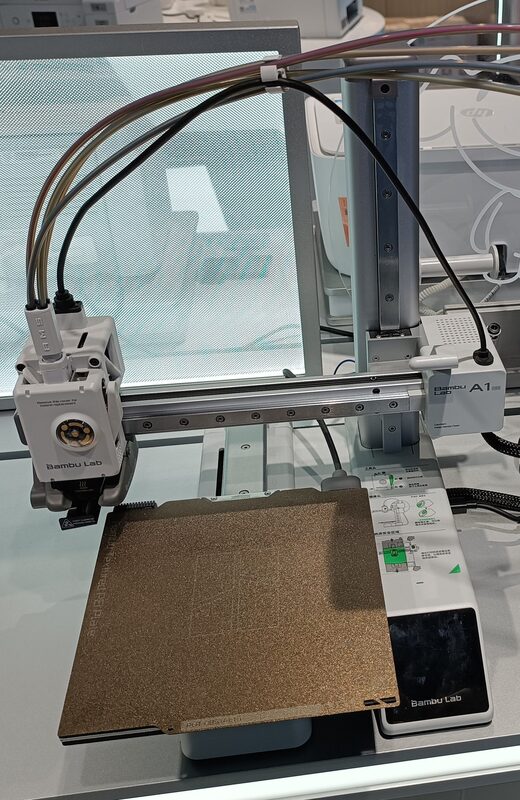
A set of Chinese patent filings surfaced this week that sketch out what could be Bambu Lab's next move in multi-material printing: a mechanism that swaps entire printheads mid-print from a storage rack, rather than swapping nozzles, hotends, or filament alone. According to reporting from 3D Printing Industry, the filings — submitted June 30, 2026 — cover three related systems: an automatic printhead-exchange mechanism, a nozzle-integrated lighting design for camera-based extrusion monitoring, and a dual-guide alignment system to keep swapped heads seated precisely. Two of the three filings share the same four inventors; the lighting filing lists two different inventors. Taken together, they read less like isolated tweaks and more like a coordinated hardware roadmap.
What the Filings Describe
The centerpiece is the printhead-exchange system. Rather than a single hotend that gets serviced or a toolhead that gets unlatched by hand, the patent describes a storage rack holding multiple complete, replaceable printheads. The filing specifies a combined unlock-and-deposit motion — the machine releases the active head and seats it in the rack in one continuous action, rather than as two separate steps. The stated goal, per the filing as described in the report, is cutting both exchange time and the flushing waste that comes with purging a nozzle between materials or colors.
That waste-and-time problem is a familiar one to anyone running multi-color or multi-material jobs today: single-nozzle systems that share one hotend across materials have to purge the old material out before printing with the new one, which burns filament and adds minutes to every color change. A system built around swapping whole printheads — rather than pushing new filament through the same melt zone — sidesteps that purge cycle entirely for at least some material transitions, at the cost of needing multiple pre-loaded heads on hand.
The second filing addresses a different problem: knowing when something has gone wrong during a print. It describes embedding illumination directly into the printhead's cooling-air ducts, using matte black and white interior surfaces to control light spill and reduce overexposure, positioned to light the nozzle tip and extrusion zone for a camera. The idea is to give an onboard or connected camera system consistent, purpose-built lighting for spotting extrusion abnormalities — under-extrusion, clogs, stringing, or other defects — as they happen, rather than relying on ambient chamber lighting or a separately mounted light source.
The third filing is mechanical rather than optical: a stabilization design using two sets of guides positioned at different heights around the printhead, along with angled magnetic interfaces meant to limit unwanted forces and align the head precisely as it's stored and retrieved from the rack. This is the piece that makes the other two work as a system rather than a novelty — a printhead-swapping mechanism is only useful if the swapped head lands in exactly the same position every time, since even small offsets translate into layer shifts or Z-height errors on the printed part.
How This Fits Bambu Lab's Existing Lineup
3D Printing Industry's report ties the filings directly to hardware Bambu Lab already ships. The H2D has a dual-nozzle architecture intended to reduce purging during material changes, alongside a macro-lens nozzle camera designed to identify material build-up, clumping, air printing, and other extrusion failures — but a two-nozzle setup only scales to two materials at a time. Vortek, the company's automatic hotend-changing system launched in 2025, already swaps the hotend assembly automatically to cut down on purge waste and nozzle contamination — but it operates on a smaller scale than a full printhead, exchanging the hotend rather than the complete head assembly as a unit. Per the report, Bambu Lab evaluated exchanging the gantry, the complete toolhead, the hotend assembly, or just the nozzle before settling on the hotend assembly for Vortek.
A rack-based system that swaps complete printheads would sit a level above both: instead of two fixed nozzles or a single hotend cycling through configurations, a printer could, in principle, draw from a bank of pre-configured heads — different nozzle diameters, different materials already loaded, or different extrusion hardware entirely — and swap among them automatically over the course of a single print. That's a meaningfully larger jump in multi-material flexibility than either existing system offers on its own.
What It Means for Makers
It's worth being clear about what these filings are and aren't. A patent application describes an engineering concept a company wants to protect — it is not a product announcement, and there's no confirmed release timeline, model name, or pricing attached to any of this. Companies file patents on ideas that sometimes ship years later, get folded into unrelated products, or never leave the lab. 3D Printing Industry's report does not include any comment from Bambu Lab on these filings, and none could be found elsewhere as of this writing. That said, the filings are a real signal about direction. Bambu Lab has spent the last two product cycles building toward faster, lower-waste multi-material printing — first with the H2D's dual nozzles, then with Vortek's automatic hotend changes. A patented mechanism for swapping full printheads from a rack, combined with nozzle-integrated monitoring hardware to catch extrusion failures in real time, would be a logical next rung on that same ladder rather than a departure from it. For makers currently weighing multi-material options, the practical takeaway is patience rather than action: nothing here is buyable, but it suggests Bambu Lab's next moves in this space are aimed at reducing the two biggest pain points of multi-material printing today — purge waste and failed prints going undetected until they're pulled off the plate.
One caveat on the sourcing itself: 3D Printing Industry's report cites specific Chinese patent numbers for these filings — CN 122560409 A for the nozzle-lighting system, CN 122560413 A for the printhead-exchange system, and CN 122560412 A for the stabilization design — but those numbers could not be independently confirmed against Google Patents or Espacenet during this research pass. The substance of what the filings describe — the three-system breakdown, the June 30, 2026 filing date, and the inventor rosters — comes directly from that outlet's reporting. Readers who want to verify the underlying documents themselves should treat the specific patent numbers as unconfirmed until they can be checked against a patent database directly.
