
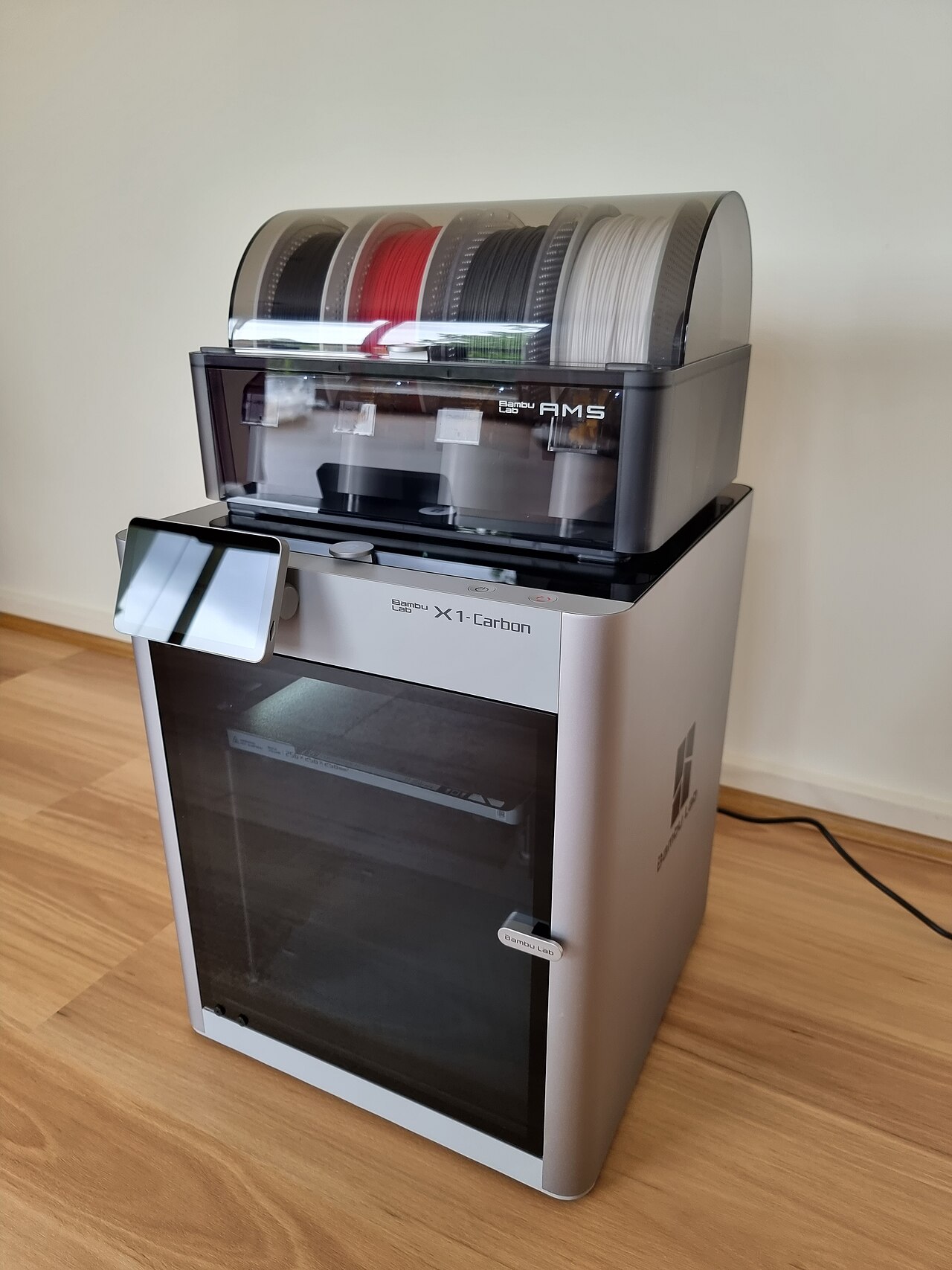
The spec sheet is one thing; the price is another. Bambu Lab's X2D, the declared successor to the company's category-defining X1 Carbon, is now live on the company's store, and the number that anchors the listing is what makes it worth a careful look: Bambu is pricing the base configuration at a strikingly low $649. That figure, more than any single spec, is the clearest signal yet that Bambu intends to push flagship-class hardware down into the price band where most serious makers actually shop. On its own FAQ, Bambu frames the machine plainly, calling the X2D "X1C's next chapter."
What Actually Changed
On paper, the X2D is a meaningful revision of the X1 Carbon rather than a cosmetic refresh. The headline addition is a dual-nozzle system, pairing a primary nozzle with an auxiliary one. Bambu's argument for the second nozzle is twofold. First, it speeds up multicolor printing, because the dual nozzles swap in a split second and cut the purge cycles — and the flush-and-purge waste — that have always dogged single-nozzle color changes on AMS-equipped machines. Second, it makes support removal easier: one nozzle can be reserved for a dedicated support material, laying down a clean support interface without the constant tool changes and priming a single hotend would demand. For anyone who has pried supports off a functional part or watched a purge chute fill with wasted filament, both improvements land squarely on real pain points.
The chamber is the other substantive change. The dual-nozzle print volume is 256 x 256 x 260 mm, and where the X1 Carbon relied on a passively enclosed, heat-retaining chamber, the X2D adds active chamber heating up to 65C. Paired with a 300C nozzle, that is hot enough for the majority of engineering filaments — ABS, ASA, and nylon among them — where warping and layer adhesion are governed as much by ambient temperature as by nozzle heat. Bambu says the actively heated chamber distributes heat evenly, so large engineering prints come out strong and flat rather than curling off the plate. That is the kind of capability that separates hobby machines from ones you can reasonably ask to print engineering polymers.
The Spec Sheet Beneath the Headlines
Bambu has loaded the X2D with the sort of instrumentation that has become the company's signature. The official product page lists 31 sensors spanning the entire system — monitoring the feeding path and the printing process — alongside a toolhead camera and an AI Liveview camera dedicated to print monitoring. Positioned close to the action, they watch for spaghetti, nozzle clumping, and purge-chute jams in real time rather than from a distant corner of the enclosure, pausing a job before it wastes hours of time and filament. Three-stage filtration is built in — a G3 pre-filter, an H12 HEPA filter, and a granulated coconut-shell activated-carbon layer — a nod both to the health considerations of printing in a home or shared space and to the reality that a hotter chamber running engineering materials produces more to filter out.
For makers chasing dimensional accuracy, Bambu also offers an optional Vision Encoder, which the product page lists as required for its Motion Accuracy Enhancement. That is an add-on rather than a baseline promise, and the distinction is worth reading carefully: the base machine is a capable multicolor workhorse, while the motion-accuracy calibration applies to a configured, upgraded unit.
The Price Is the Story
Pricing is where the X2D stops being an incremental update and starts looking like a strategic move. The base machine is $649. The Combo, bundled with an AMS for multi-material and multicolor work — the pairing that lets the dual-nozzle system reach up to 25 colors — runs $899. Independent coverage from OC3D headlined the launch bluntly, calling the X2D "aggressively priced."
That framing matters because the X1 Carbon spent its life as a premium object — the printer you bought when you had decided that reliability and features were worth a flagship price. Slotting a successor in at $649, while adding a second nozzle and active chamber heating rather than cutting features to hit the number, is an unusual combination. It suggests Bambu is willing to compress its own margins, or has driven enough cost out of manufacturing, to defend the mid-range against a crowded field of competitors.
What Still Needs Testing
Specs and pricing can be recited from a product page; consistency under real workloads cannot. Bambu points to life-cycle testing — it says the dual-nozzle system completed over 1,000,000 switch cycles while maintaining smooth, consistent performance — but a spec sheet is not the same as sustained results on a maker's bench. Real-world print quality across materials, the actual time savings from the dual-nozzle color workflow, and how the 65C chamber behaves over long engineering-polymer prints are the questions that will define the X2D's reputation, and those are precisely the things that a longer testing cycle answers. What the listing confirms today is that the hardware is real and shipping.
It is worth being clear about what a product page does and does not settle. A datasheet can promise cleaner color transitions and stronger engineering prints; only sustained use across a range of materials proves them out. That gap is the whole reason independent testing exists, and it is why the pricing is the safest thing to take to the bank right now.
Bottom Line for Makers
If you have been running an X1 Carbon and wondering whether an upgrade is justified, the X2D's case rests on two features: the second nozzle and the actively heated chamber. If your work is single-color PLA and PETG, neither will change your life, and your existing machine remains perfectly good. If you routinely fight support removal, burn filament on multicolor purges, or want to print engineering materials like ABS, ASA, and nylon without a warping lottery, the X2D targets exactly those frustrations — and at $649 base or $899 with the AMS, it does so without the flagship tax that defined its predecessor.
The smarter move for most buyers is to wait for the longer-form, independent testing that a launch like this invites. The value proposition is unusually strong on paper, but the X-series reputation was built on consistency under real workloads, not spec sheets. The good news is that the machine is real and shipping now, which means the answers are coming. For a $649 printer that adds capability instead of subtracting it, that is a wait worth making.
