
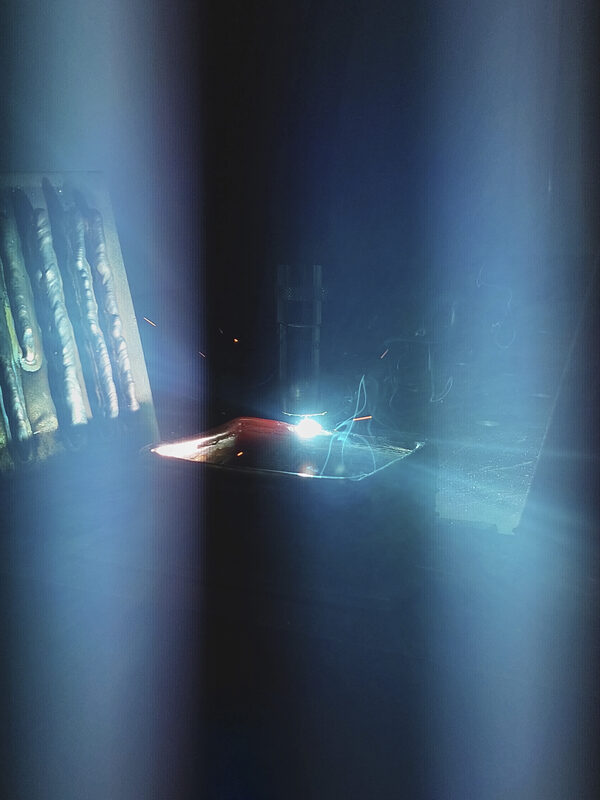
DAIHEN Corporation, the century-old Japanese heavy-electrical and welding-equipment manufacturer, has officially entered the metal additive manufacturing market with the ArcBuilder 3D, a wire-arc directed energy deposition (WAAM) system unveiled around the Robot Technology Japan 2026 show. It's the company's first additive manufacturing product since it was founded in 1919 — a notable debut from a firm better known for industrial welding power sources and transformers than for 3D printing.
The ArcBuilder 3D is priced between $450,000 and $500,000, positioning it firmly in industrial and production-shop territory rather than the prosumer or job-shop market most metal-printing newcomers chase. DAIHEN built both the power source and the robot arm in-house — an integrated approach the company credits with producing smoother surfaces and less pronounced layer lines than typical WAAM output, rather than the more common industry practice of pairing a third-party arc power source with an off-the-shelf robot.
What Makes the Process Different
WAAM systems build metal parts by depositing weld beads layer by layer, using an electric arc to melt wire feedstock — essentially robotic welding used as an additive process instead of a joining one. It's fast and cheap on raw material compared to powder-bed metal printing, but it has historically struggled with two things: spatter (molten metal droplets ejected from the weld pool that contaminate the build and waste material) and rough, wavy surface finish that often demands heavy post-machining.
DAIHEN's answer is a proprietary technique it calls AC Synchro-Feed, which synchronizes high-speed forward-and-backward feeding of the welding wire with the alternating welding current itself. Rather than feeding wire at a constant rate into a continuous arc, the process times the wire's push-pull motion to the current cycle, which DAIHEN says reduces spatter by more than 98% compared with conventional arc welding while also improving build efficiency by 24%. Less spatter means less wasted feedstock and a cleaner build chamber; DAIHEN also claims the resulting surface finish is smoother than typical WAAM output, which would narrow — though not eliminate — the post-processing gap between wire-arc printing and slower, more expensive powder-based metal processes.
The machine handles steel, stainless steel, and aluminum alloys, covering the materials most commonly requested for structural and repair work in manufacturing and fabrication shops. According to 3D Printing Industry's coverage, the ArcBuilder 3D ships with integrated CAD-to-robot trajectory software that includes build-history tracking and process monitoring — a detail that matters for any shop that needs to document exactly how a part was built, which is increasingly a requirement in aerospace, defense, and other regulated supply chains. The software also supports repair and modification builds, meaning the system can deposit new material directly onto an existing part rather than only printing from scratch — a capability that plays to WAAM's traditional strength in refurbishing worn or damaged components like turbine housings, tooling, or large cast parts.
3D Printing Industry notes DAIHEN isn't the first welding specialist to move into WAAM. Lincoln Electric has taken a different commercial path, running 26 WAAM systems around the clock as a vertically integrated service bureau in Cleveland, Ohio, rather than selling machines outright, while MX3D's robotic WAAM systems equip a €25 million, 6,000-square-meter additive manufacturing center that French nuclear firm Framatome opened in Romans-sur-Isère specifically to produce metal components for reactor primary circuits. DAIHEN's own parts demonstrated at the show — in mild steel, stainless steel, and hard aluminum — ranged from rocket nozzles and propellers to screws, manifolds, and tanks, underscoring the range of industrial applications the process is already being aimed at.
What It Means for Makers
For most desktop and prosumer makers, the ArcBuilder 3D is not a machine you'll ever touch — a half-million-dollar industrial welding robot with integrated CAD-to-path software is built for production floors and fabrication shops, not garages. But its arrival still matters to the broader maker ecosystem in a few ways.
First, it's a signal about where metal 3D printing competition is heading. A company with DAIHEN's manufacturing scale and century of welding expertise entering WAAM specifically — rather than powder-bed fusion or binder jetting — suggests the industry sees wire-arc as a commercially viable path for large, structural metal parts right now, where speed and material cost beat resolution. That's useful context for makers evaluating metal printing services or considering which metal process to learn, since it points to where investment and process refinement are actually happening.
Second, the specific claim worth watching is the spatter reduction. Spatter has been one of WAAM's most persistent practical headaches — it fouls nozzles, wastes wire, and leaves debris that has to be cleaned off both the part and the build environment. A claimed 98%-plus reduction, if it holds up under independent testing, would be a meaningful process improvement that could eventually filter down into smaller or lower-cost wire-arc systems as the underlying synchronized-feed technique matures and patents or licensing open up. Surface finish improvements matter for the same reason: less post-machining means lower total part cost, which is the main lever that determines whether WAAM parts can compete with cast or CNC-machined alternatives.
Third, for makers who run metal-capable fab shops or work adjacent to industrial manufacturing, DAIHEN entering with in-house-built power sources and robots — rather than integrating third-party components, the path Lincoln Electric and MX3D have each taken in their own ways — is a reminder that vertical integration is becoming a competitive differentiator in industrial metal AM, not just a cost play. Buyers evaluating WAAM systems for repair work, tooling, or short-run production should expect surface finish and process-control claims like these to become standard talking points across the category as more established welding and robotics manufacturers follow DAIHEN and Lincoln Electric into the same industrial customer base.
Nothing here changes what's sitting on a maker's workbench today. But the ArcBuilder 3D is a data point that metal additive manufacturing — specifically the wire-arc corner of it — is maturing fast enough to pull in manufacturers whose core business isn't 3D printing at all. When century-old industrial suppliers start building printers, it's usually because they've concluded there's now enough real demand to justify it.
