
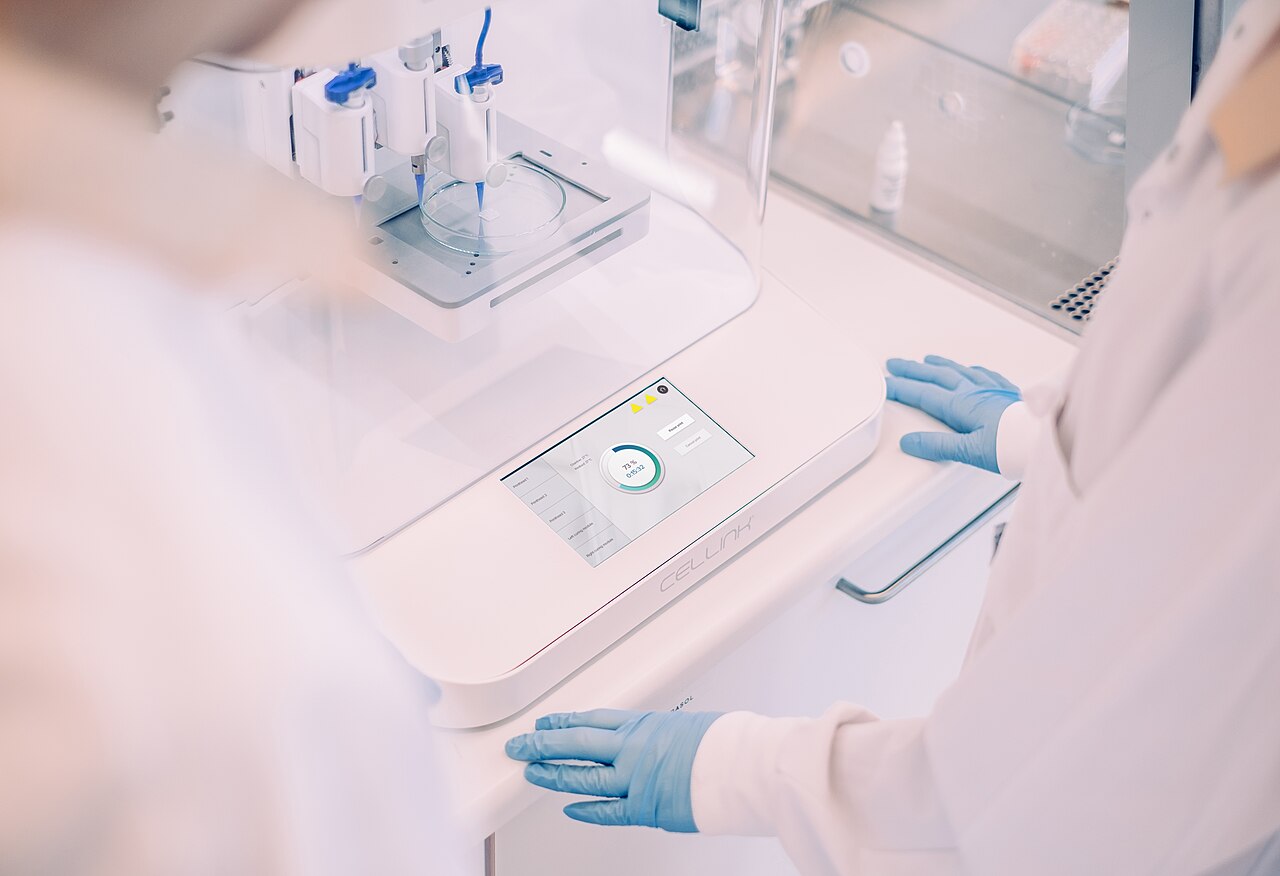
Most desktop 3D printing is a story about heat: melt a thermoplastic, squeeze it through a hot nozzle, let it freeze back into shape. Direct Ink Writing throws that script out entirely. Instead of molten polymer, a DIW machine extrudes a cold, toothpaste-thick "ink" through a fine tip and relies on the material's own physics — not a cooling filament — to hold the printed shape. The approach is niche enough that no single spec sheet captures it, but the machine makers are unambiguous about the appeal. Polish firm Sygnis markets its F-NIS line as its "DIW flagship product line," pitching the printers as "simple and reliable tools, enabling seamless printing from a wide range of liquid and semi-liquid materials including silicone, ceramic paste and photosensitive resin." That materials list is the whole point: DIW prints the stuff FDM physically cannot.
What DIW actually is
Strip away the marketing and Direct Ink Writing is an extrusion additive-manufacturing process. A digital model is sliced into a toolpath, and a nozzle traces that path in space, laying down a continuous filament of ink layer by layer. So far, that description could be any FDM printer. The difference is what comes out of the nozzle and why it stays put.
DIW was first patented in 1997 by Joe Cesarano and Paul Calvert at Sandia National Laboratory, where it was developed as a technique for printing complex ceramic structures, and it has spent most of the intervening decades in research settings rather than on hobbyist benches. Where an FDM printer deposits a thermoplastic that solidifies as it cools, a DIW printer deposits a viscous paste that holds its geometry because of how the material flows — its rheology — at room temperature. No heater block, no thermal cycling, no melt zone. That single change opens the door to a materials palette that thermoplastic printing can only envy: polymers, ceramics, cement, glass, waxes, graphene, hydrogels, metal alloys and pure metals, and even food have all been printed this way.
The rheology problem
The catch is that "the right ink" is doing an enormous amount of work in every DIW pitch. The material has to behave like two contradictory things at once. Inside the syringe and nozzle it needs to flow — thin enough to extrude through a fine tip under manageable pressure. The instant it exits, it needs to stop flowing and behave like a solid, supporting both its own weight and the layers stacked on top of it.
The engineering language for this is shear-thinning: the ink's viscosity drops sharply when it's under the mechanical stress of extrusion, then recovers when that stress disappears. In practice DIW inks land in a broad window, with typical viscosities running from 102 to 106 mPa·s measured at a low shear rate of around 0.1 s-1. That's a range spanning something like runny honey up to a stiff putty, and formulating a paste that hits the target is often harder than running the printer. Get the rheology wrong and the ink either won't extrude or slumps into a puddle the moment it's deposited. Get it right and you can build free-standing structures out of materials that were never meant to be printable.
Where it's being used
Because the process is cold and material-agnostic, DIW has migrated into fields that have nothing to do with prototyping brackets. In energy storage, researchers print electrodes for lithium-ion batteries and supercapacitors, patterning active material into geometries that improve how a cell charges and discharges. In the life sciences, hydrogel and bioink formulations feed work on biodegradable scaffolds, stretchable self-healing shape-memory elastomers, and organ-on-a-chip devices, where the ability to deposit soft, water-rich, cell-friendly material at room temperature is not a convenience but a hard requirement — you cannot run living cells through a 200°C hotend.
Soft robotics leans on DIW to print silicone actuators and compliant structures directly, and the technique also shows up in wearable devices and microfluidic systems, where fine control over deposited geometry matters more than raw build speed. The common thread is that these applications need a specific functional material in a specific shape, and DIW is often the only additive process that can deliver both.
The hardware landscape
The commercial market splits along a familiar fault line between accessible and specialized. Sygnis's F-NIS systems sit at the approachable end, priced between roughly $10,759 and $13,350, and the company sells them through its shop and a dedicated diw3d.com site into "industrial companies, universities and research institutes and laboratories." Purpose-built bioprinting hardware runs far higher — a MakerPi bioink system has been quoted around $68,526, reflecting the sterility, precision, and biological-handling demands of that corner of the field. Between those poles are makers like Avay in India and PowerDIW in Spain, plus the open-source Printess project for those inclined to build rather than buy.
What It Means for Makers
DIW is not a replacement for the FDM printer on your bench, and it isn't trying to be. It's a different tool for a different problem: printing functional materials — silicone, ceramic paste, conductive graphene, living hydrogels — that thermoplastic extrusion simply can't process. If your work stays in the world of rigid plastic parts, DIW has little to offer. If it strays into soft robotics, printed electronics, ceramics, or anything biological, it may be the only additive route available.
The honest barrier to entry isn't the printer. Entry-level DIW hardware now costs about what a decent professional FDM or resin machine does, which puts it within reach of a serious lab or a well-funded workshop. The real work is formulating an ink that shear-thins on cue and holds its shape once deposited — a materials-science problem that no machine solves for you. For makers with that appetite, though, DIW's promise is genuine: a room-temperature process that treats "printable" as a rheology question rather than a melting-point one, and in doing so pulls an entire category of materials into the additive-manufacturing tent.
