
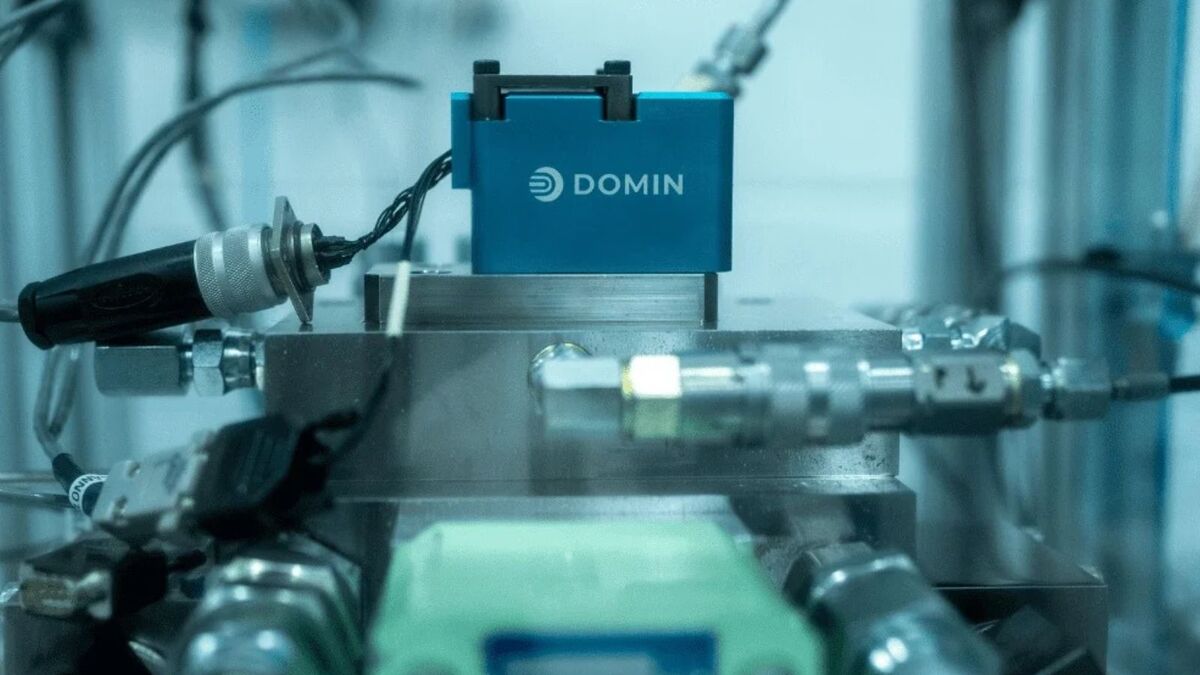
Domin, the British hydraulics company that builds its valves with 3D metal printing, has chosen Gastonia, North Carolina, for its first manufacturing site in the United States. According to a press release from North Carolina Governor's office dated November 24, Domin, Inc., the U.S. entity of the UK's Domin Limited, will invest more than $16.2 million in the Gaston County city and create 204 jobs. The facility will cover 40,000 square feet and handle production, research and development, and supply operations.
Economic development announcements are routine. This one deserves a closer look from the additive manufacturing crowd, because what is moving into Gastonia is not described as a prototyping lab or a service bureau. It is a company whose core technology combines metal printing with digital control, setting up a manufacturing operation to supply products to its U.S. customers.
What Domin Actually Makes
The state describes Domin's technology as a combination of 3D metal printing and high-speed digital control, applied to two product families: control valves and electro-hydrostatic actuators. Trade outlet VoxelMatters notes that the company markets those products as smaller and lighter than conventional hydraulics.
That pitch maps neatly onto the strengths of metal additive manufacturing. A traditional hydraulic valve body starts life as a block of metal, and its internal fluid passages are produced by drilling straight bores that intersect at the required points. The geometry is dictated by what a drill can reach. Cross-drilled holes leave sharp corners and dead-end stubs that are then plugged, and the block has to be large enough to contain all those straight-line paths. Printing the body layer by layer frees the designer from that constraint: passages can curve, merge and branch where the fluid needs to go, and material that exists only to host drill paths can be removed. Less material means less mass and a smaller envelope, which is the kind of advantage Domin claims for its products.
The second half of the equation is control. Domin pairs its printed hardware with high-speed digital control, which points to a valve that is less a passive metering component and more a device commanded by software. The same combination of metal printing and digital control underpins the company's electro-hydrostatic actuators.
The company's own news page gives a sense of how far the product line has developed. Recent entries cover the S14 Pro and P14 Pro valves, described as the company's largest yet, delivering up to 1,250 liters per minute for presses, test rigs, turbines and ships, and the S12 Pro and P12 Pro, which target NG16 applications, a standard size designation in industrial hydraulics. Those are not desktop-scale curiosities; flow rates in that range belong to serious industrial machinery.
The Money Behind the Move
Domin's news page also lists a £30 million investment from Legatum, which it calls its largest backing yet, an Innovate UK grant of £1.25 million for aerospace-ready 3D printed hydraulic technology, and a place in the FT1000 2026 ranking. Taken together, those items describe a company that has attracted private capital and government research funding and is growing quickly.
North Carolina is contributing as well. The project qualifies for a Job Development Investment Grant (JDIG) that could reimburse Domin up to $2,315,700 over 12 years. As VoxelMatters points out, JDIG money is not paid upfront: payments happen only after the state verifies that the company has met its yearly job creation and investment targets. The state estimates the project will generate more than $728 million in economic growth over that 12-year term.
The jobs themselves are well paid by local standards. The governor's office puts the average wage for the new positions at $95,929, against a Gaston County average of $54,736, with a potential payroll impact of more than $19.5 million a year. The positions include fabricators, engineers, machinists, managers and technicians. Domin CEO Marcus Pont is quoted in the state's announcement saying the company has built a large customer base in the United States and that the Gastonia site will let it serve those customers better and faster.
Domin's customers span industrial, automotive, marine, aerospace and defense applications, according to the release. A U.S. plant puts production closer to American buyers in all of those sectors, several of which care a great deal about where critical components are made.
Why Hydraulics Is a Telling Test Case
Additive manufacturing has spent years trying to shed its reputation as a prototyping tool. Plenty of companies print end-use parts, but much of that work is low-volume, high-value aerospace hardware or custom medical devices, where per-part cost matters less than performance or personalization.
Hydraulic valves are a harder market. They sit inside presses, vehicles, ships and industrial machinery, buyers expect them to be reliable and reasonably priced, and the incumbent manufacturing process, machining from a block, is mature and cheap at scale. For a printed valve body to win, the design advantages have to be large enough to pay for the slower and costlier printing process, and the whole production chain, from powder to post-processing to inspection, has to run predictably enough to support a manufacturing plant rather than a job shop.
A 204-job facility with dedicated production space suggests Domin believes it has crossed that threshold, or is close enough to commit capital. That is inference rather than anything the company has said. What the sources do confirm is that the state grant is tied to verified annual hiring and investment, so the plant's growth will be measured over years, not just announced.
What It Means for Makers
Most people reading FilamentFeed will never print a hydraulic valve, and nothing in this announcement suggests Domin's process is anything a hobbyist could replicate. But the story is still instructive for anyone who designs printed parts.
The lesson is the same one makers learn on a desktop FDM machine at much smaller stakes: printing pays off when the design is built around the process rather than copied from a part originally intended for machining or molding. Domin's pitch is not that a printer can reproduce a conventional valve body. It is that printed metal combined with digital control can yield products that are smaller and lighter than conventional hydraulics. The same thinking applies to a printed bracket with organic ribs or a duct with a swept internal path.
It also matters that the company couples printed hardware with electronics and software. Many of the most interesting maker projects work the same way, with the printed part acting as a physical platform for sensors, motors and control code instead of a standalone object.
Finally, the announcement is a notable example of additive manufacturing sitting at the center of a new factory rather than serving as a side process within one. For makers who follow the industry or work in it, Gastonia will be worth watching as the plant ramps up and those annual job and investment targets come due.
