
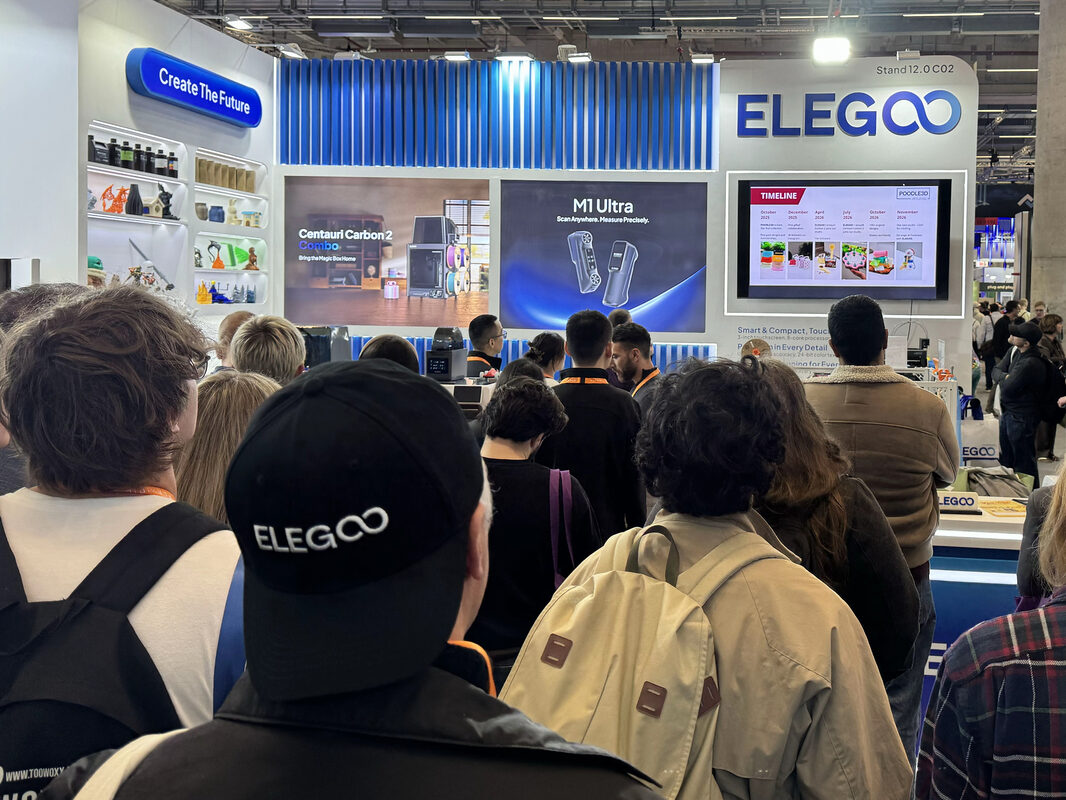
Elegoo had not said a toolchanger was coming. At Formnext 2026 in Frankfurt it showed one anyway. In a release dated November 19 and distributed through PR Newswire, the company described the Centauri X Ultra as an FDM printer with four independent printheads. It was shown at booth 12.0-C02 with no advance notice. Next to it was the Saturn 5 Ultra, a desktop resin printer that monitors its own resin supply and refills it automatically. The Centauri X Ultra takes the existing Centauri series into multi-printhead technology.
Anyone hoping for a spec sheet will be disappointed. The release gives no price, no build volume, no print speed, no nozzle temperature and no ship date for the Centauri X Ultra. Read the announcement as a statement of direction, not a product launch.
What Elegoo Actually Confirmed
The confirmed details are few, so here they are in full. The Centauri X Ultra has four independent printheads. Elegoo says it switches between them quickly, and it presents that as a way to cut the material wasted during color changes. The company also says the machine handles both rigid and flexible materials. That's all the official release says about the printer itself.
The waste-reduction pitch matters, though. The common route to multicolor printing on consumer machines is a single nozzle fed by a filament-switching unit. That design has to purge the old color from the hot end at every swap, which leaves the familiar pile of "poop" and an oversized prime tower beside the model. When each color has its own printhead, nothing needs flushing. The printer parks one head and picks up another that is already loaded. Some ooze control and priming probably remain, but the losses should be smaller.
Elegoo's mention of flexible materials hints at a second use: mixing materials. Separate heads let a printer combine a rigid body with a TPU gasket or grip in one job. A shared hot end handles that poorly, and swapping soft filament through a shared feed path is notoriously unreliable. Until Elegoo publishes hardware details, it's unclear how well the Centauri X Ultra will handle soft filaments. Its toolhead design, extruder type and maximum hot-end temperature are all unknown.
Where It Lands in the Toolchanger Race
3D Printing Industry's coverage places the Centauri X Ultra alongside two reference points. The first is the Co Print Quadro, a four-toolhead machine with fixed toolheads, launched on Kickstarter. The second is Bambu Lab's H3C, which carries nine tools and uses a system Bambu calls Swaptek, with tool swaps quoted at under six seconds. By head count, Elegoo's machine matches the Quadro and falls well short of the H3C.
Head count alone says little, though. Two numbers will decide where the Centauri X Ultra actually fits, and Elegoo hasn't given either. One is swap time, because it determines how much a heavily multicolor print slows down. The other is price, because it determines who will buy the machine. Elegoo sells consumer printers, so price matters. If it brings four-head printing in clearly below the incumbents, the category changes. If it prices alongside them, the Centauri X Ultra becomes one more option in a crowded field.
The company has the scale to compete either way. According to 3D Printing Industry, Elegoo was founded in 2015, sells in more than 150 countries, employs over 1,000 people and reported 2025 revenue above $300 million. A company that size can absorb the engineering and support costs of a mechanically complex product. Toolchangers have more moving parts, more calibration steps and more ways to fail than single-nozzle printers, and the support burden after launch is real.
Saturn 5 Ultra: Taking the Bottle Out of the Loop
The resin announcement is easier to understand. According to Elegoo's release, the Saturn 5 Ultra is a desktop resin printer with smart resin management that monitors the resin level and replenishes it automatically. Elegoo plans to launch it early in the first quarter of 2027. As with the Centauri X Ultra, the release gives no price or specifications.
Anyone who runs an MSLA printer knows why this matters. Long or tall prints can drain a vat partway through. The usual fixes are to overfill the vat at the start or to check on the job and top it up by hand. The first wastes resin and the second means more time handling uncured resin. An automatic refill system addresses both, and it could make unattended overnight printing more practical. What remains unknown is how it works: what container the system draws from, whether it locks users into proprietary cartridges, and how it handles resin types with different viscosities. Those details will decide whether the feature is a real convenience or a source of lock-in.
The booth also had the M1 Ultra, which Elegoo calls its first all-in-one smart 3D scanner. 3D Printing Industry reports accuracy of up to 0.02 mm and companion software called ELEGOOSCAN. At this show it mainly rounds out Elegoo's message that it now covers resin, FDM and scanning. Co-founder and vice president Kevin Wang is quoted in the release on the company's broader ambitions, but the quote adds no technical detail.
What It Means for Makers
For now, the Centauri X Ultra is a confirmed product category with no confirmed product details. Elegoo has committed to four independent heads, fast switching, and support for both rigid and flexible filaments. Everything a buyer would use to compare machines is still missing.
Holding off is the sensible choice. If you're shopping for a multicolor printer today, this announcement doesn't justify putting a purchase on hold indefinitely. It does justify watching for Elegoo's pricing before you commit to a premium toolchanger. If Elegoo prices aggressively, the Centauri X Ultra could make toolchanging affordable for many more makers. If not, it still adds competitive pressure, and that tends to bring prices down across the category.
Resin users have a clearer timeline. The Saturn 5 Ultra is scheduled for early Q1 2027, and its headline feature fixes a real everyday annoyance. Before you buy, find out what feeds the refill system and whether it accepts ordinary bottled resin.
