
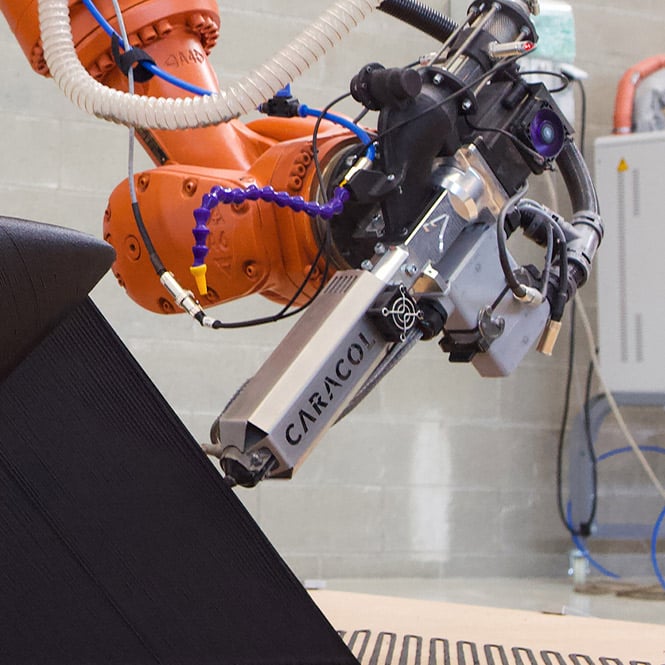
Greenland Arctic Development Corp (GADC), a recently founded company backed by Chicago investor Larry G. Swets Jr., has bought a Caracol Heron 400 large-format robotic 3D printer. According to Caracol's press release, the system will be installed and tested in Chicago first, then moved to Greenland. There it will be run by a local joint venture making spare parts, marine components and construction elements. The release is datelined Chicago and Nuuk, September 29, 2026, and appeared on Caracol's press page on October 14.
On its face this is one printer sale. What makes it interesting is the reasoning behind it, which makers who live far from suppliers will recognize: when the nearest distributor is weeks of freight away, you can't wait for spare parts or afford the shipping, so you start making them yourself.
The Machine: A Robot Arm on a Long Rail
The Heron 400 is not a gantry printer scaled up. Caracol describes it as a robotic arm with six or more axes, mounted on a linear rail. The arm reaches about 4 meters, and the rail extends the printable X axis past 10 meters. That gives a long, open work envelope suited to large parts such as boat components and construction elements, which a typical desktop-style enclosed build chamber could not hold.
The system prints thermoplastics and fiber-reinforced composites. Caracol also points to non-planar toolpaths as a key feature. Anyone who has fought with a desktop FDM printer knows the problem this addresses. Planar slicing stacks flat layers, so parts are weakest between layers and overhangs need support material. A multi-axis arm can tilt the nozzle and lay down curved layers that follow the part's shape. Caracol says greater control of overhanging surfaces can reduce the need for supports, and that non-planar toolpaths can help mitigate weakness between layers. For a bracket that takes vibration on a snowmobile or flex on a boat, layer orientation can decide whether the part is usable at all.
Neither source gives build rates, material lists by brand, or a price for the system, and we won't guess at them. The stated capabilities are enough to show the intent: one machine flexible enough to make very different parts, run by a small local team.
Who Is Buying, and Why Greenland
VoxelMatters reports that GADC was founded recently by Swets, who plans to raise up to $200 million by the end of next year. That money is meant for aviation, maritime shipping, data centers and tourism infrastructure in Greenland. The printer is a small part of that plan. It is something GADC can install, test and staff before any larger infrastructure projects get started.
VoxelMatters also notes that interest in Greenland has grown recently, partly because of President Trump's focus on the territory. That political context explains some of the investor attention. The industrial argument for the printer doesn't depend on it, though. Remote places with small populations have always had expensive, slow supply lines, whoever is paying attention to them.
The two companies tell the same story from different angles. Swets talks about building capability that stays in Greenland, not bringing in a finished operation from outside. Francesco Pantaleone, Caracol's Head of Sales, Americas, focuses on the logistics: remote regions pay high shipping costs and then wait a long time for the parts to arrive. A printer on site doesn't solve every part of that problem, but it shortens the wait for anything that can be made from polymer or composite.
The Joint-Venture Model
The ownership structure is the most unusual part of the deal. According to Caracol, GADC plans to recruit a Greenlandic entrepreneur who will receive technical training and the opportunity to develop and operate a joint-venture manufacturing facility. The Chicago testing phase comes first, which makes sense. Commissioning a large robotic cell, working out process parameters and finding problems is much easier near the vendor and its support network than after the machine has shipped to the Arctic.
Because a local operator will run it, success depends on more than whether the printer works. A large-format robotic cell needs someone who can design or adapt parts, plan toolpaths, manage materials and handle maintenance. Training is the critical step. If the operator becomes confident enough to take repair jobs from boat owners and builders and design solutions in-house, the facility becomes a real local business. If not, it's an expensive showpiece.
What It Will Make
The planned uses are practical. Caracol lists furniture, marine components, replacement parts for boats, ATVs and snowmobiles, and construction elements. Most of these share three traits: there is steady but low demand for them, a broken one can stop a vehicle or vessel from working, and importing replacements is costly.
A broken snowmobile panel or boat fitting is a much bigger problem when the replacement is a long shipping trip away. Being able to make an acceptable replacement locally, even one that is heavier or plainer than the original part, can matter more than matching factory specifications.
What It Means for Makers
Most readers won't run a 10-meter robotic cell. Still, the deal reflects ideas that are spreading through additive manufacturing at every scale, and they're worth noticing.
Non-planar printing is no longer only a research topic. Multi-axis toolpaths that reduce supports and layer weakness are now a selling point in commercial deals like this one. When large-format vendors invest in this, the slicing software and design practices for curved layers tend to improve, and that may eventually benefit smaller machines too.
Distributed manufacturing is mainly about people. The plan here isn't just shipping a printer to a remote place. It's training a local operator and building a business around that person. Maker spaces and small print shops in rural areas often work this way, with one capable machine and one skilled operator serving a community's repair needs. GADC is betting that this model scales up to boat components and building elements.
Material flexibility matters for field repair. Caracol argues that in remote places, changing the feedstock rather than the production system gives more ways to make a needed part. As fiber-reinforced materials reach more machines, the gap between a printed prototype and a usable replacement part may get smaller.
The real test will come once the printer is in Greenland, in the hands of a local operator, with a backlog of broken parts to replace. That's when we'll find out whether the idea holds up.
