
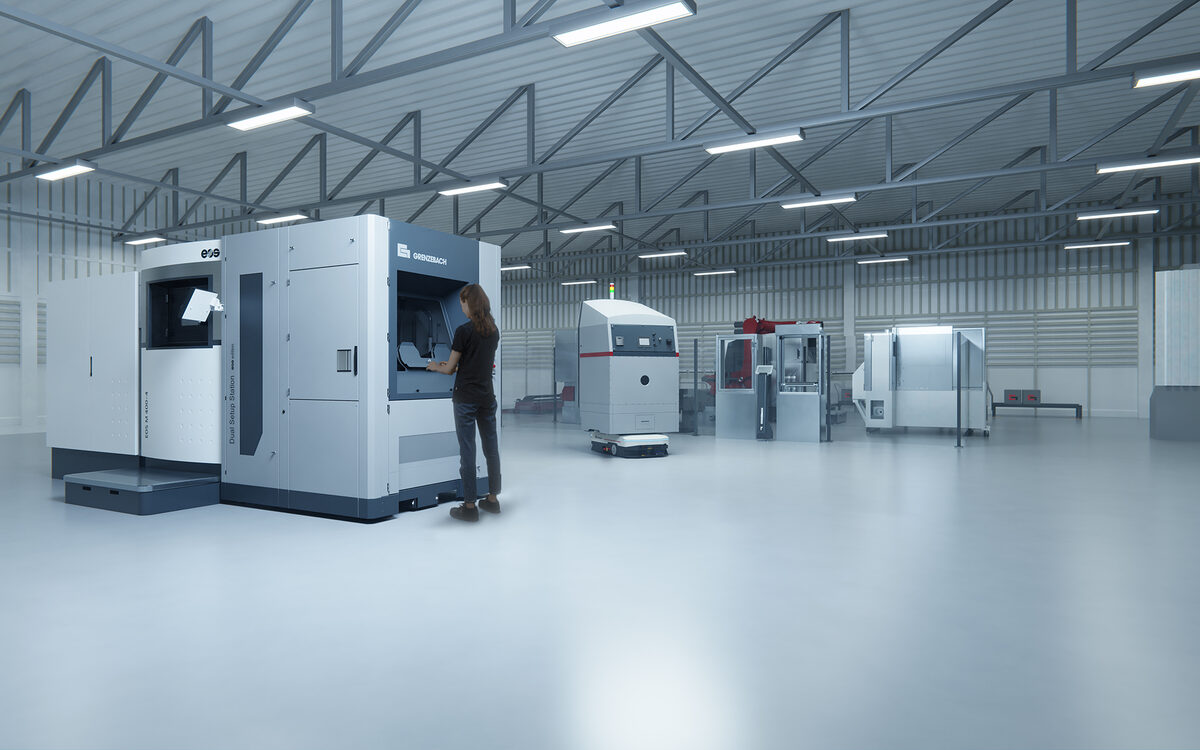
Most of the conversation in additive manufacturing still centers on the printer: build volume, laser count, layer time. Grenzebach Additive Solutions argues that this focus misses where production actually stalls. As VoxelMatters reported on October 21, the company has widened its offering to manufacturer-independent, end-to-end projects that cover the whole post-processing environment around industrial printers, including loading and unloading, buffering, transport, depowdering, and links to CNC machining. It is also taking on overall project responsibility, so the customer has one party accountable for the whole integration rather than a stack of vendors pointing at each other.
The pitch is summed up by CEO Dimitrios Livadas, who told VoxelMatters that optimizing individual machines is not enough and that the real challenge is automating the processes between them. Anyone who has watched a metal powder bed fusion cell in operation will recognize the problem. The printer runs unattended for hours, then a finished build sits waiting for a technician, a crane, a depowdering station, and a free slot on a machining center. The expensive asset idles while people and parts shuffle around it.
What Grenzebach Is Actually Selling
Grenzebach is pitching this as a different way of engaging with customers, not just a bigger product catalog. "We do not start with a product catalog," said Oliver Elbert, the company's Vice President of Sales and Business Development. "We start with the customer's production process." His questions, as quoted by VoxelMatters, are what equipment is already in place, where waiting times and manual interfaces occur, and what capacities need to be reached in the future. In practice that suggests the company starts from a specific factory's workflow and develops a concept to fit it, rather than handing over a standard cell and expecting the shop to adapt.
According to VoxelMatters, the building blocks include:
- Automatic loading and unloading combined with transport, buffer, and post-processing stations.
- Decoupled cooling. A finished build job can be removed from the printer and placed outside it to cool or await the next step, which frees the printer sooner.
- Parallel depowdering. Powder removal can run at the same time as the next print rather than in sequence with it.
- Autonomous transport of material between stations.
- Inert-gas handling. In metal AM, hot components can move under an inert gas atmosphere in suitable containers.
- Third-party integration. Grenzebach links its own post-processing machines with existing equipment from other manufacturers, including depowdering, storage, buffer, and CNC machining stations.
That last point is the business news. "Manufacturer-independent" means Grenzebach is positioning itself as a systems integrator that will connect whatever equipment a plant already owns or prefers, not as a vendor that only automates its own hardware. For production sites that have built up a mix of printers and finishing equipment over several purchasing cycles, this matters. It is the difference between automating a showroom cell and automating the factory you actually have.
The Dual Setup Station and the EOS Order
Grenzebach's credibility here rests partly on a single product with real volume behind it. Its Dual Setup Station loads and unloads build containers, and VoxelMatters reports that EOS ordered 155 of these units in 2026.
That number is worth thinking about. A printer maker ordering more than 150 container-handling stations in one year suggests the handover between printer and downstream processing is no longer a niche concern for a few pilot lines. It looks like a volume problem that a major machine builder wants solved at scale. It also hints at Grenzebach's strategy: the company has a foothold in the handoff where a build leaves the printer, and from there it is extending outward into the rest of the chain.
Why the Gaps Between Machines Matter
The logic behind decoupling cooling and depowdering from the print is plain throughput math. If a finished build has to stay in the machine until it is cool enough to handle, and depowdering waits until after that, the printer's utilization takes a hit every cycle. Pull the build out, let it cool elsewhere, and run depowdering in parallel with the next job, and the printer spends more of its life printing. The inert-gas transport option addresses a related constraint in metal AM: moving hot components without exposing them to air.
None of these ideas is exotic on its own. What Grenzebach is claiming is the ability to tie them together into one coordinated flow across multiple vendors' equipment, and to be the single party responsible for making the elements work together. That is a classic integrator's offer, and it reflects where industrial AM is heading. Buyers who already accept that the printers work are now asking what it takes to run them like any other production asset.
Formnext 2026 and IMTS
The company plans to show the concept in person. VoxelMatters says Grenzebach will be at Formnext 2026 next month, where visitors will be able to move through an interactive production environment. Grenzebach's own news section lists a release dated 20 October 2026 titled "From Print Job to Production Flow: Grenzebach Demonstrates Automated and Seamlessly Connected Post-Processing at Formnext." Its teaser describes how 3D printing, material flow, and post-processing connect into an integrated AM production process. Only the headline and teaser of that release were available to review, so specifics of the booth demo are not yet confirmed.
Formnext is not the first stop. The same news list includes an 8 September 2026 item on Grenzebach Additive Solutions bringing end-to-end automation to IMTS 2026, presenting manufacturer-independent end-to-end solutions for additive manufacturing. IMTS is a machine-tool show, which fits a pitch that explicitly includes CNC integration. The people who run machining centers are the ones who will eventually receive these parts, so it is a sensible audience to court alongside the AM crowd at Formnext.
What It Means for Makers
Nobody running a desktop FDM printer or a small resin farm is going to buy a Grenzebach installation. But the argument behind the announcement scales down better than the hardware does. Livadas's point, that what happens between the machines is what matters, holds just as well in a garage print farm as it does in an aerospace plant. If your printers sit finished and idle while you are washing, curing, removing supports, or clearing beds, you have the same bottleneck in miniature.
For makers who sell into industry, whether as service bureaus, contract designers, or small production shops, the message is that customers are increasingly judging AM on the whole workflow, not on what comes off the build plate. The EOS order shows that real money is going into the unglamorous logistics of handling build containers. The Formnext demo will be a useful look at how far integrators have actually gotten with connecting mixed-vendor equipment into one line.
The bottom line: Grenzebach is betting that the next round of gains in industrial 3D printing will come from the conveyor, the buffer rack, and the depowdering station rather than from the printer. Given how much idle time sits in many AM workflows, that is a reasonable bet.
