
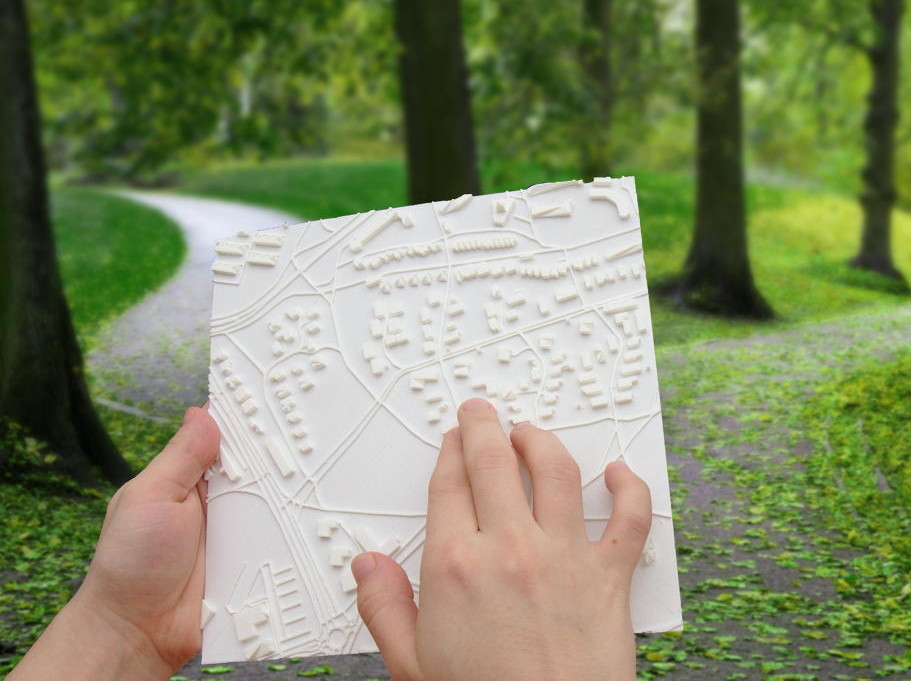
For most expectant parents, the 20-week anatomy scan is a visual milestone — a grainy grayscale image pinned to a fridge or shared on social media. For parents with sight loss, that moment has historically been described to them rather than experienced. Guide Dogs, the UK's largest sight loss charity, is trying to close that gap with a free pilot program called First Hello, which converts a standard 2D ultrasound image into a physical, touchable 3D-printed model that blind and partially sighted parents — and their family members — can hold.
The mechanics are deliberately simple on the user-facing end. A parent uploads a JPG or PNG of their 20-week scan, capped at 10MB, through a dedicated ordering site. On the back end, that flat image is converted into a 3D render and then printed as a physical tactile object, which arrives by mail in about a week. There's no charge to participating families, and the pilot is being delivered in partnership with the agency Hope and Glory, which appears to be handling production and fulfillment logistics for Guide Dogs.
Why a Charity Best Known for Guide Dogs Is Doing This
Guide Dogs framed the program around survey data on how excluded visually impaired people feel from a moment sighted parents take for granted. In a survey of 2,000 UK adults with visual impairment, 54% said pregnancy scans should be made more inclusive, and 80% felt that every parent should get to experience a first sonogram in some form. Notably, 64% said a tactile replica would help family members — not just the visually impaired parent — feel included in the moment. That last figure is likely why First Hello isn't restricted to parents with sight loss: according to 3DPrint.com's coverage, sighted parents who have family members with impaired vision can also order a print, extending the program to shared-experience use cases rather than a narrow medical-accommodation one.
Kerry Bevan, Guide Dogs' head of support services, is quoted in coverage of the launch saying that "every parent, grandparent and loved one deserves to experience the joy of early parenting milestones," and that people with sight loss are too often excluded from significant life moments that others take for granted. One expectant father who tried the program, Reece Finnegan-Knight, described holding the tactile scan for the first time as "an incredible experience," adding that he "didn't feel like [he] got much from" the standard in-person scan appointments themselves — a real-world data point for the gap the charity is describing. The framing of both quotes centers on the inclusion gap the charity is targeting rather than the technical execution — the 2D-to-3D pipeline itself is where the interesting engineering questions live.
The Conversion Pipeline: What's Actually Happening to the Image
Neither source publishes the exact software stack, but the workflow described — 2D ultrasound scan image in, 3D render, then physical print out — implies a photogrammetry-adjacent or depth-inference process rather than a literal 3D reconstruction from volumetric scan data. Standard 20-week anatomy scans submitted by parents are 2D grayscale images, not the raw 3D/4D ultrasound datasets that specialized obstetric equipment can produce. That distinction matters: a true 3D ultrasound reconstruction (the kind some clinics already offer as a premium add-on, typically printed in resin at cost) starts from volumetric acquisition data with real depth information. Converting a flat 2D image into a tactile object instead almost certainly means the pipeline is inferring relief and depth cues — likely through some combination of grayscale-to-heightmap conversion, edge detection to isolate the fetal outline from surrounding tissue and amniotic fluid noise, and manual or semi-automated cleanup — rather than reconstructing a geometrically accurate 3D form.
That's not a criticism of the program; it's a reasonable engineering tradeoff given the goal. The object doesn't need to be anatomically precise the way a surgical-planning model does. It needs to be tactilely legible: a recognizable head, a curve of a spine, a hand — enough relief that fingers reading the surface can construct the same mental image a sighted parent gets in half a second of looking at the printout. That's a fundamentally different design target than the medical 3D-printing work done from MRI or CT data, and it's closer to bas-relief sculpture than to reverse engineering.
What It Means for Makers
First Hello sits at an intersection makers rarely see covered: accessibility-driven 2D-to-3D conversion at genuine production scale, even if that scale is currently capped at just 50 prints for this pilot. A few things are worth watching if you work anywhere near tactile graphics, assistive tech, or image-to-relief tooling:
The 2D-to-tactile-relief pipeline itself — turning a flat grayscale or photographic image into a printable heightmap with legible edges — is a problem the tactile-graphics and low-vision communities have worked on for years, usually for maps, diagrams, and textbook figures. Grayscale ultrasound images, with their speckle noise and low contrast between fetus and surrounding fluid, are a genuinely harder source image than a line diagram, so whatever segmentation approach Guide Dogs and Hope and Glory landed on is solving a real computer-vision problem, not just running a stock heightmap filter. If the charity or its delivery partner ever documents that pipeline publicly, it would be a useful reference case for anyone building assistive tactile-print tools, since ultrasound noise characteristics aren't wildly different from other low-contrast medical or scientific imagery makers might want to convert.
There's also a fulfillment-model lesson here: a free, mail-order, image-upload-to-physical-object service run at pilot scale (50 units) is a legitimate small-batch print-on-demand structure that other charities or maker-adjacent nonprofits could copy for other accessibility use cases — tactile birth announcements, tactile family photos, tactile diagrams for educational materials — without needing to build bespoke hardware. The bottleneck isn't the printer; it's the conversion software and a review step to make sure a printed relief is actually legible by touch, which is a very different QA process from checking a print for dimensional accuracy.
Whether Guide Dogs expands past 50 prints, and whether they publish results on how successful families found the tactile output, will say a lot about whether this becomes a template other charities and health systems pick up — or stays a one-off pilot.
