
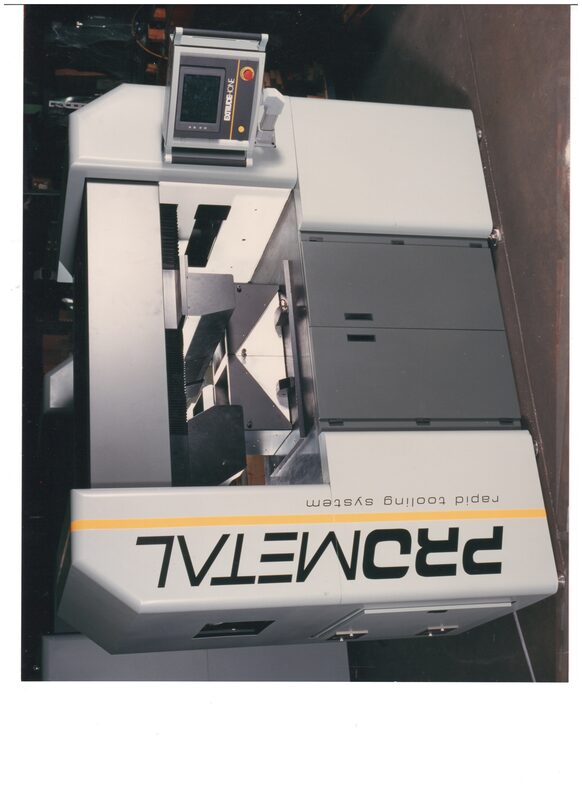
Hyundai Motor Group has installed two ExOne VX1000 High Speed Sintering (HSS) printers at its Namyang R&D Center in South Korea, giving the automaker the ability to sinter a complete, full-scale door panel in a single build. The machines anchor Hyundai's new Additive Manufacturing Solution Center — the group's first facility built specifically for additive manufacturing — and mark a significant scale-up from the desktop and mid-size polymer printers that have typically populated automotive prototyping labs.
The installation was first reported by VoxelMatters on September 9, which described the move as an expansion of Hyundai's existing polymer additive manufacturing infrastructure, ahead of a more detailed follow-up from 3D Printing Industry on September 13. According to VoxelMatters, Hyundai has run an in-house 3D printing program since 1996, and the two new VX1000 systems now sit within a newly formed Additive Manufacturing Solutions team responsible for the center's polymer output.
What Is High Speed Sintering, and Why Does It Matter Here
HSS is a powder-bed polymer process, but it works differently from the laser-based selective laser sintering (SLS) most makers associate with nylon printing. Instead of tracing each layer with a moving laser spot, an HSS system deposits an infrared-absorbing ink onto the areas of a powder bed that are meant to fuse, then passes an infrared emitter over the entire bed at once. Wherever the ink was printed, the powder heats up and sinters; everywhere else, it stays below the fusing threshold and remains loose, unsintered support material.
Because the fusing energy is applied across the full width of the build in one pass rather than traced point-by-point, HSS scales print speed with print area far better than laser-based SLS does. That's the entire premise behind the VX1000: it uses an 8,000-nozzle printhead — closer in concept to an industrial inkjet than to a laser scanner — combined with full-volume temperature management to keep the powder bed thermally stable across a large build chamber. The build volume is substantial for a polymer system: 1,000 x 550 x 190 mm, large enough to lay out a single automotive door panel, or several smaller parts, flat across the bed.
The material is PA12 (nylon 12) powder, the same polymer chemistry widely used in SLS across the industry for its balance of strength, flexibility, and chemical resistance — but here processed at a throughput automakers need for functional parts rather than small test coupons. VoxelMatters also reports that the process can reuse up to 80 percent of the unfused powder from a build without compromising part quality, a recovery rate that matters at the material volumes a door-panel-sized build consumes.
Why Hyundai Is Deploying This at R&D Scale
According to 3D Printing Industry's report, Hyundai is running the twin VX1000 systems for pre-production and test parts, small-batch production, general prototyping, and what the report describes as the urgent sourcing of components that would otherwise require dedicated tooling to procure — the kind of one-off replacement or bridge part a development program needs on short notice while tooling is still being finalized. A door panel is a useful proof point for that use case: it's a large, structurally relevant exterior part that would otherwise require injection-mold tooling or a slower, smaller-format printer run assembled from multiple sections.
The Additive Manufacturing Solution Center itself is the broader story here. 3D Printing Industry describes it as the first facility Hyundai Motor Group has built specifically for additive manufacturing, bringing polymer and metal printing under one roof — everything from vat photopolymerization to directed energy deposition (DED) for large structural metal parts, alongside the new HSS line. Every component produced there, per the report, is checked against production-equivalent benchmarks for dimensional accuracy, tensile strength, bending stiffness, and impact resistance.
ExOne CEO Eric Bader framed the deployment as validation of the machine's intended purpose, telling 3D Printing Industry: "Hyundai is using High Speed Sintering exactly as we designed it, for full-scale functional parts. Keeping large polymer parts accurate and repeatable, print after print, is one of the hardest challenges in polymer 3D printing. We solved it, and that turns additive manufacturing into a tool automotive teams can rely on for real development work." 3D Printing Industry reports that the process compresses design iterations from weeks to days compared with conventional manufacturing — the turnaround between a design change and a physical part an engineer can bolt onto a test mule or evaluate for fit and finish.
It's worth noting what neither report specifies: exact print times per part, unit cost, post-processing steps (depowdering, dyeing, or surface finishing), or how the printed panels compare mechanically to production-tooled parts. Those are the numbers that would matter most for judging whether "weeks to days" holds up as a durable operational figure rather than a best-case example, and FilamentFeed will follow up if ExOne or Hyundai publish more detail.
What It Means for Makers
Nobody is putting a VX1000 in a garage — this is industrial-scale hardware serving one of the world's largest automakers, and it sits well outside the price and footprint bracket of anything a hobbyist or small shop would consider. But the technology trend underneath it is directly relevant to anyone who runs nylon prints on desktop or benchtop SLS gear.
HSS's core bet — replace a scanning laser with a full-bed inkjet-and-heat-lamp pass — is the same bet driving a wave of newer, more affordable SLS and multi-jet fusion-adjacent machines aimed at prosumer and small-business users. As that inkjet-fusing approach gets validated at the scale Hyundai is now running it, expect the underlying print-head and thermal-management engineering to trickle down into smaller, cheaper systems the way MJF's core ideas eventually influenced consumer-facing nylon printers. If you're evaluating a next-generation nylon-capable printer for your own shop, watching how manufacturers position "single-pass fusing" versus laser-scanned SLS in their marketing is worth doing now — it's becoming a real dividing line in the market, not just a spec-sheet footnote.
The other takeaway is about what large-format polymer AM is actually being bought for in 2026: not novelty parts, but bridge production and rapid-iteration prototyping for parts big enough that "print it overnight" genuinely competes with tooling lead time. That's the same logic driving demand for larger-format FDM and resin systems in smaller shops — the bigger the part class a printer can cover in one build, the more workflow it can absorb that used to require outside vendors or hard tooling.
