
On September 5, 2026, Isar Aerospace's Spectrum rocket lifted off from Andøya Space in Norway, crossed the Kármán line, and deployed satellites into orbit — becoming, according to the company's own press release, the first commercial European launch to reach orbit from continental European soil. It was the German launch startup's second orbital attempt, coming roughly 18 months after a first flight that ended about 30 seconds after liftoff. This time, every phase went to plan: main engine cutoff, stage separation, second-stage ignition, fairing jettison, a circularization burn, and spacecraft separation, all executed in sequence during a mission Isar named "Onward and Upward."
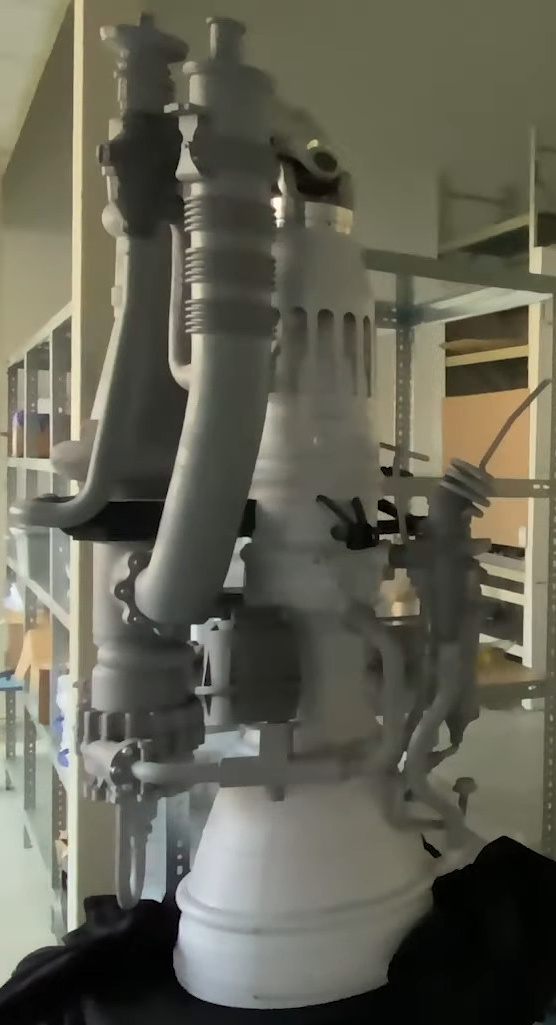
For the maker and manufacturing crowd, the headline isn't just that a European rocket reached orbit — it's what's inside the engines that got it there. Spectrum's first stage is powered by nine Aquila engines burning propane and liquid oxygen, with a vacuum-tuned tenth variant on the second stage. The thrust chamber assemblies at the heart of those engines are additively manufactured, produced on a bespoke in-house metal-printing setup that Isar built around two machines from EOS and its large-format subsidiary AMCM: the AMCM M 450 and the EOS M 290.
Why Print a Rocket Engine
Thrust chambers are about as unforgiving a part as exists in mechanical engineering. They have to survive sustained exposure to combustion temperatures well above the melting point of the metal they're made from, route cryogenic or cryogenic-adjacent propellant through internal cooling channels only millimeters wide, and do it all while holding tight geometric tolerances under extreme pressure and thermal cycling. Conventionally, that means machining, brazing, and welding together dozens of individually milled or cast components — a process that is slow, expensive, and prone to failure points at every joint.
According to reporting from VoxelMatters, EOS has said these thrust chamber assemblies would otherwise be the heaviest, longest-lead-time, and most expensive parts on the vehicle to manufacture using traditional methods. Laser powder bed fusion — the metal 3D-printing process used by both the M 450 and M 290 — lets Isar print the chamber, injector features, and internal cooling geometry as a much more consolidated structure, cutting part count, weight, and the assembly time that conventional fabrication demands.
The two machines split the job by scale. The EOS M 290 is a compact-format industrial metal printer used for smaller, more standard-sized components, while the AMCM M 450 is EOS's answer to large-format, customizable printing — AMCM builds machines with adjustable build volumes tailored to a customer's specific part geometry rather than shipping a fixed off-the-shelf envelope. Christian Wenzl, Isar Aerospace's head of manufacturing, is quoted by VoxelMatters citing the customization AMCM provided — delivering the build volume the Aquila chamber's design required — as what led Isar to choose AMCM's platform for the job.
Running both machines in-house, rather than outsourcing thrust chamber production to a contract manufacturer, also gives Isar tighter control over iteration speed. Rocket engine development typically involves repeated redesign as test data comes in; owning the print farm means design changes can go from CAD to metal without waiting on an external vendor's queue.
What It Means for Makers
None of this trickles down to desktop FDM printers anytime soon — the M 450 and M 290 are industrial laser powder bed fusion systems, operating at a cost and complexity level far removed from anything in a home shop. But the Isar flight is a useful data point for anyone tracking where metal additive manufacturing is proving itself under the harshest possible conditions. A propane/LOX rocket engine thrust chamber is about as extreme a stress test as exists for a printed part: it has to survive real combustion, real pressure, and real thermal cycling on the first try, with no do-overs once it's bolted to a flight vehicle. When a company stakes an orbital launch on printed hardware and the mission executes clean through spacecraft separation, that's a meaningful validation of metal AM's readiness for safety-critical, mission-critical parts — not a demo, but a load-bearing component in an actual production vehicle.
It's also a signal about where the aerospace supply chain is heading. Isar's press release notes that Spectrum vehicles 3 through 7 are already in production, and the company is finishing a new 40,000-square-meter facility intended to support up to 40 launch vehicles a year. Scaling a launch cadence like that depends on manufacturing methods that can turn around complex parts fast and repeatably — which is exactly the pitch additive manufacturing vendors like EOS and AMCM have been making to the space industry for years. A successful orbital flight is a stronger argument than any trade-show pitch.
The Payload and the Bigger Picture
The satellites launched on this flight were selected through the German Space Agency's Microlauncher Competition, funded under the European Space Agency's Boost! program — part of a broader European push to build independent, sovereign launch capability rather than relying on non-European providers. Isar Aerospace CEO Daniel Metzler framed the flight in exactly those terms in the company's press release, saying "Europe now has sovereign access to space." VoxelMatters reports that six payloads were deployed on the mission — five cubesats (CyBEEsat, TriSat-S, Platform 6, FramSat-1, and SpaceTeamSat1) plus the Let It Go experiment — and that Isar is the first privately funded launch company from continental Europe to put satellites into orbit. Isar's press release describes the beneficiaries of the Microlauncher Competition as educational institutions and start-ups, consistent with the program's stated goal of giving smaller European players a domestic path to orbit.
That geopolitical framing matters for the additive manufacturing angle too. A domestic, in-house metal-printing capability isn't just a manufacturing efficiency play for Isar — it's part of keeping the entire supply chain, from raw powder to flight-ready thrust chamber, inside Europe rather than dependent on external vendors. As the company scales toward dozens of launches a year, that in-house AMCM/EOS printing setup is likely to become one of the more closely watched pieces of infrastructure in the European space sector.
