
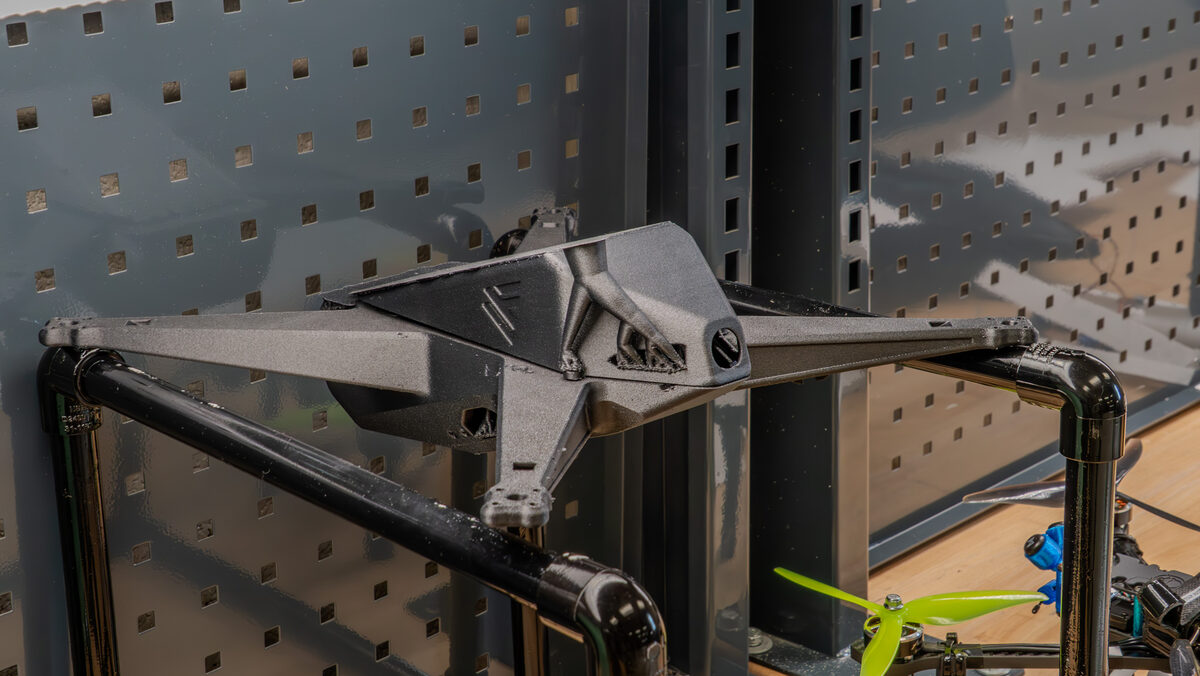
Japan's defense procurement agency doesn't move fast. So when the Acquisition, Technology & Logistics Agency (ATLA) announced that Terra Drone's Terra B1 interceptor had solely passed its demonstration test, the headline wasn't really the pass/fail result — it was what happens next. Under ATLA's Interceptor Drone Early Acquisition Program, the agency is moving the Terra B1 from a passed demonstration test toward a mass-production contract in roughly three months, a pace ATLA's own announcement calls "notably accelerated" and that trade outlet 3DPrint.com describes as "an extremely fast-track program design." Neither source states what a normal Japanese defense-procurement timeline looks like for comparison, but both treat the speed itself — not any single new technology — as the notable part of the story.
The Terra B1 is a small interceptor drone built to knock down cheap, mass-produced loitering munitions — the Shahed-type "kamikaze" drones that have become the signature threat of contemporary drone warfare. Terra Drone, the Tokyo-based company behind it, is also active in Ukraine, where it has acquired local subsidiaries and says its related A1 model "has been successfully intercepting Shaheds since last year." ATLA selected Terra Drone from a field of 38 competing proposals on July 15, 2026, then ran the design through a demonstration test covering flight performance, range, endurance, maximum and cruise speed, guidance method, the ability to control multiple aircraft simultaneously, launch and recovery method, system integration, safety, and operational track record. Terra B1 was the only proposal to clear that bar.
A Fast Timeline, a Thin Paper Trail on the "Why"
According to reporting from 3DPrint.com, the jump from demonstration approval to mass-production approval is happening in about three months. That's the headline fact, and it's well documented in both the company's own announcement and the trade press covering it. What's considerably less documented is why. Neither Terra Drone's press release nor 3DPrint.com's coverage attributes the compressed timeline to 3D printing, additive manufacturing, or any specific manufacturing process. ATLA's announcement frames the acceleration as a feature of the Interceptor Drone Early Acquisition Program itself — a procurement track built for speed — not as a byproduct of how the airframe is built. 3DPrint.com's own report doesn't mention 3D printing or additive manufacturing anywhere in its account of the Terra B1 program either.
That's a notable gap for a story to run on a 3D-printing publication, and it's worth being direct about it: 3DPrint.com's coverage sits in the outlet's "3D Printing," "Drones," and "Military 3D Printing" categories, and the piece opens with several paragraphs of background on Japan's broader 3D-printing industry — the CMET SOUP printer, Teijin Seiki's early additive work, TDK's acquisition of Fabric8Labs, Sodick's acquisition of Prima (now Altform) — before turning to the Terra B1 itself. That context establishes that Japanese industry is investing in 3D printing generally. It does not establish that Terra Drone is using 3D printing on the Terra B1 or its predecessor, the A1. No source specifies an airframe material, a manufacturing process, or a printer. There is no quote from Terra Drone leadership crediting additive manufacturing — or any other manufacturing method — for the compressed schedule.
What the sources do document is a company narrowing its supply chain rather than opening it up. Terra Drone has said it plans to produce batteries and controls domestically in Japan as part of localizing its supply chain, and to expand its production and support systems alongside the mass-production ramp. That's a real, sourced detail about how the company plans to scale manufacturing — it just isn't a detail about 3D printing.
What the Cost Math Is Actually About
For a sense of what's being scaled up, the existing Terra A1 — the Ukraine-active model the Terra B1 appears to be a Japan-focused counterpart to — tops out around 300 km/h, has a range up to 32 km, roughly 15 minutes of endurance, and a reported unit cost in the $2,500–$3,000 range, according to 3DPrint.com. Neither source gives a unit cost for the Terra B1 itself. Those A1 numbers exist to make an interceptor cheap enough to trade one-for-one against a Shahed-class target that itself costs only a few thousand dollars. Terra Drone's own framing, quoted in its announcement, ties the program directly to that math: expensive interceptor missiles used against cheap attack drones create a "growing imbalance in cost-effectiveness," while low-cost interceptor drones used against Shahed-type threats in Ukraine have "achieved high interception rates." If the Terra B1 lands in a similar cost bracket to the A1, the economics of the intercept — not any particular fabrication method — are what's actually backed by what Terra Drone and ATLA have said.
What It Means for Makers
This isn't a story about a new printer or a new filament, and — despite running under 3DPrint.com's banner — it isn't a confirmed 3D-printing story about the Terra B1 at all. Terra Drone hasn't disclosed a manufacturing process, machine, or material for either the A1 or B1 airframe, and neither of the two sources behind this coverage makes that connection either. What is genuinely relevant to the maker community is the pattern sitting one level up: a national defense-procurement agency openly building its acquisition timeline around rapid iteration and treating that speed as the headline achievement, in a program explicitly aimed at out-iterating a cheap, mass-produced adversary weapon. Anyone who has iterated a drone frame or a robotics chassis through a dozen printed revisions before locking a design recognizes that logic instinctively, even when — as here — the reporting doesn't confirm that 3D printing is the tool doing the iterating.
It's also a reminder to read defense-technology coverage on its own terms rather than through the lens of the outlet covering it. A story appearing on a 3D-printing trade site isn't, by itself, evidence the subject was 3D printed — and here, the article's own text bears that out: it treats the Terra B1 as newsworthy because a Japanese firm is entering the drone-interceptor space at speed, not because of a disclosed additive-manufacturing angle.
Delivery of the Terra B1 is targeted for around September 2026, following a mass-procurement contract expected in late August, with Japan's Maritime Self-Defense Force first in line to receive units and possible expansion to the Air and Ground Self-Defense Forces under consideration. If the roughly three-month demonstration-to-production timeline holds, it will stand as a notable proof point for fast-track defense procurement generally — and if Terra Drone or ATLA ever confirm what role, if any, 3D printing played in hitting that schedule, that's the follow-up worth watching for.
