
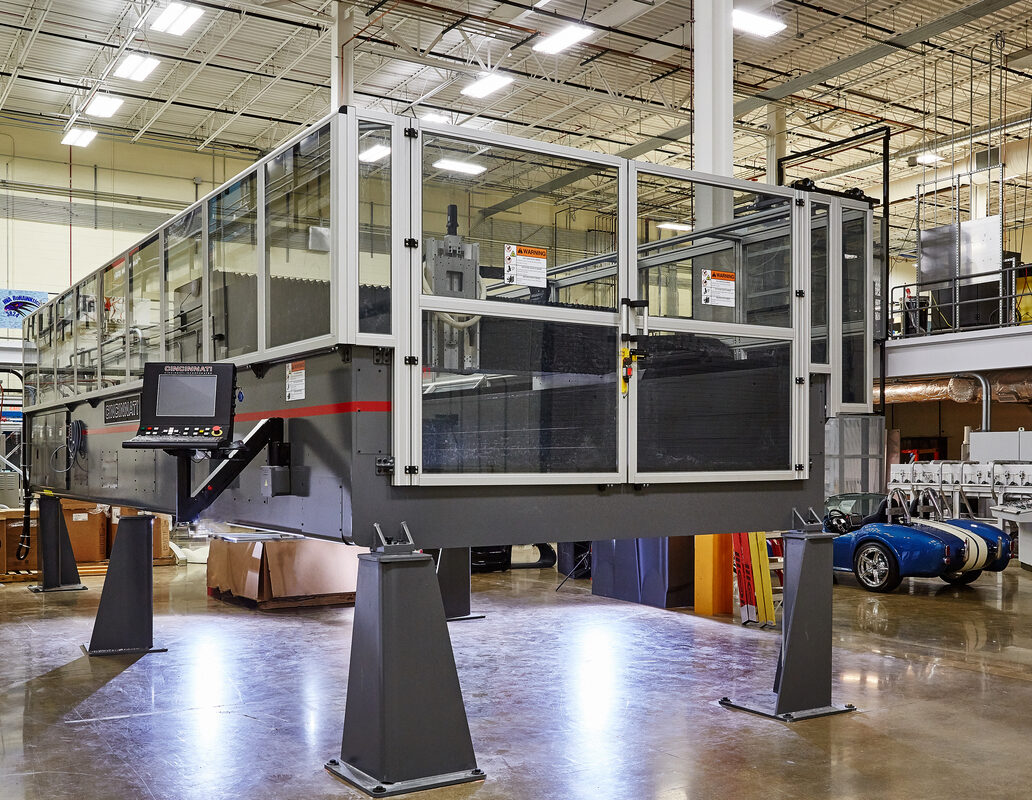
For most of large-format additive manufacturing's short history, you picked a lane. You either fed thermoplastic pellets through a screw extruder and lived with the thermal and mechanical ceiling of those materials, or you dispensed a reactive resin and accepted the slower, chemistry-bound world of thermosets. JuggerBot 3D wants to stop choosing. The Youngstown, Ohio maker is scaling a hybrid platform called the H6-106 that does both inside a single heated build chamber, and it is doing so on the strength of a $4 million award from the Air Force Research Laboratory. The company laid out the program on its own newsroom, framing it as a deliberate move beyond the thermoplastic-only machines that made its name.
The effort has a name: Project ACME, for Advanced Composite Material Extrusion. The award was announced on February 22, 2024, and funds a 24-month program. The pitch is straightforward to state and hard to engineer: put pellet-fed material extrusion and two-part resin dispensing on the same gantry, in the same enclosure, and let a single system print parts that combine the strengths of both material families. In practice that means marrying the throughput and geometry of screw-fed thermoplastics with the durability and thermal performance you can only get from a cured thermoset. In JuggerBot's own framing, the objective is to develop a state-of-the-art, hybrid, large-scale AM system that incorporates both two-part resin and pellet-fed material extrusion technologies — a single platform rather than two machines standing side by side.
Two chemistries, one chamber
What makes the H6-106 interesting is not that it can print two materials — plenty of machines carry multiple tools — but that it reconciles two fundamentally different processes under one set of thermal conditions. Pellet-fed extrusion melts a solid feedstock, lays it down, and relies on the chamber to manage cooling and layer adhesion. Two-part resin dispensing, by contrast, is a Direct Ink Writing problem: you meter and mix a reactive system, extrude it, and let chemistry rather than temperature drive it from liquid to solid. Those are not naturally compatible neighbors. A chamber hot enough to keep a large thermoplastic part from warping is not obviously the same environment you want for a curing thermoset, and the dispensing hardware for a mixed two-part system has little in common with a heated screw.
JuggerBot's answer is a fully enclosed, heated chamber that processes both, according to a July 24, 2026 feature in 3DPrint.com. The machine is built as an evolution of the company's commercial Tradesman Series rather than a clean-sheet design, which matters for anyone tracking whether hybrid AM can escape the lab. Starting from a shipping industrial platform means the mechanical bones, the motion system, and the pellet-extrusion path are already field-proven; the novel work concentrates on integrating the thermoset dispensing and getting the two processes to coexist.
Who is paying, and why
The money traces back to the Office of the Under Secretary of Defense for Research and Engineering, with the program managed through AFRL. The target application is large-format aerospace composite manufacturing — specifically tooling. That is a telling choice. Aerospace tooling, the molds and layup fixtures used to produce composite structures, is a domain where conventional additively manufactured materials frequently fall short. Tooling has to survive autoclave cycles and repeated thermal loading without distorting, and it has to hold tolerances over large spans. If a hybrid part can place a durable, thermally stable thermoset exactly where the tool sees the most punishment while using cheaper, faster thermoplastic elsewhere, the economics of printed tooling change.
That is the stated goal of the program: demonstrate aerospace tooling built from materials that offer greater durability and thermal performance than the materials additive manufacturing conventionally reaches for. It is a demonstration award, not a production contract, and the honest read is that success means a credible tool coming off the H6-106 within the 24-month window — not a machine on every shop floor.
The partner list reflects how much of hybrid AM is still an open research question. JuggerBot is working with America Makes, the national additive manufacturing institute that provides the program's framework — the kind of institutional backing that matters when a program depends on tight iteration. Oak Ridge National Laboratory is contributing on pellet printing and process automation, an area where ORNL has deep large-format credibility. Mississippi State University's Advanced Composite Institute rounds out the roster, bringing the composites expertise that the thermoset side of the machine leans on.
What It Means for Makers
Let's be clear about the audience. The H6-106 is a large-format industrial system aimed at aerospace tooling, funded by a defense research office. Nobody is putting one next to a Bambu on a workbench, and the price of admission will be measured in ways most makers never encounter. So why should the broader community care?
Because the ideas tend to trickle down. The core problem JuggerBot is solving — running two incompatible material processes in one thermal environment, with reliable metering and clean handoffs between tools — is the same problem that will eventually define multi-material desktop and benchtop machines. The pellet-extrusion lineage here is worth watching too: pellet feeding is one of the clearest paths to cheaper large-format printing, and every dollar of process-automation work ORNL contributes on that front is generally applicable knowledge. And the fundamental thesis, that you can beat the material ceiling of any single AM process by combining families rather than chasing a better single feedstock, is a strategy that scales down as readily as it scales up.
The near-term takeaway is more modest. This is a 24-month demonstration program, and the deliverable is proof that hybrid tooling works, not a product you can order. But it is a concrete, funded bet that the future of AM is not one process winning, but several learning to share a chamber. If the H6-106 puts a durable, thermally stable aerospace tool on the table, the argument for hybrid becomes a lot harder to wave off.
