
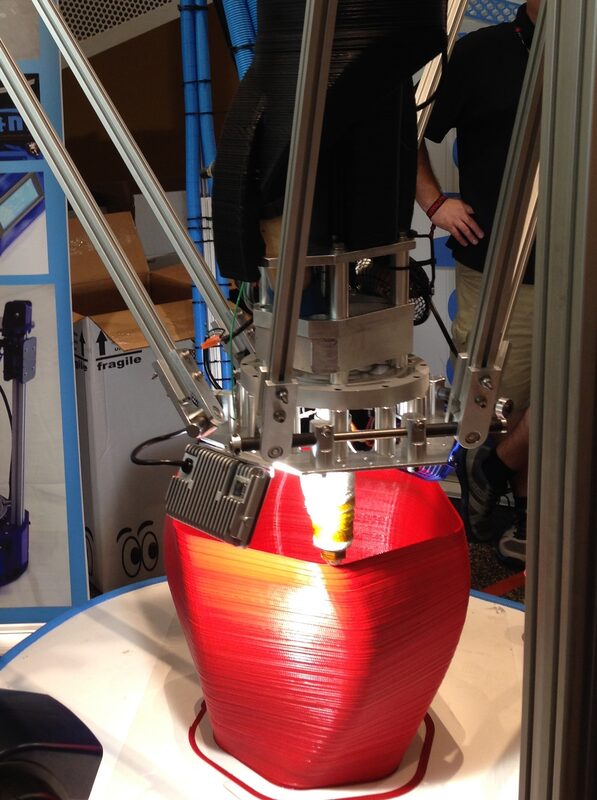
Kentstrapper has launched Mille, an industrial FFF 3D printer built around a genuinely enormous build volume: a full one-cubic-meter chamber, 1000 x 1000 x 1000mm, with pricing starting at €40,000. The Florence-based manufacturer, which has been building printers since 2011, is pitching Mille squarely at industries that currently fabricate large parts the hard way — printing them in sections and bonding the pieces together afterward.
Each Mille unit is individually assembled in Florence rather than mass-produced on a line, a detail that signals where Kentstrapper expects this machine to live: low-volume, high-value production runs for automotive, marine, aerospace, heavy engineering, tooling, and defense customers, according to VoxelMatters' launch coverage. Kentstrapper previously showed the machine at the Mecspe trade show in Bologna in March 2026 before bringing it fully to market this week.
The Numbers That Matter
A one-meter cube is large enough to print things that normally require a mold, a CNC router with a correspondingly huge bed, or several smaller prints glued or welded together. Mille's spec sheet is built around keeping that volume productive rather than just impressive on paper. The chamber heats to 60°C to manage warping and layer adhesion on engineering polymers, while the bed reaches 120°C across six independently controlled zones — a detail that matters at this scale, since a single uniform heating zone across a full square meter would make consistent first-layer adhesion nearly impossible to tune. Before a print starts, a pre-print scanner maps the build plate and auto-compensates for irregularities across that much surface area, a step that matters more on a full square meter of bed than it would on a desktop machine's more forgiving footprint.
Mille ships with two continuous-mode extruders and automatic failover between them, meaning a nozzle clog or filament runout on one toolhead can hand off to the second without stopping a job outright. That failover logic pairs with a stated ability to run print jobs up to 72 hours long, complete with power-loss recovery — both prerequisites for a machine this size, where restarting a multi-day print from scratch after a power blip or a jam is not a minor inconvenience but a lost week. The system uses Kentstrapper's Mantis high-flow extruder with a nozzle range from 0.4mm up to a bead-laying 1.4mm for bulk material deposition.
Tool changes use a magnetic quick-swap system Kentstrapper calls S.E.M., rated at under 30 seconds and requiring no tools — a meaningful detail for shops that need to switch nozzle diameters or maintenance heads between jobs without pulling the printer out of rotation for an hour.
Built for the Segment-and-Bond Problem
The pitch behind Mille isn't just "bigger bed." According to 3Druck.com's reporting, Kentstrapper is framing the machine as a direct alternative to the current workaround for large-format parts: splitting a design into multiple prints small enough to fit a conventional bed, then bonding or mechanically fastening them together. That approach introduces seams, weak points, and assembly labor that a single-piece print avoids entirely. For a marine bracket, an aerospace jig, or a defense enclosure where structural integrity at the joint is a real engineering concern, printing the part as one continuous piece is not a convenience — it can be the difference between a part that passes qualification and one that doesn't. Kentstrapper has demonstrated the point with a single-piece EV battery enclosure over 700mm long printed on Mille, the kind of part that would otherwise be split across multiple beds and bonded at the seams.
The steel-frame Cartesian motion system underpinning Mille is a deliberate choice for a machine this size: at a full meter of travel per axis, frame rigidity and repeatable motion control become harder problems than they are on a desktop printer, and a heavier, more conventional Cartesian layout is the more provable path to accuracy at scale.
Material support leans into that industrial framing as well. Mille is rated for glass- and carbon-fiber-reinforced nylons, PPS-CF, ESD-safe polymers, and materials rated UL 94 V-0 for flame resistance — the kind of material list aimed at people making load-bearing brackets and enclosures, not display models. 3Druck.com also reports a cost comparison Kentstrapper is using in its own marketing: roughly €70 per unit for outsourced tooling versus about €20 in in-house material cost when produced on Mille, with lead time dropping from around three days to about twelve hours — framing the machine as a payback play for shops currently outsourcing large fixtures and jigs.
Software and Security
The other half of Mille's pitch is remote operation, handled through an encrypted Cloudflare Zero Trust tunnel with two-step authentication and audit logging — a notably rigorous setup for a class of machine that has historically shipped with, at best, a basic web dashboard on the local network. 3Druck.com specifically calls out the cybersecurity approach as unusual for an industrial 3D printer at this price point. For a defense or aerospace customer, that's not a nice-to-have: audit logging and proper authentication on a networked production machine are often contractual requirements, not preferences.
On top of that tunnel, Kentstrapper has built a "Clara" AI troubleshooting assistant, Telegram bot notifications for print status and alerts, and over-the-air firmware updates. Mille also qualifies for Italy's Industry 4.0 and Transizione 5.0 tax incentive programs, which subsidize capital equipment purchases tied to digital and automation upgrades — a detail that will matter more to Italian and EU buyers running the ROI math than to shops elsewhere, but it underscores that Kentstrapper built this machine to slot into a regulated industrial purchasing process, not a maker workshop budget.
What It Means for Makers
Mille isn't a machine most individual makers will ever own — €40,000 and a one-meter cube of chamber space put it firmly in fabrication-shop and OEM territory. But it's a useful marker of where the ceiling on "desktop-adjacent" FFF technology is heading: the same continuous-extrusion, automatic-failover, remote-monitored feature set that shows up on smaller prosumer machines is now scaling up to genuinely industrial dimensions, at a price that undercuts a lot of large-format competitors that historically started well into six figures. For makers running a business that services automotive, marine, or defense clients, Mille represents a plausible in-house alternative to outsourcing oversized tooling and fixtures — and the six-figure price gap between Mille and legacy large-format systems is itself a sign that big-format FFF is becoming a more contestable market, not a niche owned by a handful of established industrial names.
