
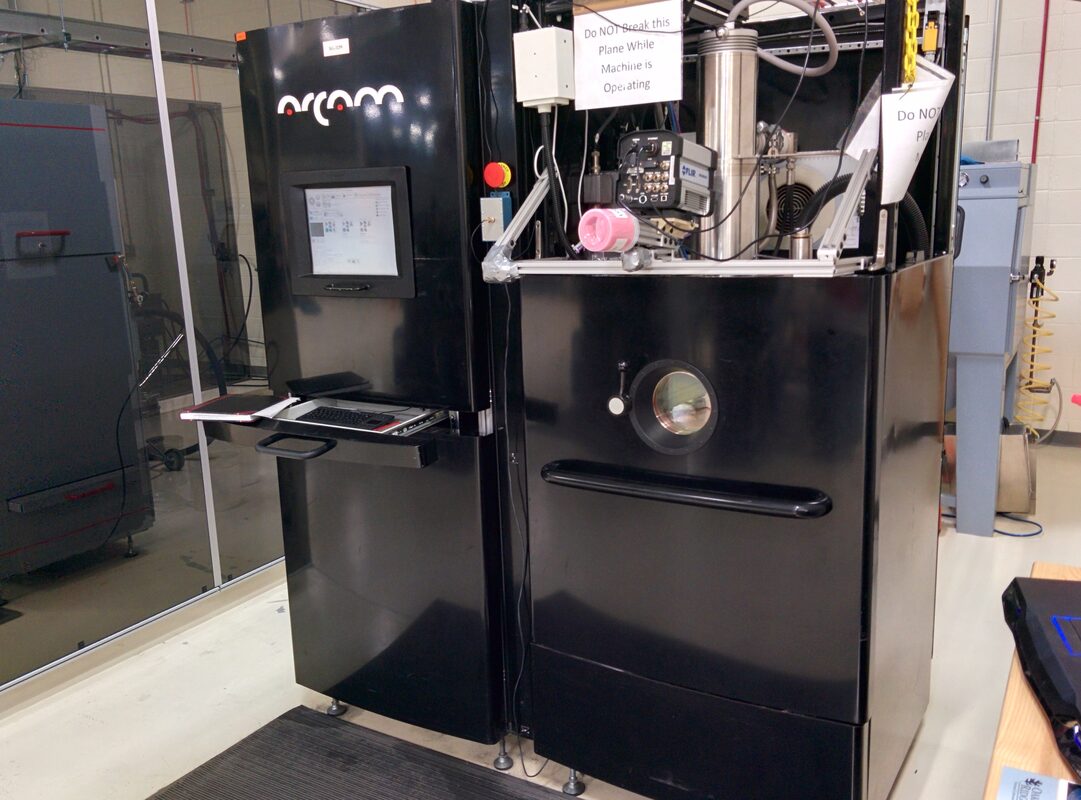
New Zealand's Zenith Tecnica, which its CEO has described as one of the largest EBM service bureaus in the world, has new ownership and an immediate expansion plan. According to TCT Magazine, former Boeing and Amazon executives Andrew Burgess and Blair Jordan closed their acquisition of the New Zealand company on June 18, 2026, and announced on July 8 that they are adding two more EBM systems to a fleet of six that is already running at full capacity — while simultaneously relocating to a larger facility to accommodate the growth.
For a niche corner of the additive manufacturing industry that most desktop and prosumer printer owners never interact with directly, the deal is a significant marker. EBM — a powder-bed fusion process that uses a focused electron beam instead of a laser to melt metal powder layer by layer inside a vacuum chamber — is one of the more demanding and capital-intensive branches of metal 3D printing, reserved almost exclusively for aerospace, defense, and medical applications where titanium's strength-to-weight ratio and biocompatibility justify the cost. Zenith Tecnica has built its business squarely in that space since its founding in 2014, and the new ownership's first move is simply to buy more machine capacity because the existing six printers can't keep up with demand.
Who's Buying, and Why It Matters
Andrew Burgess and Blair Jordan bring resumes from two of the largest manufacturing and logistics operations in the world. Jordan has stepped in as Zenith's new Managing Director and was quoted directly in the TCT Magazine announcement discussing the expansion plans. Outgoing owner Heather Grace, who is quoted by 3D ADEPT Media on the transition, is not exiting immediately — she remains as interim General Manager through August 2026, providing continuity while the new leadership settles in.
The financial backdrop for the deal is striking: 3D ADEPT Media reports Zenith has posted 490% revenue growth since fiscal year 2020. That kind of trajectory in a specialized, high-barrier-to-entry manufacturing niche is a strong signal of sustained, real demand rather than speculative capacity-building — EBM titanium parts are expensive to produce and even more expensive to qualify for flight and implant applications, so customers don't commit to a supplier without serious vetting.
The Customer List Tells the Story
Zenith's client roster is the clearest indicator of why two executives with aerospace and hyperscale operations backgrounds would want in. The company has a 10-year partnership with Lanteris Space Systems, according to 3D ADEPT Media, and that relationship includes work supporting NASA's Psyche mission — the spacecraft launched to study the metal-rich asteroid 16 Psyche — as well as Space Development Agency programs. TCT Magazine confirms the same Lanteris Space Systems relationship and notes Zenith also supplies orthopedic implant makers, the other classic anchor market for EBM titanium given the process's ability to produce porous, bone-integrating lattice structures that laser powder bed fusion struggles to replicate as efficiently.
Aerospace flight hardware and orthopedic implants sit at opposite ends of the human-risk spectrum from typical desktop 3D printing, but they share a requirement that EBM satisfies well: fully dense, high-strength titanium parts with minimal residual stress, produced in a vacuum environment that keeps oxidation and contamination out of a notoriously reactive metal. That's a large part of why EBM technology — despite being less common than laser-based metal printing — has held on to a durable niche for two decades.
A Long EBM Track Record
Zenith's current expansion is not its first. VoxelMatters has documented the company's fleet growth over the years, including earlier installations of its fourth and fifth GE Additive Arcam EBM systems — the same underlying Arcam EBM platform, now under GE's Additive division, that has anchored Zenith's production since early in the company's history. That steady, incremental scaling from a handful of machines up to six, and now toward eight, reflects a manufacturer that has consistently reinvested in capacity rather than chasing a single big contract and stalling out. It also underscores how concentrated the EBM printer market is: Arcam-derived systems remain the dominant commercial EBM platform, and a company running eight of them would represent one of the largest single EBM installations anywhere in the world.
What It Means for Makers
None of this touches the FDM or resin printer on a maker's bench directly — EBM titanium systems cost roughly what a house does, run in vacuum chambers, and produce parts destined for spacecraft and hip implants, not cosplay props or prototype enclosures. But the story is still worth tracking for a few reasons.
First, it's a useful data point on where real capital is flowing in additive manufacturing right now. When executives from Boeing and Amazon — companies that understand manufacturing scale and supply chain risk better than almost anyone — choose to buy into a metal AM shop and immediately commit to more machines rather than optimizing the ones they have, it signals genuine backlog and confidence in the technology's industrial maturity, not hype. That matters for the broader credibility of 3D printing as a manufacturing method, which indirectly benefits every tier of the industry, including the desktop segment that rides on the same "AM is real manufacturing now" narrative.
Second, watch the supply chain angle. NASA's Psyche mission and Space Development Agency programs are exactly the kind of end customers that validate a manufacturing process for wider adoption. Every time a process like EBM titanium printing proves itself on a flight-qualified or FDA-cleared part, it strengthens the case for metal AM generally, which eventually trickles down into more accessible metal printing options and better-understood post-processing standards that smaller shops can lean on.
Third, for makers curious about the technology itself: EBM remains one of the more interesting and least-covered corners of metal 3D printing precisely because it's so specialized. A company doubling down on it — expanding facilities and machine count rather than diversifying into laser powder bed fusion or binder jetting — is a reminder that EBM still holds real, defensible advantages for specific titanium applications, even as competing metal processes get most of the trade-show attention.
