
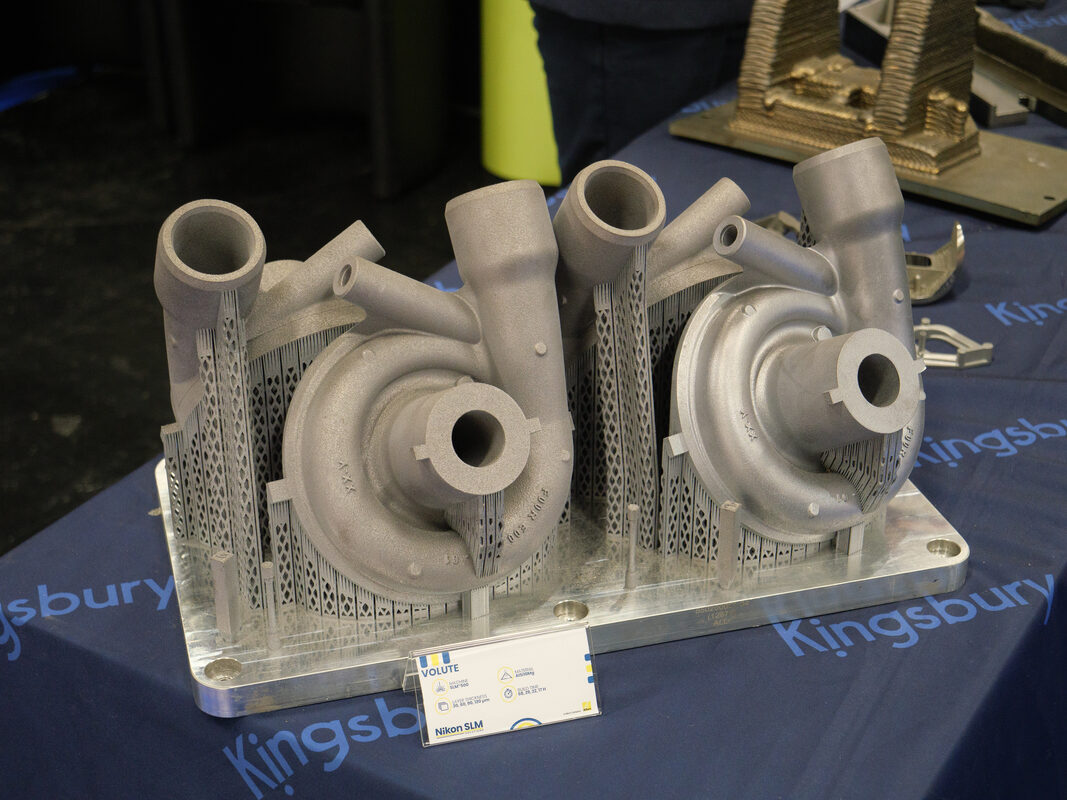
An engine block is one of the least glamorous parts of a car, and that's exactly why it makes such a good stress test for a manufacturing technology. It's big, structurally critical, full of internal passages, and has been made almost exclusively by casting for over a century. So when Nikon SLM Solutions announced it had printed a complete V8 engine block as a single aluminum part with Bosch, the news wasn't about a novelty show piece — it was a deliberate shot across the bow of traditional casting.
The block was produced on Nikon SLM Solutions' NXG XII 600, a multi-laser metal powder bed fusion system, at Bosch's Additive Solution Center in Nuremberg, Germany. The material was AlSi10Mg, a well-established aluminum-silicon-magnesium alloy already common in metal 3D printing for its strength-to-weight ratio and printability. According to both companies, no casting and no tooling were involved anywhere in the process. The part went straight from a digital design file to a finished, functional geometry.
Why a V8 Block, and Why It's Hard
Casting an engine block is not simple. It typically starts with sand cores or a die, molten aluminum poured under controlled conditions, and then extensive post-processing — machining, deburring, pressure testing for porosity. Developing that tooling is itself a slow, capital-intensive step, and both companies point to it as the real bottleneck compared with a design that can simply be revised and reprinted. That lead time is fine for a design that's locked down for a ten-year production run. It's brutal for prototyping, low-volume runs, or any engine program that needs to iterate.
Additive manufacturing sidesteps that tooling step entirely, and that's the headline claim here: a design revision doesn't mean cutting a new die or reworking a sand mold, it means editing a CAD file and reprinting. For something as complex and iteration-heavy as an engine block — where a cooling channel routing or a wall thickness might change multiple times during development — that's a fundamentally different economics than casting.
The geometry itself is where printing earns its keep. Bosch and Nikon SLM Solutions designed the block with integrated cooling channels and a topology-optimized, weight-reduced structure — internal features and material distribution that follow the actual stress and thermal loads on the part rather than the constraints of a mold that has to release cleanly. According to the companies, the result is a block that is considerably lighter than a cast equivalent with no loss of performance. Casting can approximate some of this with cores, but there are channel geometries and lattice-like internal structures that a mold simply cannot produce economically. Powder bed fusion builds the part layer by layer, so an internal passage that snakes and branches costs no more in tooling complexity than a straight one — because there's no tooling.
The Machine Doing the Work
The NXG XII 600 is Nikon SLM Solutions' large-format, multi-laser metal system, and the "multi-laser" part matters as much as the "large-format" part for a build this size. An engine block spans a substantial build volume, and a single-laser system would take proportionally longer to scan every layer. Multiple lasers scanning simultaneously across the build plate is what makes printing a part this large in a production-relevant timeframe plausible rather than a multi-week curiosity run.
Neither company's materials published in this release break out build time, laser count, or cost figures for the block specifically, so those remain open questions for anyone trying to model where this technology sits against casting on a per-part economic basis today. What is clear is where Bosch chose to do this work: its Additive Solution Center in Nuremberg, a facility explicitly set up to develop and qualify metal AM processes for automotive-grade parts, not a research lab running a one-off demo.
The Supply Chain Angle
Nikon SLM Solutions frames the block as a proof point aimed less at OEMs and more at the supplier tier underneath them. The company's release notes that an estimated 60 to 80 percent of the components in a finished vehicle come from the network of tier 1 and tier 2 suppliers, not the automaker itself — the businesses that actually manufacture the parts an automaker's badge ends up on. That's a pointed detail. It reframes the V8 block less as "look what we can build" and more as "look what your supply base could be building," positioning widespread AM adoption across that supplier tier as the real next hurdle, not the technology itself.
That framing lines up with where metal AM has actually been gaining ground in automotive over the past several years: motorsport parts, low-volume specialty components, and tooling for other manufacturing processes, rather than mass-production body-in-white or powertrain parts. A full engine block is a deliberate step up in both scale and criticality from that track record, and both companies are clearly aware that's the point.
What It Means for Makers
None of this touches the desktop FDM or resin printer sitting in your garage — the NXG XII 600 is an industrial multi-laser powder bed fusion system running in a facility purpose-built for qualifying automotive metal parts, not equipment you'll find on a job-shop floor. You won't be printing your own V8 block anytime soon, and neither will most small job shops.
What it does signal is where the ceiling on metal additive manufacturing keeps moving. Every year, the case for "AM is fine for prototypes but not for mission-critical production parts" gets narrower. A one-piece, cast-free, tooling-free V8 block with integrated cooling and topology-optimized structure is exactly the kind of part that argument used to rule out. If Bosch and Nikon SLM Solutions can make the economics work at scale — and that's still an if, since neither company has published cost or cycle-time figures for this specific build — it changes what "3D printed" means as a credibility marker on a parts bin, not just in aerospace and medical, where metal AM already has a foothold, but in the automotive supply chain that touches far more manufacturers and far more machinists.
For makers running metal printers or eyeing a jump from polymer to metal AM services, the practical takeaway is about where the industry's attention — and eventually its qualification standards, post-processing know-how, and price curves — is heading: toward large, complex, structurally demanding parts that used to be casting's exclusive territory.
