
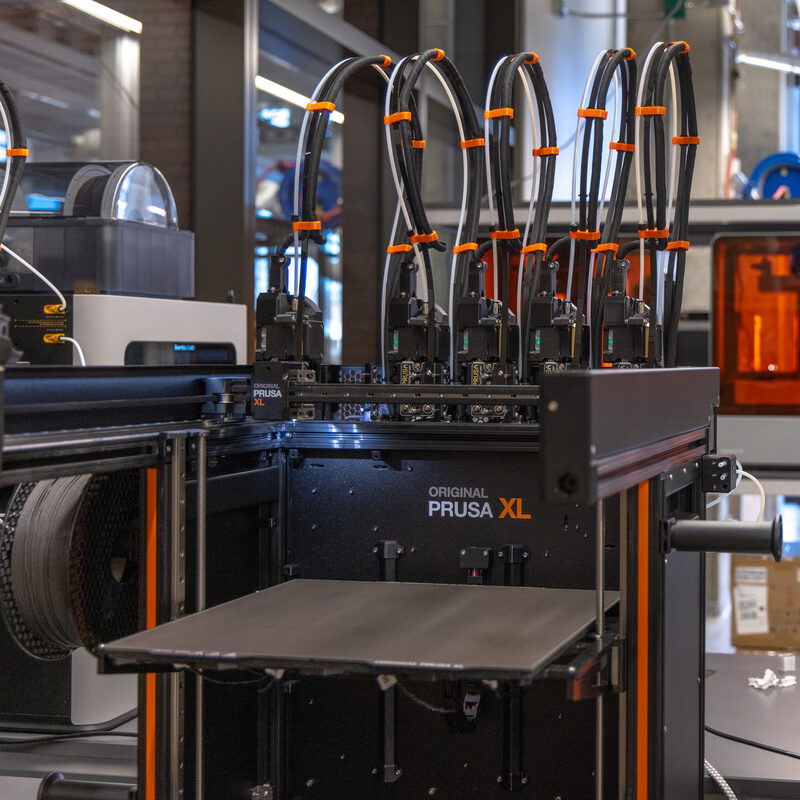
Prusa Research's July 2026 State of INDX update, published July 3, sets a firm timeline on the toolchanger accessory makers have been waiting on since the Founder's Edition began shipping: the standard, non-Founder's Edition INDX Conversion Kit for CORE One and CORE One+ will start leaving the factory by the end of July, with the full first production batch out the door by the end of August. It's the clearest signal yet that Prusa's multi-material toolchanger is moving from early-adopter hardware into something ordinary customers can actually order and expect to receive on a predictable schedule.
The update arrives alongside firmware version 6.6.1, the latest release for CORE One and CORE One+ INDX machines, which resolves two of the more disruptive bugs owners have reported since launch: spontaneous INDX Head resets during prints and incorrect tool assignment following a REDSCREEN (crash-recovery) reset. Both bugs share a common trait — they tend to surface mid-print, on jobs long enough that a silent tool mix-up or an unexplained head reset turns hours of print time into scrap.
What's Actually Shipping
The Founder's Edition kit — the limited early-access version fulfilled through Prusa's hardware partner Bondtech — is now shipping. The standard kit follows a few weeks behind it, which is the more consequential news for most of the CORE One installed base, since the Founder's Edition was run as a limited, reservation-based early-access program through Bondtech rather than a mainstream SKU.
Both versions convert a CORE One or CORE One+ into an 8-tool machine running Prusa's CMYKW+RGB configuration — cyan, magenta, yellow, key (black), and white alongside red, green, and blue — giving owners eight simultaneous material or color slots without swapping spools mid-print. Independent trade coverage from Fabbaloo corroborates the eight-tool, Bondtech-built upgrade path Prusa first announced, for makers who want confirmation from outside Prusa's own marketing channel before committing to an order.
Also new in this update: an automatic Tool Offset Sensor calibration routine, which removes a manual step from the toolchanger setup process, and a promise of four additional print profiles arriving in PrusaSlicer soon. Prusa didn't specify exactly which materials or geometries those profiles target, but for a system this dependent on precise per-tool offsets and purge behavior, expanded slicer support matters as much as the hardware itself.
The Waste Numbers Prusa Wants You to See
Toolchangers and multi-material units exist to solve the same basic problem — printing in multiple colors or materials without manual spool changes — but they solve it in very different ways, with very different waste profiles. A traditional multi-material-unit approach typically purges filament through a single nozzle every time it switches materials, dumping the purged plastic into a waste chute. A toolchanger like INDX instead parks a fully loaded, pre-primed tool and swaps the entire tool head, so the only waste is the small "priming pellet" each tool extrudes to confirm it's flowing before printing resumes. Prusa's blog post quantifies that difference with two test prints. In the primary comparison, a print run through the INDX system generated 29 grams of waste, against a potential 696.4 grams for a comparable multicolor competitor setup — a roughly 24-fold difference. A second test, described as a "Rocket Engine" comparison print, showed 842 grams of waste on the competing system against roughly 30 times less on INDX. Prusa also disclosed the mechanism behind the low per-tool figure: priming pellets average just 0.013 to 0.015 grams each, an amount so small it barely registers per swap but which compounds dramatically in the competitor's favor once you're comparing it against purge-tower-style waste that scales with every single material transition in a print, not just once per tool per job.
These are Prusa's own numbers from Prusa's own test prints, and the company hasn't published the competing system's exact configuration or software version, so the comparison should be read as a marketing data point rather than an independently reproduced benchmark. Still, the underlying mechanical logic — swap a pre-loaded tool once versus purge a shared nozzle repeatedly — is sound, and it's the same reason toolchangers have drawn interest from makers who print multicolor or multi-material jobs often enough that filament cost and cleanup time actually matter.
What Firmware 6.6.1 Fixes
Beyond the headline toolchanger stability fixes, the 6.6.1 release notes on GitHub list several smaller but practical changes. The bed now lowers automatically when the firmware detects an unknown or lost tool, giving users safe clearance to remove a print without having to manually jog the gantry out of the way first. Dock Calibration gains three explicit choices — Keep, Calibrate, or Invalidate — for handling a tool's stored calibration state, rather than forcing a full recalibration every time. There's also a new M109 G-code flag that lets custom start/end sequences skip temperature stabilization when it isn't needed, useful for anyone scripting custom multi-tool startup routines. On the housekeeping side, Prusa removed the extruder filament sensor from the printer's footer display and Sensor Info menu — a change that will only matter to owners who were actively relying on that readout.
What It Means for Makers
For CORE One and CORE One+ owners who held off on the Founder's Edition, the practical takeaway is timing: order windows opening around the standard kit's end-of-July factory departure should mean realistic delivery estimates for the first time, rather than an open-ended early-access queue. The firmware fixes matter just as much as the hardware milestone — a toolchanger that resets mid-print or silently misassigns tools undermines the entire pitch of walk-away multi-material printing, so 6.6.1 addresses reliability issues that were arguably more urgent than the shipping timeline itself. The waste comparisons are worth taking as directional rather than gospel, but the mechanical case for toolchanging over purge-based multi-material systems doesn't depend on Prusa's specific gram counts to be credible. Makers evaluating INDX against MMU-style alternatives should weigh upfront tool cost against the long-run savings in filament, cleanup, and print time — and wait for real-world 6.6.1 reports before assuming the reset bugs are fully behind the platform.
