
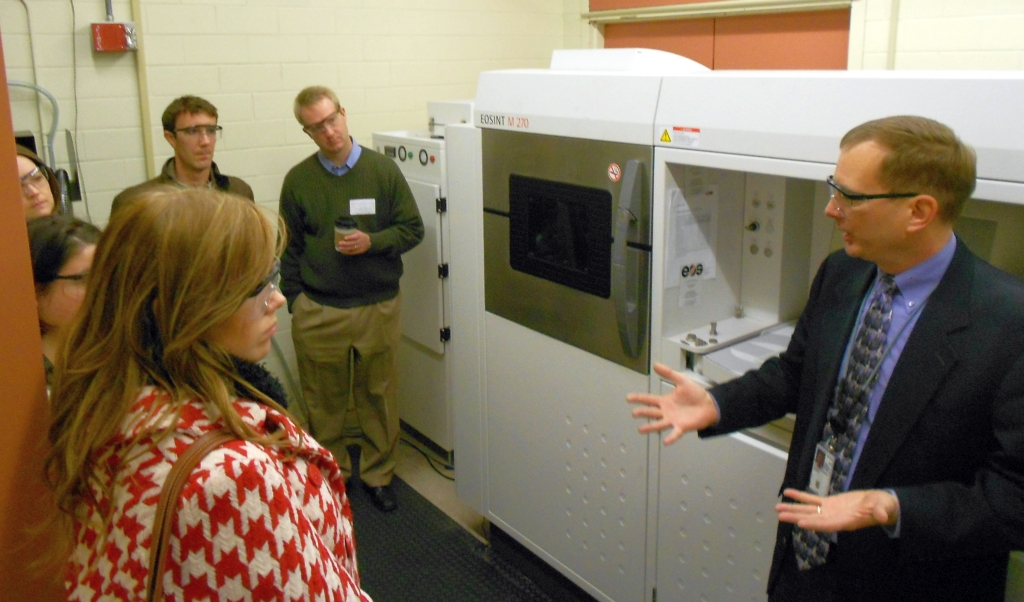
The US Navy has cleared a shore-based facility to print metal parts destined for its ships and submarines using laser powder bed fusion, a milestone the Naval Undersea Warfare Center announced this week. NUWC Division Keyport, located on Washington's Puget Sound, has become the first Navy Warfare Center to receive NAVSEA qualification for a metal additive manufacturing procedure — clearing the facility's EOS M290 laser powder bed fusion (PBF) system to produce 17-4PH stainless steel components for tactical and shipboard-level use. Qualification for a second material, 316L stainless steel, is already underway.
For an industry that has watched the Department of Defense talk up additive manufacturing's disruptive potential for the better part of a decade, this is unglamorous procedural news that actually matters. NAVSEA — Naval Sea Systems Command — certifies that parts on Navy vessels won't fail, and its metal AM qualification process has historically been the bottleneck between "we can print this" and "the fleet can use this." Keyport clearing that bar means a Navy-owned facility can now legally produce metal parts for tactical and shipboard systems, rather than relying entirely on outside vendors or waiting years for case-by-case approvals.
A Seven-Year Path to Qualification
According to the release, authored by Frank Kaminski and published through the Defense Visual Information Distribution Service (DVIDS), the effort traces back to 2019, when it started as a Naval Innovative Science and Engineering (NISE) project — the kind of internally funded seed program Navy commands use to test whether a new capability is worth formal investment. Over time it evolved into a structured qualification effort backed by the Submarine Industrial Base, the Navy's push to expand supplier and production capacity for submarine construction and sustainment. Trade outlet 3DPrint.com, which published a corroborating report on August 10, independently confirmed the seven-year timeline and reported that Keyport validated its 17-4PH process on the EOS M290, calling it one of the most widely used PBF systems in the world. That report also sketched a wider ecosystem forming around Navy metal AM, separate from Keyport's own effort: shipbuilder Austal USA has stood up a "Digital SEA" platform giving Navy suppliers access to the technical data needed for metal AM parts, Phase3D's in-situ monitoring hardware is already installed on an EOS M290 at the Navy's AM Center of Excellence in Danville, Virginia, and consultancy The Barnes Global Advisors has landed a separate contract to build a qualifications database covering Inconel 625 and 316L stainless. None of that infrastructure directly supported Keyport's work, but it points to a broader Navy metal AM supplier base filling in around it.
Andy Bloom, acting head of Keyport's Rapid Prototyping and Fabrication Technology Division, framed the payoff in operational terms: "You can really print what you need when you need it, which is one of the primary benefits" of having qualified in-house metal AM capability. For a command whose mission is sustaining undersea warfare systems, that's not a throwaway line — it points at the Navy's long-standing interest in AM as a hedge against fragile supply chains for parts that may no longer have an active vendor.
Inside the Qualification Testing
Metal powder bed fusion qualification isn't a matter of printing a part, measuring it, and calling it good — the process has to demonstrate the resulting material is metallurgically sound across conditions a real production environment will throw at it, including conditions nobody wants but everybody has to plan for. Mechanical engineer Jonathan Heier described the scope of the challenge: "There are so many unknowns with regard to process variables," a comment that gestures at the sheer number of interacting parameters — laser power, scan speed, layer thickness, powder chemistry, chamber atmosphere, thermal history — that a PBF qualification program has to characterize and control. One test detailed in the release stands out as a direct stress test of production reliability rather than pure material properties: qualifiers deliberately halted a build partway through and kept it stopped for 12 hours to simulate a power outage, then restarted it and verified through destructive testing that no metallurgical defects resulted from the interruption. That's a meaningful thing to prove. Long PBF builds are vulnerable to layer-adhesion defects, porosity, and residual-stress issues if a print is stopped and resumed under uncontrolled conditions, and shipboard and shore facilities can't guarantee uninterrupted power the way a controlled lab might. Confirming the process survives a 12-hour outage mid-build without compromising part integrity removes a practical objection to relying on a single shore-based printer for parts that matter.
Why 17-4PH First, 316L Next
17-4PH is a precipitation-hardening stainless steel prized for a strong combination of strength, corrosion resistance, and machinability — a workhorse alloy across defense and aerospace hardware, and one of the more mature, well-characterized materials in the metal PBF world, which likely made it the logical first target for a from-scratch qualification effort. 316L, the material now in the pipeline, is a lower-carbon austenitic stainless known for superior corrosion resistance, particularly in marine and chloride-rich environments — an obvious complement for a Navy AM program, given how much shipboard and submarine hardware must survive sustained seawater exposure. Bryce Weber, Keyport's platform readiness and endurance technology lead, called the 17-4PH milestone "a key enabler for the NAVSEA organic industrial base to begin upscaling metal AM technologies in a meaningful way" — language that signals this qualification is meant as a template, not a one-off.
What It Means for Makers
None of this puts an EOS M290 in your garage, but it's a useful data point for anyone tracking where metal AM qualification standards are heading. Keyport's approach here — years of dedicated qualification work building a defensible metallurgical data package on a single, well-characterized alloy before expanding to a second one — is a reasonably legible blueprint for how a serious metal AM qualification program gets built, whether you're a defense contractor, an aerospace supplier, or a job shop trying to break into regulated metal printing. It's also a reminder Keyport isn't operating in a vacuum: adjacent Navy metal AM infrastructure — Phase3D's monitoring, TBGA's qualification database, Austal USA's supplier-access platform — is being built out in parallel, even if not part of this qualification. The power-outage resilience test is worth noting: it's real-world failure-mode testing that consumer and prosumer metal printing conversations rarely touch, since desktop and even industrial polymer AM discourse mostly focuses on part geometry and mechanical properties rather than production-line interruption scenarios. As the Submarine Industrial Base push continues and more Warfare Centers presumably pursue similar qualifications, expect the Navy's metal AM supplier base — and the standards vocabulary around it — to keep expanding outward from programs like this one.
Sources
- NUWC Division, Keyport Receives NAVSEA Qualification for Metal Additive Manufacturing — DVIDS, Aug 5, 2026
- NUWC Keyport Becomes First Naval Warfare Center to Receive Official Approval for Metal AM Process — 3DPrint.com, Aug 10, 2026
