
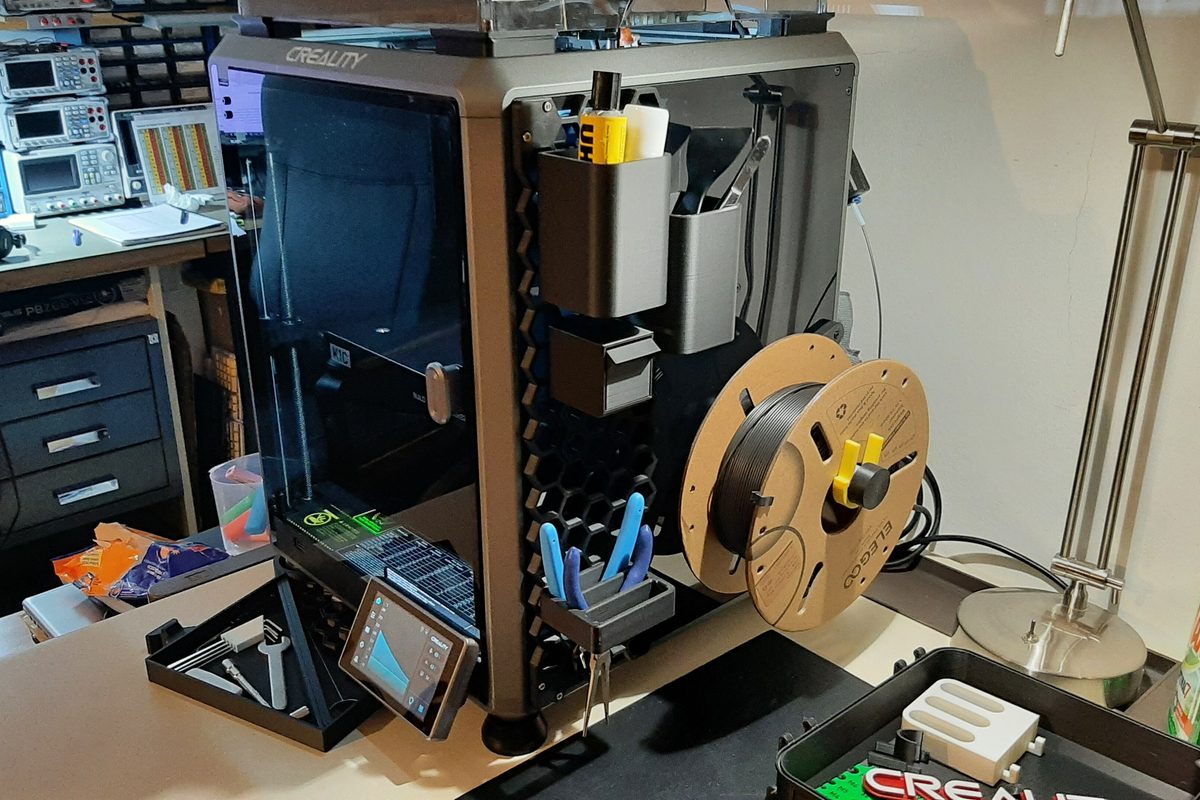
Creality's four-nozzle K3 is no longer a pre-order curiosity. In a press release issued November 3, the company announced official US availability starting at $849, adding that the first pre-order units began shipping on November 2. The same day those shipments started, Tom's Hardware published a full review that lands somewhere between enthusiasm and caution: the tool-changing hardware works, the prints are good, and several practical details still need attention. With the machine now in buyers' hands, the useful question is no longer what Creality promised. It is which of those promises the shipping printer keeps.
What Creality Is Claiming
The K3 is built around what Creality calls the KliTek system: four independent nozzles on a tool-changing head, with a nozzle switch the company puts at approximately five seconds. Creality's earlier FAQ, dated September 30, is more precise, quoting 4.8 seconds for a nozzle change and 15 seconds for a full color or material change, plus XYZ deviation under 25 microns. That FAQ predates launch, so its figures are best read as the company's own targets that the November 3 release only rounds off, not as independently confirmed numbers.
The headline efficiency claims are bigger. Creality says internal testing shows up to 80 percent shorter print times and up to 85 percent less material waste compared with conventional single-nozzle multicolor workflows. Those are the company's own measurements, and the comparison is to single-nozzle systems that purge filament at every color change, so the "up to" qualifiers carry real weight. A print with two colors and few transitions will likely see far less benefit than a densely striped multicolor model.
The launch release also lists optional accessories: a top cover for engineering materials, a TPU kit that also covers soluble supports, and mixed nozzle sizes. Per the FAQ, the standard configuration ships with four 0.4 mm hardened steel nozzles, with a multi-nozzle kit of 0.2, 0.6 and 0.8 mm nozzles to be sold later. The FAQ describes the TPU kit as four filament dry boxes, a CFS FLX unit and four high-flow nozzles, designed for softer TPU such as 85A and 90A. Through November 30, Creality is bundling four free rolls of Hyper PLA, and orders through its official online store also get free shipping.
What the Review Found
The Tom's Hardware review calls the K3 a solid entry in the tool-changer market, and the core mechanism holds up. Each of the four tools has its own ceramic heater and a hardened steel insert nozzle, and the rest of the printer shares its design with the K2, including a CoreXY motion system. The printer carries 37 sensors, 12 of them dedicated to nozzle swapping, and over the course of testing the reviewer reported no dropped or misplaced tools and not a single bad print. For a tool changer, where a mis-seated head can mean a ruined print or worse, that reliability is the most important result in the review.
Waste is lower but not gone. The K3 still prints a purge tower, though the reviewer found the discarded material to be a small fraction of what AMS-style color systems waste. That squares with the spirit of Creality's waste claim even if it doesn't independently confirm the 85 percent figure. Most of the reviewer's PLA and PETG test prints ran at average speeds of 160 to 180 mm/s.
On the software side, Creality Print 7.3, which is based on Orca Slicer, adds a color blending feature the reviewer notes was borrowed from Snapmaker's open-source Full Spectrum approach. Creality's FAQ says the K3 works with Creality Print 7.0 and later as well as OrcaSlicer, and that its Klipper-based firmware will be released in phases with root access, which matters to anyone who expects to tinker. The built-in 720p camera and AI detection for build plate, foreign objects and spaghetti failures produced no false positives during testing.
Where It Falls Short
The review's most practical complaint concerns spool holders. They are sized large enough that spools from Prusa, Cookiecad and Ambrosia didn't work for the reviewer, while Polymaker and Bambu spools did. For makers with a shelf of mixed-brand filament, that means modifying the holders, printing adapters or buying around the limitation, an odd oversight on a machine whose whole purpose is juggling multiple materials.
Two of the accessories Creality advertises were not ready when Tom's Hardware tested the printer: the lid, or top hat, and the TPU kit. The reviewer describes the TPU kit as swapping in a CFS Flex, dry boxes and a high-flow nozzle, which lines up with the FAQ, and says the lid will be bundled with it. Without the lid, the open-top design makes the K3 rather loud, and the printer needs the lid for high-temperature filaments, so those remain untested until the top cover arrives. So the shipping printer covers the PLA and PETG multicolor work it was clearly designed for, while the engineering-material and flexible-filament story depends on hardware buyers cannot yet evaluate.
The reviewer also raises a concern familiar to anyone who has followed Creality's product cadence: a worry that a "pro" or "max" variant could appear within four months. That's speculation, not an announcement, but it is a reasonable consideration for early buyers weighing whether to wait. The review also notes that at its $849 price the K3 costs $100 more than a similarly equipped, slightly larger Snapmaker U1.
Bottom Line for Makers
At $849, the K3 is a capable but not groundbreaking entry in a stiff field of affordable tool changers. The review supports the central pitch: tool changes are reliable, print quality is strong, and purge waste drops sharply compared with AMS-style multicolor printing. Those are the reasons to buy a tool changer, and the K3 appears to deliver on them.
The caveats are about completeness rather than fundamentals. Creality's 80 and 85 percent figures come from its own testing under "up to" conditions, so real savings will depend heavily on the models you print. Spool compatibility is narrower than it should be. And the accessories that would extend the K3 into engineering materials and TPU were not ready for review, which leaves buyers taking those capabilities on faith for now.
For makers who mainly want reliable multicolor PLA or PETG with far less waste, the shipping K3 looks like a sound purchase, especially with the free-filament promotion running through November 30. Anyone buying it primarily for enclosed engineering filaments or flexible multi-material work should wait until the top cover and TPU kit are in reviewers' hands.
