
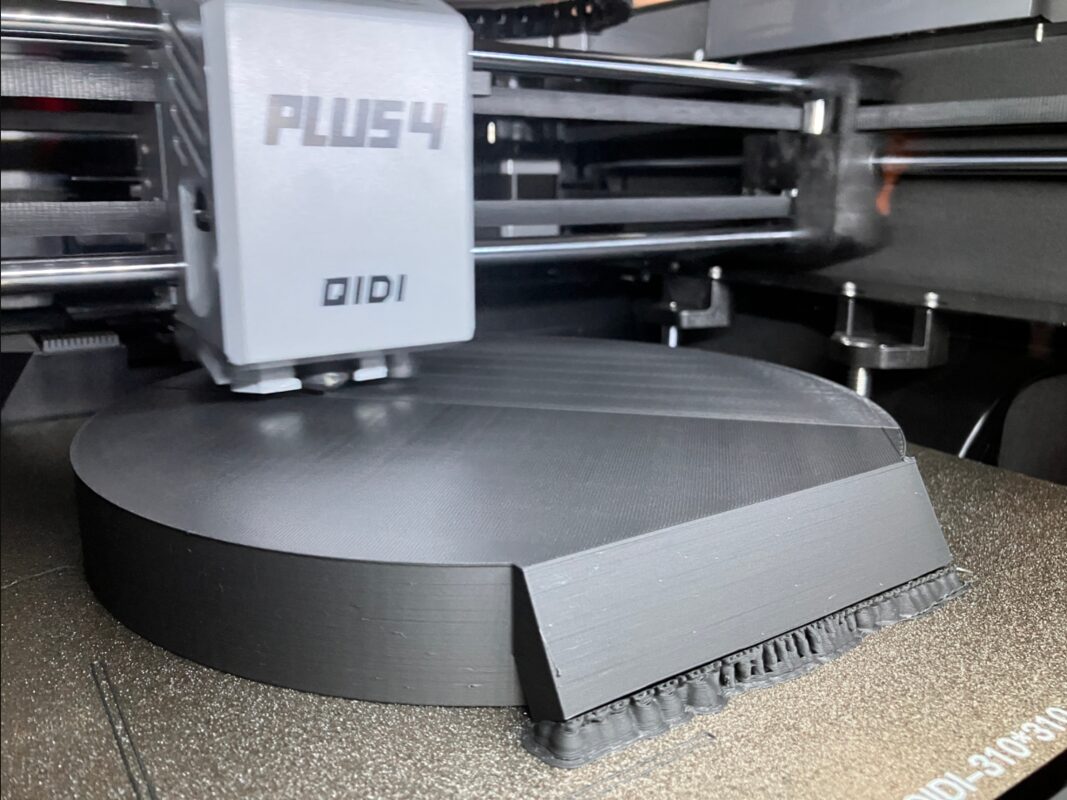
QIDI has taken the wraps off the Plus5, the successor to its Plus4 enclosed CoreXY printer, in a launch that landed across QIDI's own storefront and hardware press on August 5, 2026. The headline change is size: QIDI grew the build chamber to 320 x 320 x 300mm, an 18 percent volume increase over the Plus4's 305 x 305 x 280mm envelope — a figure QIDI itself cites on the product page. What's notable is what QIDI didn't change — the entry price. The Plus5 still opens at $749, the same floor the Plus4 shipped at, with a Combo configuration bundling QIDI's Polar Cooler running up to $1,049.
That's a meaningful data point in a printer category that has spent two years trending upward in both capability and price. QIDI's bet with the Plus5 is that makers will take a larger, hotter, more automated machine over a cheaper but more limited one — without QIDI itself pocketing the difference at checkout.
What's Actually New
Beyond the larger chamber, the Plus5 pushes several thermal and mechanical specs past where the Plus4 left off. The hotend now tops out at 370C, putting the Plus5 solidly in territory suitable for engineering filaments that need high melt temperatures. Chamber heating is now active rather than passive, reaching 65C — a spec that matters for anyone printing ABS, ASA, or other materials prone to warping and delamination in an unheated or passively-heated enclosure. The heated bed climbs to 120C and QIDI describes it as "even-heating," with an RGB status light built into the bed assembly that presumably signals print state at a glance.
Motion hardware carries over the CoreXY layout with precision rails and 9mm 1.5GT CoreXY belts — a beefier belt profile than the more common 6mm variants, which should help with resonance and long-term stretch at speed. Neither QIDI's product listing nor Notebookcheck's coverage publishes a toolhead speed figure for the Plus5, so it isn't possible to say from these sources whether QIDI held speed flat versus the Plus4 or changed it. What is clear from the published specs is that this generation's upgrade is framed around thermal headroom, print volume, and reliability features rather than a speed claim.
On the reliability and quality-of-life side, the Plus5 adds true auto bed leveling via load cell — a more precise approach than strain-gauge or inductive probing schemes on cheaper machines — paired with what QIDI calls "full smart detection." According to Notebookcheck's coverage of the launch, that detection suite includes an integrated camera for catching print errors mid-job, control via a 4-inch touchscreen or over USB/Wi-Fi, and a multi-stage activated-carbon filtration system for the enclosure — QIDI's own listing describes this as 3-stage air filtration. For an enclosed printer running ABS or ASA in a garage, bedroom, or shared workspace, that filtration stack is arguably as important as the raw thermal specs, since it's what keeps ultrafine particulate and VOC output from becoming a household problem.
Multi-Material via QIDI Box
QIDI is positioning the Plus5 as the anchor of a modular ecosystem rather than a standalone machine. The Combo configuration bundles the printer with a QIDI Box, QIDI's external material-handling module, enabling multi-material and multi-color printing on a machine that otherwise runs a single filament. That puts the Plus5 in the same general conversation as Bambu Lab's AMS-based multi-color systems and Prusa's MMU. Neither QIDI's product listing nor Notebookcheck's writeup, however, specifies how many QIDI Box units can be chained together, how many colors or materials the system tops out at, or exactly how multiple boxes would interface with the print head — those details simply aren't in the material published for this launch, and readers should treat any specific box-count or color-count figure for the Plus5 as unconfirmed until QIDI documents it or reviewers get hands-on time.
Notebookcheck's writeup does flag a useful sizing reference point for makers comparing machines across brands: the Plus5's 320 x 320 x 300mm build volume roughly matches Bambu Lab's open-frame A2L. That's a helpful anchor, since QIDI is essentially offering A2L-class print volume inside a fully enclosed, actively heated chamber — a combination that open-frame designs by definition can't match on the thermal side.
What It Means for Makers
For anyone currently running a Plus4 or shopping in the same $749-$1,049 enclosed-CoreXY bracket, the Plus5's value proposition is straightforward: more build volume, a hotter chamber and nozzle, load-cell auto-leveling, and better filtration, at the same starting price as the machine it replaces. That's the kind of generational upgrade that doesn't require a trade-off calculation — there's no "you get X but lose Y" asterisk in the specs QIDI has published so far.
The pricing across the two sources is actually consistent once the tiers are laid out. QIDI's own store lists four configurations: $749 for the base Plus5, $899 for the Plus5 with the Polar Cooler bundle, $899 for the Plus5 Combo (with QIDI Box) at standard spec, and $1,049 for the Plus5 Combo with the Polar Cooler bundle added on top. Notebookcheck's $899 combo figure lines up directly with QIDI's own "Plus5 Combo" entry-level price before the Polar Cooler add-on — not a conflict between sources, just two outlets citing different rungs of the same four-tier pricing ladder. Makers price-shopping should check QIDI's storefront directly to confirm which combination of Combo and Polar Cooler they're being quoted, since that's where the $899-versus-$1,049 confusion originates.
The QIDI Box multi-material system is the feature most likely to draw scrutiny once real-world testing starts, precisely because so little about it has been published yet. Multi-material systems live or die on purge waste, color-swap reliability, and whether the software actually makes multi-color slicing painless — none of which is verifiable from a launch announcement, and none of which QIDI has detailed for the Plus5's Box ecosystem so far. Makers considering a multi-box setup should wait for QIDI to publish the actual chaining and color-count specs, and for hands-on reviews, before committing to that spend — the jump from a $749 single-material Plus5 to a fully expanded multi-material rig is a very different purchase decision, even if the exact size of that jump isn't clear yet.
Overall, though, the Plus5 reads as a straightforward, well-specced refresh: QIDI grew the machine, added the thermal and automation features that matter for demanding filaments, and didn't ask buyers to pay more for the privilege. That's a rarer combination in 3D printing hardware than it should be.
