
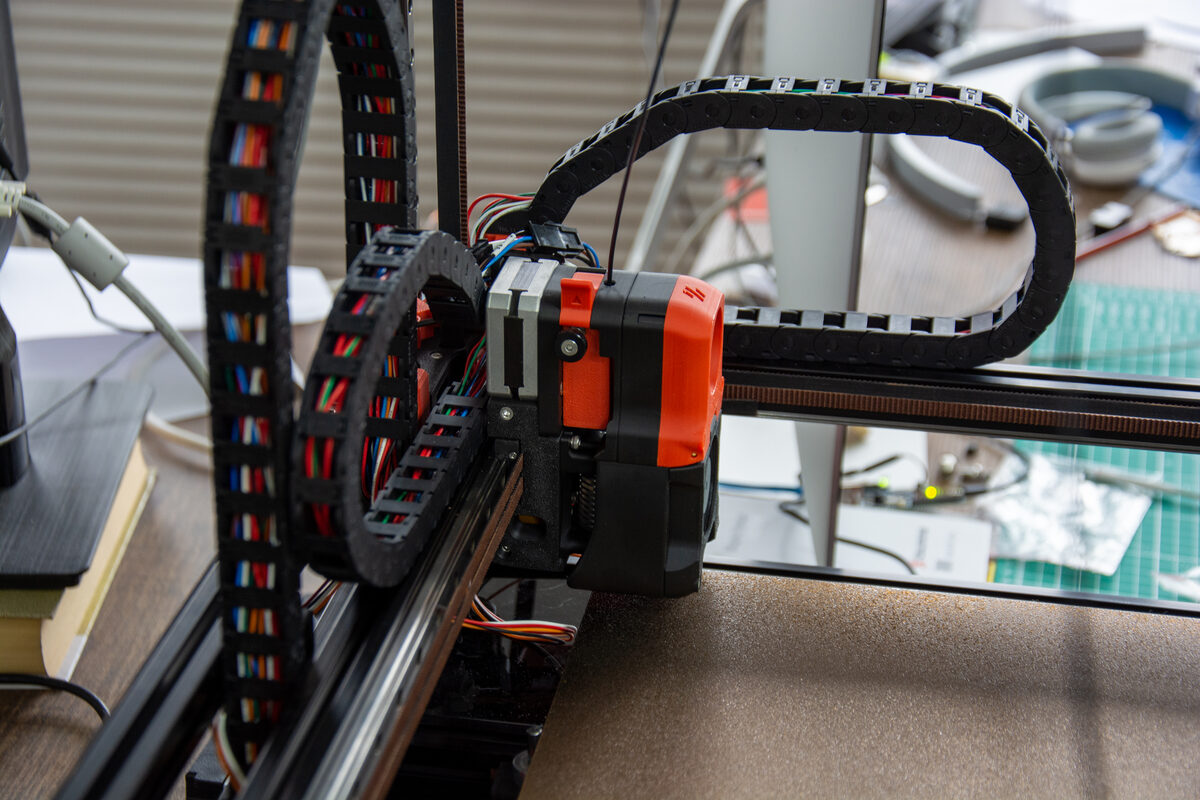
Bondtech began taking orders for its INDX Development Kit on Friday, July 3, at 9 AM CEST (3 AM Eastern, 12 AM Pacific), according to a report from All3DP. The kit repackages the Swedish extruder maker's induction-based tool-changing system for a very different audience than its first customer: rather than bolting onto Prusa's CORE One out of the box, this version is aimed squarely at DIY builders who want to wire INDX into custom machines running Klipper, Kalico, or RepRapFirmware.
That distinction matters. INDX launched as a Prusa-exclusive proposition, previewed at Formnext in November 2025 and later sold as a Founders Edition tied to the CORE One and CORE One+. The Development Kit is the first sign that Bondtech intends INDX to become a general-purpose tool-changing standard rather than a single-vendor feature — the same trajectory the company's extruders and heater blocks have followed for years.
How INDX Actually Works
INDX departs from the two dominant tool-changing philosophies in desktop 3D printing. It isn't an E3D Tool Changer-style setup where every tool carries its own full hotend and motor, and it isn't a simple multi-material splitter like the Bambu AMS or Prusa MMU that feeds several filaments through one nozzle. Instead, INDX centers on a single active "Smart Head" — the only part of the system with electronics, heating, and a drive motor — that docks onto whichever tool it needs for the next feature.
The tools themselves are deliberately dumb. According to Bondtech's product page, each interchangeable tool is thin and entirely passive, with no wiring, no PCB, and no onboard electronics. Power and signal transfer between the Smart Head and a parked tool wirelessly, via induction, which is where the system's name comes from. That design choice is the whole pitch: because tools carry no electronics, they can be made small, cheap, and numerous. A print farm or multi-material machine can theoretically park a dozen tools in a dock without a dozen sets of stepper motors, thermistors, and cartridge heaters sitting idle.
Bondtech's published specs give a sense of how fast that handoff is meant to be. A tool change takes roughly 14 seconds, and a freshly docked tool heats up in 4 to 12 seconds depending on target temperature — numbers that put INDX in the same performance neighborhood as dedicated tool-changing machines rather than slower DIY conversions. The Smart Head itself weighs 345 grams with a tool docked, handles nozzles from 0.2mm up through 1.0mm and larger, and is rated for a maximum nozzle temperature of 300°C and a maximum flow rate of 40mm³/s — enough headroom for high-flow nozzles printing standard engineering filaments, if not the most exotic high-temp materials. Tools need a minimum center-to-center spacing of 35mm in the dock, a figure that will matter to anyone designing a custom toolhead carriage or dock layout around the system.
Firmware-Agnostic by Design
The detail most likely to excite the DIY crowd is Bondtech's insistence that INDX carries no vendor lock-in and works across Klipper, Kalico (a community-maintained Klipper fork), and RepRapFirmware. That's a deliberate contrast with tool-changing and multi-material systems that are tightly coupled to a single firmware fork or a single OEM's control board. For a community that has spent a decade building printers around whatever firmware best suits its motion system, cooling setup, or sensor stack, a tool-changing head that doesn't force a firmware migration is a meaningfully lower barrier to entry than a system that does.
It also signals what kind of product Bondtech thinks INDX needs to become to succeed commercially. A tool-changer that only works on one printer brand is a boutique upgrade; one that works across the open firmware ecosystems that already run most heavily-modified Voron, RatRig, and scratch-built machines has a shot at becoming an actual standard, the way Bondtech's own extruders became a near-default upgrade across dozens of printer brands.
Bondtech's own kit comparison table makes clear how unfinished a starting point this is. Where the pre-built INDX upgrade kit for Prusa's CORE One bundles filament management, a tool bar, and a runout sensor, the Development Kit ships with just a single Smart Toolhead, generic printer documentation, and tool holders that are, in Bondtech's own words, "generic options available as CAD or purchasable accessories" — meaning buyers design or source their own mounting hardware rather than unboxing a matched kit. That gap is the point: this is a component release for early adopters willing to do the integration work themselves, not a finished consumer product.
What It Means for Makers
For builders currently running heavy multi-tool setups — whether that's IDEX rigs, full tool-changers, or MMU-style filament switching — INDX's pitch is a genuine architectural alternative rather than an incremental upgrade. Passive tools mean a dock of six or eight tool positions doesn't require six or eight sets of wiring, heater cartridges, and thermistors sitting in the machine at all times, which lowers both the parts cost and the failure surface of a multi-material rig. The 14-second tool change and single-digit-second heat-up times suggest Bondtech has engineered for print speed, not just capability — a real concern for anyone who has watched a full-hotend tool-changer eat minutes per color change on a long print. The firmware-agnostic promise is the bigger deal for the DIY segment specifically. Builders who've invested years of tuning into a Klipper or RRF config won't have to abandon that work to adopt tool-changing, and print-farm operators running mixed fleets of firmware won't be locked into a single ecosystem to standardize on one tool-changing hardware platform.
The caveats are the ones that come with any "Development Kit" label: this is explicitly a build-it-yourself release, not a plug-and-play upgrade. Buyers should expect to design or adapt mounting hardware, integrate the dock into their own machine's frame and wiring, and work through firmware configuration themselves — the min-spacing figure of 35mm between tool centers and the 345g Smart Head weight are the kind of numbers that matter once you're actually laying out a carriage, not abstractions. Pricing for the Development Kit wasn't part of the verified reporting here, and neither was a broader retail rollout timeline beyond Bondtech's own note that general retail availability was targeted for Q2 2026.
