
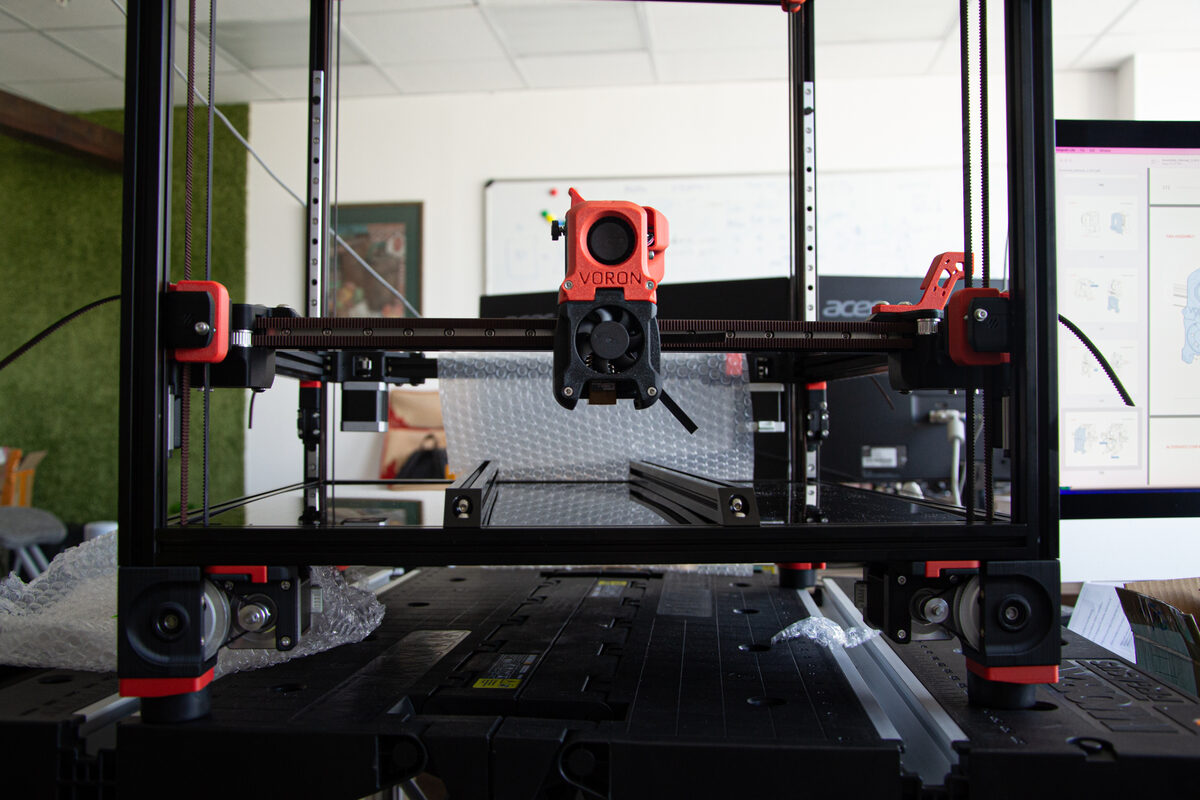
Belts have defined desktop FFF printing since the RepRap era, and most attempts to move past them — CoreXY rigs, tool changers, IDEX gantries — have still relied on a belt somewhere to translate motor rotation into head motion. A Shenzhen startup called LightMake says it has finally cut that link entirely. On August 31, the company unveiled the L4, a desktop printer that positions four independent print heads using direct-drive linear motors rather than belts, pulleys, or lead screws, and put it up for pre-order on Kickstarter the same day.
LightMake was founded by Vic Wang, an executive with prior stints at Anker and Huawei — two companies not exactly known for niche hobbyist hardware, which is itself a signal about how the L4 is being positioned. LightMake says its broader team also includes veterans of the 3D printing industry, but it's framing the L4 as a manufacturing-grade answer to a problem that has dogged multicolor and multi-material printing since it existed: purge waste.
How It's Different: No Belts, No Toolhead Parking
The dominant approaches to multicolor FFF printing today fall into two camps. Tool-changer systems park unused nozzles off to the side and swap a single active head in and out, which adds mechanical complexity and swap time but keeps only one nozzle in the melt zone at once. IDEX (independent dual extruder) systems, popular on cartesian machines, mount two heads on a shared rail and park the idle one at the edge of the build volume, which limits you to two colors and wastes travel time parking and unparking.
LightMake's approach is different on two axes at once. First, instead of two heads it runs four, each fully independent — the company describes the L4 as operating "as four independent printers in one compact unit." Second, instead of moving those heads via belts and stepper motors, the L4 uses linear motors — the same class of technology used in high-end CNC and semiconductor manufacturing equipment, where a moving magnetic coil rides directly along a track with no intermediate belt, pulley, or backlash-prone screw to introduce slop. LightMake claims this yields ±1 micron precision, a travel speed of up to 1,000 mm/s, and a rated service life of 50,000-plus hours — figures aimed at machine shops and small-batch manufacturers rather than hobbyists chasing a faster benchy.
Because each of the four heads can be parked and activated independently without a shared rail to fight over, LightMake says toolhead swaps between colors take about one second, and that the overall approach cuts filament waste by more than 79% compared to single-nozzle multicolor printing, where every color change typically means purging a tower's worth of plastic just to clear the old color from the hotend.
The Numbers on the Spec Sheet
Per LightMake's announcement, the L4 posts a maximum print speed of 500 mm/s — notably lower than its 1,000 mm/s travel speed, which is typical, since travel moves (no extrusion) can run faster than moves that are actually laying down plastic without introducing ringing or under-extrusion. Build volume is listed at 354 x 370 x 386 mm in standard single-color mode, shrinking slightly to 354 x 350 x 386 mm when running in multicolor mode — the reduction likely reflects space reserved for the additional head-parking geometry.
Kickstarter pricing starts at $1,299 for a "super early-bird" tier on the four-head L4, alongside a $1,099 tier for the L1 — a single-head version that, per Hackster's reporting, uses the same core linear-motor technology as the L4. Before the campaign opened, LightMake had also taken $50 deposits through its own site for "VIP" pricing of $1,099 for the L4 and $899 for the L1. Backers are told to expect shipping in Q4 2026, which — as with any crowdfunded hardware campaign — is a target rather than a guarantee.
An Outside Look at the "World's First" Claim
LightMake isn't the only outlet describing this as a category first. Hackster.io's independent coverage, headlined "LightMake Lays Claim to the 'World's First,'" reports the company's own description of the L4 as the "world's first independent four-head 3D printer powered by linear motors." Hackster notes LightMake isn't the first company to build a printer with independently operating print heads, but says it has gone a step further by pairing four independent heads with direct-drive linear motors, eliminating belts entirely. Notably, neither Hackster's report nor LightMake's own press release names specific competing machines or draws an explicit line against tool-changer or IDEX designs from other manufacturers; the "world's first" claim is about the combination of four heads and linear-motor motion, not a head-to-head comparison against named rivals.
Worth noting: "world's first" claims tied to a Kickstarter campaign are self-reported by the company running the raise, and independent hands-on verification of the precision, speed, and duty-cycle figures hasn't happened yet — Hackster's coverage reports those claims rather than testing them. Linear motor systems are well-proven in industrial contexts, but a desktop machine at this price point putting four into one chassis is a genuinely new combination, and campaign-stage specs have a habit of drifting once a machine reaches mass production.
What It Means for Makers
If the L4 delivers on its numbers, the practical upside for anyone doing multicolor or multi-material work is real: near-instant color swaps without purge towers mean less wasted filament, shorter print times on multicolor jobs, and less post-print cleanup. A 79% reduction in waste, if it holds up outside a press release, would meaningfully change the calculus for makers who've avoided multicolor printing specifically because of how much filament a purge-heavy workflow burns through.
The catch is the usual crowdfunding calculus. LightMake is a new entrant led by an executive from consumer electronics giants Anker and Huawei, launching an ambitious mechanical architecture at a price that undercuts some tool-changer competitors while promising specs (±1μm precision, 50,000-plus-hour motor life) that are hard to independently verify from a press release alone. Early backers are, as always, pre-ordering a promise. Makers who want four-color printing today with a track record behind it still have existing tool-changer and IDEX machines from established manufacturers to fall back on. But if LightMake ships anything close to what it's announced, the L4 would be the first real evidence that linear-motor motion systems can move from industrial CNC equipment into desktop 3D printing at a consumer price point — and that's worth watching even before the first unit ships.
