
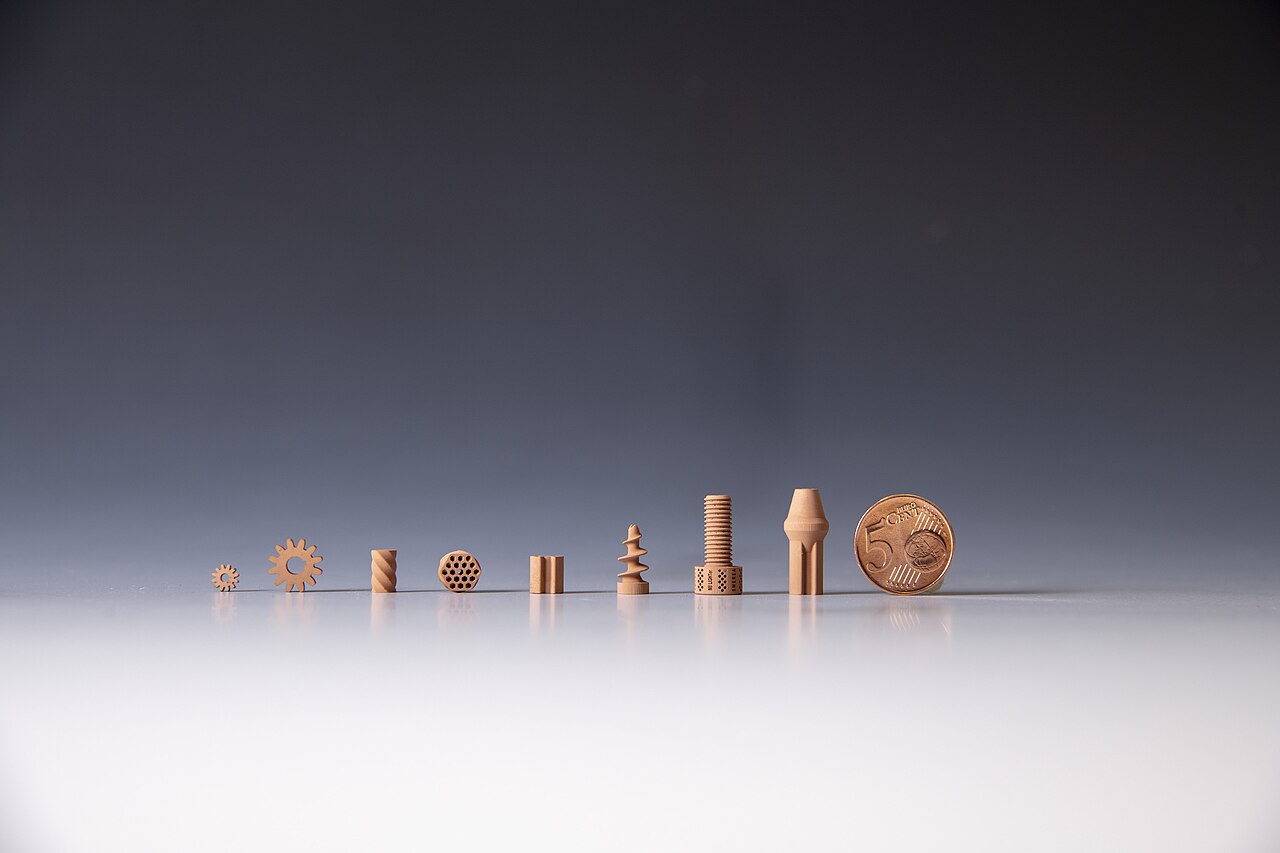
Austrian ceramic printing specialist Lithoz will use Formnext 2026 to launch a hardware upgrade for its CeraFab S65 machines. The company announced the CeraFab S65 Performance Pack on October 28. Lithoz says the pack doubles the light intensity of the CeraFab System S65 and S65 Medical and improves their resolution by 60 percent. The numbers matter less than what they are for. Lithoz is pitching the upgrade as a way to open its lithography-based ceramic manufacturing (LCM) process to dark ceramics, a class of material that light-cured slurry printing finds challenging.
The Numbers, Unpacked
Lithoz's press release gives two headline figures. First, resolution goes from 40 µm (635 dpi) to 25 µm (1016 dpi). Second, light intensity goes from 60 mW/cm² to "around 120 mW/cm²." The 60 percent figure is the dpi increase: 1016 divided by 635 is 1.6, and 40 divided by 25 gives the same ratio for the pixel pitch. So it describes a finer projected pixel, not a vague quality score.
TCT Magazine describes the pack as a tuning kit based on a 4K projection system, built for the S65 and S65 Medical. Lithoz calls it an optional pack. In other words, this is an upgrade for an existing machine family, not a new printer. That matters to shops that already own an S65. A finer pixel and a brighter source are usually the kind of improvement you get by buying the next model up. Here they come as an add-on kit.
Anyone who has run a resin printer will see the trade-off right away. A smaller pixel puts less light into each voxel unless the source gets brighter to make up for it. Lithoz has done both at once, and that is the core of the announcement. A resolution increase by itself would likely have made curing harder. Doubling the intensity at the same time is meant to keep finer features curable, and to give extra headroom for materials that soak up light.
Why Dark Ceramics Are the Point
LCM is a vat-photopolymerization process. A ceramic powder is suspended in a photosensitive binder to make a slurry. The printer cures that slurry layer by layer with projected light, and the green part is then debound and sintered into dense ceramic. The process depends on enough light getting into the slurry to cure each layer. Darker powders absorb and scatter much of that light before it does useful work.
Lithoz puts it in plain terms. It says the dual enhancement makes LCM "much more accessible for the processing of dark ceramics" because "the typical challenges of light-based curing systems related to darker slurries are significantly reduced." The wording is careful: the challenges are reduced, not removed. The company has not published cure depths, layer times or a list of newly qualified materials in the material we reviewed. That claim needs proof from real parts, and Lithoz is promising a live demonstration at its booth.
For context, Lithoz's own materials portfolio already covers a wide range. It includes LithaLox 360 alumina, LithaFlux 211 aluminum nitride, LithaNit 780 silicon nitride, LithaCon 3Y 210 zirconia and LithaBone HA 480 hydroxyapatite. The press release does not say which of these, if any, the Performance Pack is specifically tuned for. But the booth lineup hints at where the company sees demand.
The Booth as a Spec Sheet
Lithoz is showing the pack next to what it calls "application firsts" at Hall 11.0, Stand B50. According to TCT and the press release, the lineup reads like a tour of the markets technical ceramics serve:
- Thermal management: 116 aluminium nitride cooling plates printed on a single CeraFab S320 build platform. The S320 is not the machine getting the upgrade, but the display is a clear statement about batch production of a high-thermal-conductivity ceramic.
- Investment casting: a casting core from inside a real turbine blade, displayed beside its extracted twin, built by German Access e.V.
- Luxury goods: watch bezels in blue and black zirconia. A black zirconia part on a stand promoting dark-ceramic printing is probably not a coincidence.
- Medical: hydroxyapatite spinal cages co-developed with Swiss company Spherene, which TCT describes as an ADMS pioneer.
- Space propulsion: rocket engine segments developed with Leap71.
- Energy: monolithic gyroid solid-oxide fuel cell (SOFC) units from DTU Energy.
- Electronics and sensing: lead-free piezoceramic geometries. TCT cites KNN and barium titanate.
Several of these are about geometry that conventional ceramic forming struggles to produce. Gyroid SOFC cores, internal turbine-blade passages and lattice-based spinal cages are hard to press, cast or machine. The common thread of the booth is complex internal structure in hard, functional materials. A higher-resolution, brighter-light S65 fits that story.
What It Means for Makers
Let's be realistic. CeraFab systems are industrial and laboratory tools, and most FilamentFeed readers will not have an S65 next to their Bambu. There is also no indication in the announcement that the Performance Pack makes ceramic LCM any cheaper to get into. Lithoz has not published pricing for the pack in the sources we reviewed.
The engineering still carries over to the desktop. The main lesson is one every resin printer owner has learned the hard way: resolution and exposure are linked. Shrink the pixel without adding light and opaque or pigmented materials stop curing reliably. Lithoz's answer of doubling irradiance to pay for a smaller pixel is the same logic behind brighter light engines in consumer MSLA machines. The stakes are higher with ceramic slurries, which are far less forgiving than tinted resin.
The second takeaway is about which materials are becoming practical. If dark ceramics become routine on the S65, then black zirconia, nitrides and other light-absorbing technical ceramics could move closer to service-bureau availability. For makers working on watches, jewelry, high-temperature fixtures or small thermal parts, that is what to watch: more ceramics you can order as printed parts, not a new printer you can buy.
Third, the application list shows where ceramic printing is earning its keep: cooling hardware, casting cores, implants, propulsion, fuel cells and piezo sensors. These are fields where performance and geometry justify the cost of the parts. The hobby crossover, where it exists, will probably come through outsourced parts rather than home machines for some time.
Bottom Line
The CeraFab S65 Performance Pack is a focused upgrade. It brings 25 µm projected resolution and about twice the light intensity to an existing machine family, aimed squarely at the dark slurries that hold back light-based ceramic printing. Lithoz's claims are specific enough to test, and the Formnext live demo is the first chance to see whether the "significantly reduced" curing problems hold up on real parts. Until independent results arrive, the pack looks like a smart upgrade for S65 owners. It is also a sign that ceramic additive manufacturing is pushing into materials it once found difficult.
