
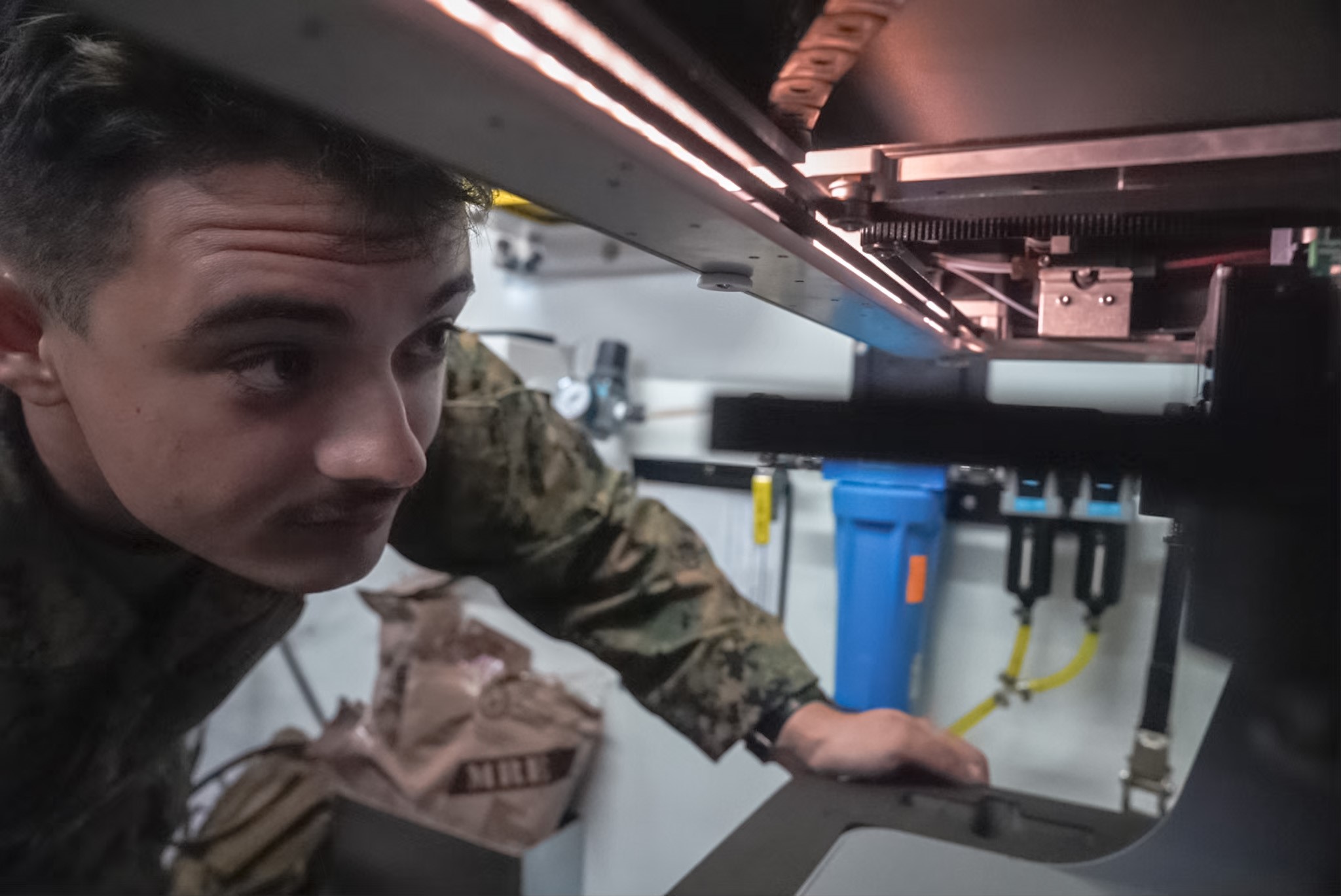
Imagery catalogued through the Defense Visual Information Distribution Service confirms a small but telling moment from this year's Combined Joint Logistics Over-the-Shore exercise: Marine maintainers in Pohang, South Korea, used a field fabrication lab to print a replacement strainer for a U.S. Coast Guard boat, turning a repair that would normally sideline the vessel for weeks into a same-day fix. The DVIDS record, credited to photographer Lance Cpl. Marcus Henson and titled to describe a demonstration of 3D printing capabilities to the U.S. Coast Guard, corroborates that the unit, the exercise, and the event are current and genuine.
CJLOTS 26 is an annual bilateral exercise focused on the unglamorous but mission-critical work of moving cargo, fuel, and equipment from ship to shore without the benefit of a developed port. It's the kind of environment where a broken part doesn't just inconvenience one boat crew — it can stall an entire logistics chain. This year, that chain included a rigid-hull inflatable boat (RHIB) valued at roughly $600,000, the type of small craft the Coast Guard and Navy use for everything from security patrols to ship-to-shore transfer during amphibious operations. When its strainer — a component that filters debris out of the engine's water intake to prevent overheating and damage — failed, the boat was effectively out of the fight until a replacement arrived.
From Broken Part to Working Print in Under Half a Day
According to reporting from VoxelMatters, the repair fell to the Regional Maintenance Operations Company North, an element of the 3rd Maintenance Battalion, Combat Logistics Regiment 35, 3rd Marine Logistics Group. Rather than routing a parts request up the supply chain — a process that, for a component like this, typically takes two to three weeks even under normal conditions — the maintenance team turned to the unit's Expeditionary Fabrication Facility, known within the Marine Corps as X-FAB. X-FAB is a deployable additive manufacturing and reverse-engineering capability the Marine Corps has been building out precisely for scenarios like this one: a forward-deployed exercise or contingency where the nearest depot-level parts warehouse is an ocean away. The team measured and modeled the failed strainer, sliced and printed a replacement, and had it validated and ready to install in under half a day — call it hours rather than days, and certainly nothing close to the standard multi-week resupply timeline.
The cost comparison is the detail that makes the story land. According to CWO2 Jonathan B. Salas, the printed strainer cost about $12 to print — essentially the same as sourcing the original part through normal channels — with the option to swap in a cheaper filament that would shave another $4 off the price without sacrificing performance. That's the part of this story worth pausing on: the win here wasn't a discount. Additive manufacturing didn't undercut the factory part on price; it matched it. The entire value proposition was speed and independence from a fragile, distance-limited supply chain. Cpl. Kenzie Gallang, a metal worker with the battalion who worked the fabrication side of the repair, described colleagues as "taken aback" that a part like the strainer could be reverse-engineered and 3D printed in full in under half a day. Col. Robert Fairley, commanding officer of Combat Logistics Regiment 35, framed the capability in terms of readiness, saying the unit is "demonstrating how non-traditional manufacturing methods, even in an expeditionary environment, can produce parts of consequence to improve the readiness across the joint force" — a $600,000 asset going from disabled to mission-capable inside a single working day, without waiting on a resupply ship or airlift that may not even be scheduled to arrive during the exercise window.
What It Means for Makers
Strip away the uniforms and the exercise name, and this is a story every maker with a desktop FDM printer will recognize instinctively: a part breaks, the OEM replacement is weeks out or discontinued, and the fastest path back to operational is a caliper, a slicer, and a spool of filament. What's notable here isn't the printer or the process — X-FAB's toolset is presumably industrial-grade, not a hobbyist Bambu or Prusa — it's the economics. A $12 reverse-engineered part kept a $600,000 asset in service, and it did so at cost parity with the "real" part, not a fraction of it. For makers who've been told additive manufacturing's selling point is always "cheaper," this is a useful correction: sometimes the value is entirely in lead time and logistics independence, and price is beside the point.
It's also a data point in a trend FilamentFeed has tracked for a while: the U.S. military's growing comfort treating 3D printing as a legitimate maintenance tool rather than a novelty. A field-deployable reverse-engineering and print capability embedded at the maintenance-battalion level, used on a live piece of Coast Guard equipment during a real multinational exercise, is a meaningfully different signal than a lab demo or a procurement slide deck. For hobbyists and small shops who reverse-engineer their own obsolete parts — a broken bracket on a lawnmower, a snapped clip on a 15-year-old appliance — this is validation of a workflow already familiar to this audience: measure, model, print, install, done before the "official" replacement would have even shipped.
There's also a quieter lesson here about where additive manufacturing earns its keep inside large organizations. The Marine Corps didn't need X-FAB to make the strainer cheaper — it needed X-FAB to make the strainer available at all, on a timeline measured in hours instead of weeks, without depending on a shipping lane, a warehouse, or a contractor's schedule. That's a distinction hobbyists intuitively understand every time they print a part rather than wait for a backordered replacement, but it's a harder case to make inside a large institution built around long lead times and centralized sourcing. A demonstrated repair on a real Coast Guard asset, during a real bilateral exercise, is the kind of evidence that moves that argument forward — not because it's dramatic, but because it's mundane and repeatable.
What isn't yet clear from the available reporting is which printer hardware or materials X-FAB used, how the part was modeled (photogrammetry, calipers and CAD, or something more automated), or whether the printed strainer is intended as a permanent fix or a bridge part pending an OEM replacement. Those details would matter to anyone trying to gauge how far this capability extends beyond a proof-of-concept repair — but on the facts confirmed so far, the headline stands: a $12 print, produced in hours, kept a six-figure boat in the water during a live logistics exercise.
